The Mustang Forum for Track & Racing Enthusiasts

Taking your Mustang to an open track/HPDE event for the first time? Do you race competitively? This forum is for you! Log in to remove most ads.

  • Welcome to the Ford Mustang forum built for owners of the Mustang GT350, BOSS 302, GT500, and all other S550, S197, SN95, Fox Body and older Mustangs set up for open track days, road racing, and/or autocross. Join our forum, interact with others, share your build, and help us strengthen this community!

R7 tire problem

This site may earn a commission from merchant affiliate links, including eBay, Amazon, and others.

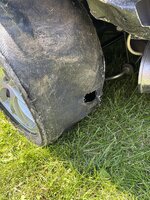
This is an interesting topic as I too experienced an on-track, straight line, Hoosier R7 tire failure which led to the ultimate destruction of my Mustang. The tire was a R7, P315/30/ZR18, date code 1722, incident date 7/2025 with 9 total heat cycles on the failure tire since new. Hot pressure was set at 32 psi. Note Hoosier Tire states in their on-line “A7/R7 Tire Care and Safety Guidelines” for a vehicle weight over 3000 lbs, recommended Hot Pressure 40-42 psi. The failed tire tread totally delaminated from the tire carcass. The carcass which remained mounted on the rim showed two hole locations breaching the carcass spaced approximately 135 degrees arc segment from each other. Both show rubber shards emanating around the holes in the outward direction as if blowing outward from the pressure chamber inside the tire.

Over the years, I have recorded data on 24 identical size, P315 Hoosier R7 tires run on my car with different mold dates. Average life of this 24 tire set was 37 track heat cycles. This tire failure at 9 heat cycles just does not family with the other collected tire information.
 
Yup that more or less what I thought as well. They look like shear tears. These were R7's from a batch a few months ago.
Not sure I agree with a few months old. It is a bit hard to see in the picture but I believe the mold date code of the tire appears to be "0123" which would be the first week of year 2023. That would indicate the tires were a couple years old. Thoughts?
 
Hot pressure was set at 32 psi. Note Hoosier Tire states in their on-line “A7/R7 Tire Care and Safety Guidelines” for a vehicle weight over 3000 lbs, recommended Hot Pressure 40-42 psi. The failed tire tread totally delaminated from the tire carcass.

So you're running hots of 32, which means colds are 23-ish. If anything, these seem on the high side. 40-42 psi in a racing tire seems ridiculously high. I've heard fairy tails of street-type tires wanting big pressures here or there over the years, but I've never experienced it. At the most, I've added a couple psi when it's really cold. Beyond that, I basically run them as low as I can get away with.
 
Thanks for your thoughts TeeLew. Actually for a track event you are trying to get to a "hot" tire pressure to get best grip. Cold settings are really just a guess to get you to the target hot pressure. All gasses (nitrogen, air, etc.) all expand when heated per Charles Law. Cold pressure start off is likely different if you are using air versus nitrogen. I never start out at cold pressures of 23-ish. More like 28-29 psi and after a couple laps, hot pit check to see how close they are to my hot pressure target. I realize many individuals think hot tire pressures of 40-42 psi are "ridiculously high", but the 40-42 psi recommendation comes directly from the MANUFACTURER which is why I stated the source of this recommendation.
 
Thanks for your thoughts TeeLew. Actually for a track event you are trying to get to a "hot" tire pressure to get best grip. Cold settings are really just a guess to get you to the target hot pressure. All gasses (nitrogen, air, etc.) all expand when heated per Charles Law. Cold pressure start off is likely different if you are using air versus nitrogen. I never start out at cold pressures of 23-ish. More like 28-29 psi and after a couple laps, hot pit check to see how close they are to my hot pressure target. I realize many individuals think hot tire pressures of 40-42 psi are "ridiculously high", but the 40-42 psi recommendation comes directly from the MANUFACTURER which is why I stated the source of this recommendation.
Don't mistake my message. I wasn't necessarily arguing against any of it, I was just surprised by it. I realize that Hoosier is the one asking for 40-42. The question is, "Why?" Compared to other tires, this is quite high. We would be hopelessly uncompetitive if we were racing any tire I'm aware at those pressures.

I appreciate you explaining tire pressure rise. I've done this in big-boy racing for a little over 30 years, so I'm somewhat acquainted. If you're not driving 7-9 psi into the tires, then you're not going fast enough, but if a 28/29 start makes you happy, then crack on.

My greater point was this. Most tire damage is done on low pressures. If you're in the situation where you're starting the tires very low (below about 17 psi), then it's very possible to hurt the carcass (generally we break the fibers of the belts in the corners between the sidewall and tread face) of the tire by excessively loading the tire laterally or hitting curbs before allowing the pressure to build. The tire pressure is what gives the tire its structure and load capacity. The more pressure, the more load capacity of the tire and the less the tire will deform when you load it. Having said that, the higher the pressure, the smaller the contact patch. Modern tires for GT cars tend to hit their happy spot somewhere in the 25-29 psi range (hot), depending on track. This is enough pressure for structure, but not so much as to compromise the size of the contact patch.

When you write there were two holes in the sidewall, it makes me think you hit a pot-hole on low pressures and pinched the sidewall against the rim in those two spots? A hard curb strike will give a single pinch. For the pot-hole to be big enough to damage the tire, it would have to be a pretty damned big hole. Did the car ever sit on the tire with no or very low pressures? Your failure mode is a bit of a strange one.
 
Last edited:
Again, not a particularly new tire either. Not defending hoosier, or blaming you , but Hoosier R/A in particular are made as disposable tires. They have none of the materials for UV stability and other magic they put in for long term durability. And none of "extra" strength stuff for potholes. It's why they are so light.

It's not like we all don't play the pressure game to get speed. But we do have to recognize that if you play with fire, sometimes you step into it. That's not an issue typically in this crowd, but as HPDE becomes more and more popular, us tire guys are dealing with a lot of new track customers who think that they can take a car out on track and abuse for 6 hours without accelerated wear on tires and brakes.

So maybe a combo of age, slightly low pressure and impact damage?

DaveW
 
Don't mistake my message. I wasn't necessarily arguing against any of it, I was just surprised by it. I realize that Hoosier is the one asking for 40-42. The question is, "Why?" Compared to other tires, this is quite high. We would be hopelessly uncompetitive if we were racing any tire I'm aware at those pressures.

I appreciate you explaining tire pressure rise. I've done this in big-boy racing for a little over 30 years, so I'm somewhat acquainted. If you're not driving 7-9 psi into the tires, then you're not going fast enough, but if a 28/29 start makes you happy, then crack on.

My greater point was this. Most tire damage is done on low pressures. If you're in the situation where you're starting the tires very low (below about 17 psi), then it's very possible to hurt the carcass (generally we break the fibers of the belts in the corners between the sidewall and tread face) of the tire by excessively loading the tire laterally or hitting curbs before allowing the pressure to build. The tire pressure is what gives the tire its structure and load capacity. The more pressure, the more load capacity of the tire and the less the tire will deform when you load it. Having said that, the higher the pressure, the smaller the contact patch. Modern tires for GT cars tend to hit their happy spot somewhere in the 25-29 psi range (hot), depending on track. This is enough pressure for structure, but not so much as to compromise the size of the contact patch.

When you write there were two holes in the sidewall, it makes me think you hit a pot-hole on low pressures and pinched the sidewall against the rim in those two spots? A hard curb strike will give a single pinch. For the pot-hole to be big enough to damage the tire, it would have to be a pretty damned big hole. Did the car ever sit on the tire with no or very low pressures? Your failure mode is a bit of a strange one.
LOL, I hope I never blow enough tires to be so familiar with what the number or locations of holes means . . .
 
TeeLew your comments are again well taken, and you do have a commanding knowledge of racing tires. The comments are appreciated.

Yes I understand, and you are correct, that belt damage can most certainly be elevated at low tire pressures due to the more extreme flexing of the sidewall, especially as the belts transition from sidewall to tread face. This is the very reason I do not run very low tire pressures to start out. Better to make several pressure adjustments to the target hot pressure than start out at a very low pressure and expose the tire to possible belt damage.

As I stated earlier “The carcass which remained mounted on the rim showed two hole locations breaching the carcass spaced approximately 135 degrees arc segment from each other.” Although not stated in this sentence, the holes presented in my R7 failure were NOT in the sidewall (see picture) and were located in the tread face area. I agree, had these holes been in the sidewall region that certainly could have suggested damage due to aggressively hitting curbs at low (cold) tire pressures. The resulting sidewall blowout would have been just that, a hole in the sidewall. This failure was a full 360 degree delamination of the tread face.

I merely post this incident information here to identify the failure I experienced, germane to the post topic. My tire issue is closed and really needs no further postmortem hypothesis as to failure. Merely info FYI.

And DaveW, thanks also for your comment, "So maybe a combo of age, slightly low pressure and impact damage?" I have it on good authority from Hoosier their tires should be consumed within 3 years (156 weeks) from the mold date. My R7 failure tire was 131 weeks into that use period, so within the recommended usage date. The data I have on 27 other P315 size R7 tires driven on the same car in the same manner range from 47 heat cycles to 25 heat cycles to retirement. An unexpected failure at 9 heat cycles just does not family with all the other tire data I have on these tires.

R7 tire carcass2.jpg
 
That's _REALLY_ bad and really rare. The only time I've seen anything like that in recent history is an older rain race tire on banking. I believe it was technically in its use time window as well, but still past its 'sell-by.'

Was this tire ever moved around in freezing conditions? It's possible to hurt tires by dropping them on the ground if it's below about 30*F.
 
What kind of manufacturing error rears its head after 9 heat cycles? On the flip side, the user has plenty of experience on the tires, setup, etc which also seems to eliminate user error.

Long way of saying also at a loss.
 
Guys, I do appreciate your comments, but I am ok after the incident and back out on the track with a new car. All is well. What is past is past.
 
Top