The Mustang Forum for Track & Racing Enthusiasts

Taking your Mustang to an open track/HPDE event for the first time? Do you race competitively? This forum is for you! Log in to remove most ads.

  • Welcome to the Ford Mustang forum built for owners of the Mustang GT350, BOSS 302, GT500, and all other S550, S197, SN95, Fox Body and older Mustangs set up for open track days, road racing, and/or autocross. Join our forum, interact with others, share your build, and help us strengthen this community!

Wheel Width v. Tire Width

This site may earn a commission from merchant affiliate links, including eBay, Amazon, and others.

519
259
Exp. Type
HPDE
Exp. Level
Under 3 Years
Georgia
Since so many here run around a 305 width tire, I thought I would share this Grassroots Motorsports post on what happened when they kept the tire and increased the wheel width from 11" to 12"

Reduction in lap times.

The McLaren rear wheels are 11" and the tires were 305. They had 12" wheels made and kept the same tires and decreased the lap times. (front tires and wheels are smaller, but they made those an inch wider, too).
 
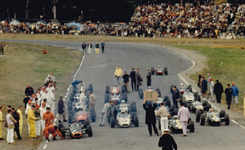
I remember reading a funny story (not sure how accurate it was) that between the mid-1960s and 1970s, F1 teams found that using a slightly wider wheel than the tire manufacturer recommended was faster, as it supported the sidewall better. The tire company would see the team using a wider wheel, so they came out with a wider tire that they though was appropriate for the wider wheel. And the teams would mount the wider tire on an even wider wheel. And around and around it went until rules were made on wheel sizes.

Formula 1 starting grid in 1963 (Britain)
1778560614312.png

1965 (US)
1778560931353.png

1968 (US)
1778561940838.png

1972 (South Africa)
1778563237882.png

1976 (US)
1778564163534.png
 
Last edited:
Since so many here run around a 305 width tire, I thought I would share this Grassroots Motorsports post on what happened when they kept the tire and increased the wheel width from 11" to 12"

Reduction in lap times.


The McLaren rear wheels are 11" and the tires were 305. They had 12" wheels made and kept the same tires and decreased the lap times. (front tires and wheels are smaller, but they made those an inch wider, too).


Saw that test a while ago. But one, most of their testing is on lightweights ("tweeners", even), at least 1000 lighter than today's fat performance Stangs.
And even 2023ish McLaren 720S is almost 1000 lbs lighter than auto DH or 20+ GT500 CFTP.

The other thing I'm not crazy about that testing with PS4S. Yes many run them on track, but also end up going with a more dedicated track tire eventually.
Cup2/GY 3R's/Nankang CR-S tires would be in the stiffer side wall category article talks about with R-comps (obviously not that drastic a change from
PS4S to R's, but still stiffer than what they tested on Mclaren, which is only car even close to current HP stangs, in power/size vehicle anyway).

I'm more or less in agreement that wider wheels help, but that test was not geared around the weight of my car, or the tires I run.
Also Ford could have picked any tire size/wheel they wanted on 500 CFTP, but still went with 11" on 305 and 11.5 on 315.
Are we saying Ford gave up lap times for "big tire" bragging rights, especially on CFTP that was built pretty much for the track?
 
We have a perfect example of this concept with our own Dave Whitworth. He mounted some dinky 295/18s on his 12 inch wheels and was blowing folks away in CAMC. This was on a set of RE71RSs so this may be a better example for some over the PS4Ss in the Grassroot's article.
 
We have a perfect example of this concept with our own Dave Whitworth. He mounted some dinky 295/18s on his 12 inch wheels and was blowing folks away in CAMC. This was on a set of RE71RSs so this may be a better example for some over the PS4Ss in the Grassroot's article.

Why wouldn't Ford do it, especially on "track pack" cars?
Is it a curb rash fear on a "stock car", probably driven on the street at least some?

I don't think they did this type setup on even the GTD.
 
Last edited:
Why wouldn't Ford do it, especially on "track pack" cars?
Is it a curb rash fear on a "stock car", probably driven on the street at least some?

I don't think they did this type setup on even the GTD.
Who knows?

I don't have any insight or information about what testing Ford has done regarding wheel width and tire sizes. It could be that they have not tried it. Maybe they have. Any answer I might give would be pure speculation.

If you have some inside information about this specific issue, then share it. Or speculate, but at least be clear that you are speculating. There is nothing wrong with speculating.
 
Also a lighter car, but I am sharing it anyway, due to the limited number of resources regarding such testing.

I mean, if I had testing with a Mustang and various wheel widths, I would obviously share that.

Link:

On a 215 tire, wheel width from 7" to 8" to 9" (yes, 215 on a 9" wheel) dry and wet performance.

Then 225 and 245 on the same 7, 8, and 9" wheels.

Summary. 9" was always faster. 225 was the fastest, followed closely by 245, but, nevertheless, even on a 9" wheel, the 225 was faster than the 245. 225 was also faster than the 245 on the 7 and 8" wheels, and faster than the 215 on all three wheel widths.

BUT - if you were tracking on a 225 with an 8" wheel and swapped it out for 245 on a 9" wheel, you would be faster. What you would not know unless you did extensive testing is that you would be even faster if you swapped only the wheel to 9" and kept the narrower 225 tire.

It would have been interesting to see what happens as you get up into the 295-315 sizes and wheel width, but this sort of car does not fit those kind of wheels and tires.

I wonder whether the optimum would be wider, like 12" or more, as seen with the McLaren.

THAT is why I posted the original post. It is the only thing I have with a 305 and an 11" wheel. What happens if we increase the width of the wheel to 12"??? Well, this is the only test I have found, so I shared it. Critique away, but that is all there is for now.
 
Last edited:
There is a YouTube video of the Tire Rack test linked in post # 8. I have not posted it here. But they decided to do a second test on a faster track with more negative camber (-2.0°) and Hawk DTC60 pads. This is a YouTube video of that faster test (and I am not posting any spoilers this time).

 
You n
Who knows?

I don't have any insight or information about what testing Ford has done regarding wheel width and tire sizes. It could be that they have not tried it. Maybe they have. Any answer I might give would be pure speculation.

If you have some inside information about this specific issue, then share it. Or speculate, but at least be clear that you are speculating. There is nothing wrong with speculating.

That's why I did not reply to you. It was to the guy that has worked with Ford race teams.

I'm not discounting the idea on wider wheels, it seems to be the way to go for many setups.
But it does not seem like you have read the available GT500 development articles.
(especially level of engineering and direct track testing)

And going "faster", for how many laps? Typically a wider tire means more durability.
Ford's goal was run all day long, flat out, stopping only for gas.
Did a 285/295 combo run faster on the 11/11.5 wheels, but not hold durability wise
for the run all day claim? The 500 is a fat pig, so maybe..........
 
On a heavy car (3000lbs +) you can't go wrong with more wheel width. If nothing else running an 11.5 or 12 wheel gives you a wider sweet spot for tire sizing. Now you can run 295-325.

I have run 295/20 on 11.5 (Fast but edgy vs 325's), and the fastest GT350 in our area runs the same 305/19 on 11.5 . Different tires physical size varies. A 305 RE71 is very wide, closer to a 315, and does not look stretched on 11.5

Apex has a good affordable flow formed 19x11.5. They also make an SM10rs forged in 19x12.
 
But it does not seem like you have read the available GT500 development articles.
(especially level of engineering and direct track testing)

I have not read them and did not know they existed. If you have some that you could link regarding this issue of wheel width and tire size, I would absolutely read them. I am open to being educated.
 
Apex has a good affordable flow formed 19x11.5. They also make an SM10rs forged in 19x12.

I have noticed both but have my doubts about installing either of those on the front of my S650 without a hacksaw and custom bodywork fender flares. LOL, which I am not going to do to such a nice daily driver.
 
Are we saying Ford gave up lap times for "big tire" bragging rights, especially on CFTP that was built pretty much for the track?

Your faith in the track savvy of Ford Street car engineers is kinda cute. There's 10,000 things that could have been done to improve the car on the track.


A friend, I'll talk about him in a coming separate thread, was running the ACS Mustangs in World Challenge in the early 20-teens. They were only allowed something like a 275 front tire, but the wheel width was free. I think I remember him stretching them onto a 12" rim.

Tires act like 4—bar linkages with joints in the corners when side load is applied. With the wider base, it did a really good job of supporting the lateral load of a nose-heavy front end. It wasn't as good as running the tire he wanted (which was wider), but it was an advantage.

I think it would be a bigger advantage on the front than the rear.
 
On a heavy car (3000lbs +) you can't go wrong with more wheel width. If nothing else running an 11.5 or 12 wheel gives you a wider sweet spot for tire sizing. Now you can run 295-325.

I have run 295/20 on 11.5 (Fast but edgy vs 325's), and the fastest GT350 in our area runs the same 305/19 on 11.5 . Different tires physical size varies. A 305 RE71 is very wide, closer to a 315, and does not look stretched on 11.5

Apex has a good affordable flow formed 19x11.5. They also make an SM10rs forged in 19x12.

No durability difference between 295 and 325? (assuming you ran exact same tire for both, on same 11.5 wheel)?
 
No durability difference between 295 and 325? (assuming you ran exact same tire for both, on same 11.5 wheel)?
Durability is more tire compound and construction dependent.
295/30/20 A052s wear very smooth and even, cannot seem to kill the tread but are heat cycling out
325/30/20 Vitour P1 grains up noticeably and shreds the first rib very quickly. Then wear evens out with more HC.
325/30/20 Nankang CRS wears smooth evenly but eventually cord/chunk the inside shoulder from camber and braking forces on the front. CRS has the softest sidewall based on the scuffs when highly loaded.
 
So we're going down this rabbit hole?
Tire width really messes with a lot of other things and IMO generally falls under the file of demon tweeks to try and make something work that really doesn't want to work, or more likely a rule work around. Assuming there is an optimum width for a specific tire, you can place them on a wider wheel, generally this will raise the spring rate because it artificially shortens the side wall. The opposite is also true, narrow wheel width, less rate, but these just don't effect spring rate. The car still has to go around corners which means the tire will have to transition across its surface area, and this is where we run into things like tire slip angle and tread squirm. Also open wheel and protype cars are designed with minimal suspension movement, production cars flop all over the place so wheel width considerations are actually more important. ( remember the concept of a similar tire temp across the tread face? Great for OW and PT, but sucks for production cars). Similar idea. I would highly recommend staying within 1 inch of the mfg recommendations in width, I would not go narrower. The super low tire pressures required on some tracks when cold,in combination of a narrower wheel is just asking for out lap cord damage,, even catastrophic bead seperation..but as in @TeeLew example, you gotta do what you have to, if stretching the tire gives you more contact patch, and that is more beneficial than a different suspension change, then do it. Sometimes you have to take the bull by the tail and face the situation
 
Top