The Mustang Forum for Track & Racing Enthusiasts

Taking your Mustang to an open track/HPDE event for the first time? Do you race competitively? This forum is for you! Log in to remove most ads.

  • Welcome to the Ford Mustang forum built for owners of the Mustang GT350, BOSS 302, GT500, and all other S550, S197, SN95, Fox Body and older Mustangs set up for open track days, road racing, and/or autocross. Join our forum, interact with others, share your build, and help us strengthen this community!

How much Negative Camber is too much?

This site may earn a commission from merchant affiliate links, including eBay, Amazon, and others.

16
24
Exp. Type
HPDE
Exp. Level
Under 3 Years
OK
I'm wondering if I have too much negative camber and toe-in for a dual purpose car, and if so, how I could relatively easily make changes for upcoming track days without paying for alignments constantly.

For background, I've had my current set of Cup 2's since March 2024, and have approx. 5,750 of miles on them, including 5 HPDE events. Prior to my last event, I increased my camber and toe to the following:

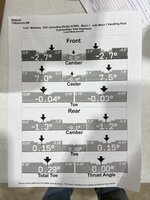
Previous: Front L (-1.53 deg.) Front R (-1.32 deg.) Front Toe (-0.09 deg.) Rear L (-1.25 deg) Rear R ( -1.23 deg.) Rear (Toe 0.08 deg.).

New: Front L (-2.4 deg.) Front R (-2.5 deg.) Front Toe (0.10 deg.) Rear L (-2.0 deg) Rear R( -2.10 deg.) Rear (Toe 0.26 deg.). Caster was untouched, left at stock of 7.9 deg.

After my last HPDE event in November, my instructor cautioned me that my tires were essentially done, and that I should look into getting a fresh set. If I am getting some new tires, I want to make sure I'm not wearing them out prematurely.

I hope to hit ~1-2 events a month until Dec. I still street drive the car a fair bit when the weather is nice. Unfortunately, I also have to drive the car to the track and back as well.

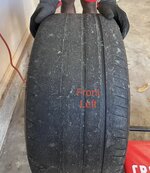
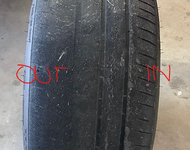
Tire pictures for context after last event.

Any advice would be appreciated!
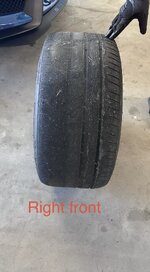
IMG_0340.jpeg

IMG_0334.jpeg

IMG_0335.jpeg

IMG_0331.jpeg
 
I'm wondering if I have too much negative camber and toe-in for a dual purpose car, and if so, how I could relatively easily make changes for upcoming track days without paying for alignments constantly.
No and no and there is no such this as a relatively easy alignment. Set it properly and drive it. You got a lot of distance out of those tyres for how bad the camber was for most of it.
You originally had toe out in the first alignment "yahh", well effectively zero as it was second digit, and toe in on the second "boo".

From the pictures you are destroying outsides and barely touching insides. Even more camber on the front than your second alignment.

Read the post below. All been discussed with @krisk who was in the same boat initially.
Pretty sure its mentioned in that thread but toe settings will kill tyres faster than camber. Track will wear tyres way faster than street driving including to and from said track.
 
I'm wondering if I have too much negative camber and toe-in for a dual purpose car, and if so, how I could relatively easily make changes for upcoming track days without paying for alignments constantly.

For background, I've had my current set of Cup 2's since March 2024, and have approx. 5,750 of miles on them, including 5 HPDE events. Prior to my last event, I increased my camber and toe to the following:

Previous: Front L (-1.53 deg.) Front R (-1.32 deg.) Front Toe (-0.09 deg.) Rear L (-1.25 deg) Rear R ( -1.23 deg.) Rear (Toe 0.08 deg.).

New: Front L (-2.4 deg.) Front R (-2.5 deg.) Front Toe (0.10 deg.) Rear L (-2.0 deg) Rear R( -2.10 deg.) Rear (Toe 0.26 deg.). Caster was untouched, left at stock of 7.9 deg.

After my last HPDE event in November, my instructor cautioned me that my tires were essentially done, and that I should look into getting a fresh set. If I am getting some new tires, I want to make sure I'm not wearing them out prematurely.

I hope to hit ~1-2 events a month until Dec. I still street drive the car a fair bit when the weather is nice. Unfortunately, I also have to drive the car to the track and back as well.

Tire pictures for context after last event.

Any advice would be appreciated!
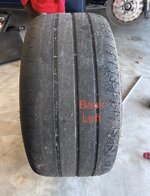
View attachment 108697

View attachment 108698

View attachment 108699

View attachment 108700
Here's my feedback from a relatively new HPDE driver, but I've done quite a bit of playing around with alignments on my car, both doing them myself and having them done at shops.

1. For track use, I would go with more negative camber up front. At least -3.0, probably would be better around -3.2. You don't want toe in up front. Either zero toe or slight toe out. You could probably take out some of the negative camber in the back and get it to -1.8 to -1.9. Rear toe looks fine.

2. Switching alignments back and forth between track and street is not something I found is feasible, especially in the rear. Adjusting the camber also changes the toe, so if you get the camber to where you want it, your toe is not going to be good. I'd pick a decent track alignment and stick with it. Hitting 1-2 track events per month, the street driving is not going to wear out your tires, the track driving will.

3. I honestly can't believe you've gotten 5,750 miles and 5 HPDE events out of the Cup 2. Were those one or two day events? Almost all my HPDE are two day with about 2 hours per day of driving, or 4 hours per event. If you got 20 hours on track with those, that is significantly better than what I've heard about how those tires last. I've never run the Cup 2, but most of the comments I've seen say to expect about 3-4 track days out of the front tires. I run Continental EC Force, which are an endurance tire, and I don't see getting 20 track hours out of them.
 
Which Cup 2?

They come in the following tread wear:

240​
180​
and 140, but this last one is called the Cup 2 R.​

I was shocked when I saw how many miles and HPDE events you had. LOL, way more than I got out of the sticky Trofeo RS tires that Ford put on my car.
 
@GAR944 Thank you, I'll read up!
Here's my feedback from a relatively new HPDE driver, but I've done quite a bit of playing around with alignments on my car, both doing them myself and having them done at shops.

1. For track use, I would go with more negative camber up front. At least -3.0, probably would be better around -3.2. You don't want toe in up front. Either zero toe or slight toe out. You could probably take out some of the negative camber in the back and get it to -1.8 to -1.9. Rear toe looks fine.

2. Switching alignments back and forth between track and street is not something I found is feasible, especially in the rear. Adjusting the camber also changes the toe, so if you get the camber to where you want it, your toe is not going to be good. I'd pick a decent track alignment and stick with it. Hitting 1-2 track events per month, the street driving is not going to wear out your tires, the track driving will.

3. I honestly can't believe you've gotten 5,750 miles and 5 HPDE events out of the Cup 2. Were those one or two day events? Almost all my HPDE are two day with about 2 hours per day of driving, or 4 hours per event. If you got 20 hours on track with those, that is significantly better than what I've heard about how those tires last. I've never run the Cup 2, but most of the comments I've seen say to expect about 3-4 track days out of the front tires. I run Continental EC Force, which are an endurance tire, and I don't see getting 20 track hours out of them.

1. My front tires look like they are getting eaten up on the inside of the tire - will additional negative camber exacerbate that? Or is that more so a symptom of too much toe?
2. I figured as much, but I thought I'd at least ask. I did get some AAD rear camber arms to facilitate easier changes, but figured that it would be better to find a good setting and leave well enough alone.
3. Most of my events are one day events - I would think the time spent driving is the same. I'm probably just not going fast enough!
4. Are you running the Continental EC Force in 315/30ZR19? How do you like them?

Which Cup 2?

They come in the following tread wear:

240​
180​
and 140, but this last one is called the Cup 2 R.​

I was shocked when I saw how many miles and HPDE events you had. LOL, way more than I got out of the sticky Trofeo RS tires that Ford put on my car.
Mine show to be 180 treadwear on the tire. These are my second set of Cup 2's, not sure what the treadwear was on my first set. They were original to the car.

One thing I forgot to mention after going through my notes is that I rotated the front to the back ~1,200 miles previous to my last HPDE event (I had 2 total events after rotating), which probably throws off the wear pattern front to back. Sorry about that.

How quickly should I get a new set of tires? Some of the guys at the track said I had some more time in them, whereas my instructor was of the opposite opinion.
 
You could probably take out some of the negative camber in the back and get it to -1.8 to -1.9.

Unless the tyres were mounted the wrong way that is definitely the outside edge getting destroyed.
The inside edge has way more sipes than the outside which can be seen in your photos.
View attachment 108706
View attachment 108707

Exactly. I thought I was very confused for a moment.

Unless the tire shop mounted all his tires backwards . . . :eek:

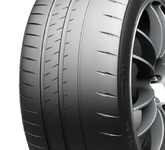
They are not directional, but they have a definite outside and inside, and it is marked on the tire.

Look on the left side of the sidewall in the photo below, and you will see it says "OUTSIDE." While some might interpret that to mean no driving indoors, it is actually a guide for installation on the car.


1770246359304.png
 
Last edited:
Are you running the Continental EC Force in 315/30ZR19? How do you like them?
He is running 305 on 11 inch wheels, and he likes them very much.


(It's in that link that GAR944 provided for you in post # 2)

 
Mine show to be 180 treadwear on the tire.
Nice tires.

In 2024, Porsche put a set of those on its 2004 Carrera GT and shaved 20 seconds off of its Nurburgring time from 2004. This simple tire change meant it beat a lot of modern supercars, including the Porsche 918 Spyder.

Twenty years of advancements in tire technology have been responsible for a lot of performance gains.


There is a Youtube video at the link, and you can see the tires at about 50 seconds in.
 
@GAR944 Thank you, I'll read up!


1. My front tires look like they are getting eaten up on the inside of the tire - will additional negative camber exacerbate that? Or is that more so a symptom of too much toe?
2. I figured as much, but I thought I'd at least ask. I did get some AAD rear camber arms to facilitate easier changes, but figured that it would be better to find a good setting and leave well enough alone.
3. Most of my events are one day events - I would think the time spent driving is the same. I'm probably just not going fast enough!
4. Are you running the Continental EC Force in 315/30ZR19? How do you like them?


Mine show to be 180 treadwear on the tire. These are my second set of Cup 2's, not sure what the treadwear was on my first set. They were original to the car.

One thing I forgot to mention after going through my notes is that I rotated the front to the back ~1,200 miles previous to my last HPDE event (I had 2 total events after rotating), which probably throws off the wear pattern front to back. Sorry about that.

How quickly should I get a new set of tires? Some of the guys at the track said I had some more time in them, whereas my instructor was of the opposite opinion.
1. Looks to me like it's the outside of your tires wearing more. Increased negative camber will help.
2. I went with the AAD camber arms initially, but didn't like the tab system. I switched to the Steeda camber arms and like them better.
3. That makes more sense that they were mostly one day events. I didn't think they would last that long with two day events.
4. I'm running the ECF in 295/30/19 square. I'm not certain I could fit the 315's up front without possible rubbing, which I don't want to have to worry with. If I switch to coilovers at some point in the future, then I'll go to the 315.
 
Honestly for almost 6k miles and 5 track events those tires look pretty darn good to me. Generally even wear inside to outside, good job. I’m a run them to the cords type of cheapskate but those are almost certainly heat cycled out. I would just get another set and go again, I wouldn’t mess with your alignment from what I can see. 3-4 events is about the limit for fast sticky tires in my experience.
 
I'm wondering if I have too much negative camber and toe-in for a dual purpose car, and if so, how I could relatively easily make changes for upcoming track days without paying for alignments constantly.

For background, I've had my current set of Cup 2's since March 2024, and have approx. 5,750 of miles on them, including 5 HPDE events. Prior to my last event, I increased my camber and toe to the following:

Previous: Front L (-1.53 deg.) Front R (-1.32 deg.) Front Toe (-0.09 deg.) Rear L (-1.25 deg) Rear R ( -1.23 deg.) Rear (Toe 0.08 deg.).

New: Front L (-2.4 deg.) Front R (-2.5 deg.) Front Toe (0.10 deg.) Rear L (-2.0 deg) Rear R( -2.10 deg.) Rear (Toe 0.26 deg.). Caster was untouched, left at stock of 7.9 deg.

After my last HPDE event in November, my instructor cautioned me that my tires were essentially done, and that I should look into getting a fresh set. If I am getting some new tires, I want to make sure I'm not wearing them out prematurely.

I hope to hit ~1-2 events a month until Dec. I still street drive the car a fair bit when the weather is nice. Unfortunately, I also have to drive the car to the track and back as well.

Tire pictures for context after last event.

Any advice would be appreciated!
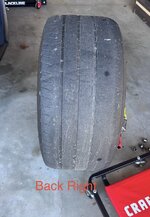
View attachment 108697

View attachment 108698

View attachment 108699

View attachment 108700
This is one of those situations that I feel a bit awkward about. First, you didn't say what car you have, but the first photo looks like a GT350. Now, the problem is that GT350's are a very different setup from Mustang GT's, and the advice of high levels of negative camber that solve problems on GT's aren't relevant to the GT350. From the look of your tires, your camber settings are perfect. Same with toe.

What I see in the photos is a set of MPSC2's that are pretty much perfect from a wear standpoint. MPSC2's have different rubber compounds across the face of the tread, and the grooves are shallower toward the outside, so the outside wears a bit faster than the inside, regardless of camber. However, your outsides still have markings on them, which means they're wearing very evenly and as they stand, they're still useable, although I'd avoid driving in the wet with them.
 
This is one of those situations that I feel a bit awkward about. First, you didn't say what car you have, but the first photo looks like a GT350. Now, the problem is that GT350's are a very different setup from Mustang GT's, and the advice of high levels of negative camber that solve problems on GT's aren't relevant to the GT350. From the look of your tires, your camber settings are perfect. Same with toe.

What I see in the photos is a set of MPSC2's that are pretty much perfect from a wear standpoint. MPSC2's have different rubber compounds across the face of the tread, and the grooves are shallower toward the outside, so the outside wears a bit faster than the inside, regardless of camber. However, your outsides still have markings on them, which means they're wearing very evenly and as they stand, they're still useable, although I'd avoid driving in the wet with them.
1770316614306.png

Good catch.

So what sort of camber settings are better or so very different from a Mustang GT?
 
View attachment 108710

Good catch.

So what sort of camber settings are better or so very different from a Mustang GT?
First and foremost, the GT350 isn't a GT with stickers on it. It's different car developed by a different engineering group. Various bits of structure, like the aluminum front knuckles, are very different from the GT. If you're running stock GT350 rims and tires, the recommendations in the "Owner's Supplement" are based on extensive track time and testing by Ford Performance. If you follow them, you'll get good results. If you change to lighter (more bendy) wheels, you'll need more camber. If you change springs, the shock calibration might not be optimal. Making a GT350 underperform is easy - the aftermarket is loaded with goodies that promise greatness and miss the mark. Making it better is a challenge, it can be done, but it's expensive, to say the least.
 
These alignment specs?


If they are anything like the Dark Horse factory track recommendations, then they are conservative compared to what provides the shortest lap times. And the lighter wheel thing would apply to garden variety GTs, too, right? And corvettes? And BMWs? And Honda Civics?

(and no, I have never driven a GT350, much less tried different camber settings, much less run more than the factory setting on the track, so if you have a 2018 and set the front camber to more than -1.50°, the optimal track setting based on extensive track time and testing by Ford Performance, and it actually slowed down, feel free to correct me, but until you do so, wow, let's just say that I have my doubts that the car would be slower at -2° or even -2.5°, but those doubts are based on common sense, not real life experience).
 
Last edited:
it seems like you guys are trying to find a perfect everywhere camber setting which of course doesn’t exist. So many variables including tire types, track conditions, suspension setup etc. Generally these cars like a lot of front camber on track. On a dual duty car, get some good cc plates and use them. Most people set the street alignment where they want it, with camber plates in the most upright position and zero toe, and then adjust to add neg camber when at the track. The toe out this creates aids turn in and is fun. End of day, put back to stock street setting. Easy. Dedicated track car will want a more precise track alignment of course but this method works very well for fun hpde days where you are driving home after the day is done.
 
Strictly tire and track dependent. Hoosier R7/A7s like up to -4.0, Michelin S9 or H2 are happy at -3.5 to -3.7 up front. In the rear we look at what is most desired, ranging from -1.8 for maximum drive off and braking stability to -2.3 for better turn in and grip. Always remember that toe moves a lot when putting negative camber in and out. I see so many posts saying, "I put the camber to -2.5 for track day and wore out my inside shoulders, must be too much negative for these tires." Most times if asked they don't know where the toe is, well it is probably 6 mm toe out and scrubbing the hell out of those inside edges down the straights. Set camber first, then check and reset toe. Then recheck camber and maybe make a fine adjustment, and a final toe check. Roll and bounce the suspension each time you jack the car as well.
 
it seems like you guys are trying to find a perfect everywhere camber setting which of course doesn’t exist. So many variables including tire types, track conditions, suspension setup etc. Generally these cars like a lot of front camber on track. On a dual duty car, get some good cc plates and use them. Most people set the street alignment where they want it, with camber plates in the most upright position and zero toe, and then adjust to add neg camber when at the track. The toe out this creates aids turn in and is fun. End of day, put back to stock street setting. Easy. Dedicated track car will want a more precise track alignment of course but this method works very well for fun hpde days where you are driving home after the day is done.

I need to just have this auto post every 45-60 days, but the above is a terrible idea. I do alignments, mostly on performance cars as a decent part of my living. Average about 250/year. And lots of camber plates.

Any non threaded adjustment is not reliably repeatable. Especially camber plates (and eccentrics). Moving a plate back and forth to the same "mark" is really only getting it withing 3-5 tenths of a degree from where it was before. That is not a huge deal but the toe change certainly is. In fact, sometimes you move the camber plate and you watch it move 1/4" and no camber change, but only the toe moves.

Unless you check your toe every time you move the plates, you are risking having your toe be wildly off, likely toed out which will kill tires faster than even 4 degrees of camber.

One thing that is dead nuts reliable and repeatable is threaded adjustments like on tie rods. If you like toe out at the track for the turn in, you can mark the two spots really easily while on the machine and then just move between the paint marks at the track.


DaveW
 

Latest posts

Buy TMO Apparel

Buy TMO Apparel
Top