The Mustang Forum for Track & Racing Enthusiasts

Taking your Mustang to an open track/HPDE event for the first time? Do you race competitively? This forum is for you! Log in to remove most ads.

  • Welcome to the Ford Mustang forum built for owners of the Mustang GT350, BOSS 302, GT500, and all other S550, S197, SN95, Fox Body and older Mustangs set up for open track days, road racing, and/or autocross. Join our forum, interact with others, share your build, and help us strengthen this community!

How much Negative Camber is too much?

This site may earn a commission from merchant affiliate links, including eBay, Amazon, and others.

If you can find the camber plates we use on the Gt4, they actually have shims in them, so you could really pull a camber shim out,, or add one, and it would be repeatable. Im guessing big $$ from Multimatic, but I'm not sure. If you use that and a " toe bar"(a telescoping bar with flat plates that go up against the tire) you could probably get away with aligning your car on track days, but it would still be cumbersome.
If it were me, I'd just run 3 degrees of camber all the time, maybe 3.1, Mustangs love camber which why it's restricted in competition.
With regards to the tires, im not familiar with all of them, but when you post a Pic mark the direction of rotation, it would be helpful. On production based cars expect the center of the tire to be less worn than the outer edges. This may look like overinflation, but it's not. Basically Mustangs ( and all strut cars) have funky tire wear, they also have something called " camber gain" when they lean into a corner. So the car runs down the straight on the inside of the tire, transitions over the center, then tries to grind off the outer edge in the corner, then the same coming off the corner. This is one reason across the face tire temps should be taken with a grain of salt, I've seen inside temps at 250, centers at 200, outers at 220, ( slicks). It would seem like they need more pressure, they don't, (throw in banking and it gets even more screwed up. ) the whole idea of across the face equal tire temps come from open wheel and prototypes, NOT production class cars), those cars only have about 2 inches of suspension travel, production cars should flop all over the place.
Im not a tread wear racing type of guy, but these concepts (not necessarily the temps) should be applicable to treaded tires as well.
 
I need to just have this auto post every 45-60 days, but the above is a terrible idea. I do alignments, mostly on performance cars as a decent part of my living. Average about 250/year. And lots of camber plates.

Any non threaded adjustment is not reliably repeatable. Especially camber plates (and eccentrics). Moving a plate back and forth to the same "mark" is really only getting it withing 3-5 tenths of a degree from where it was before. That is not a huge deal but the toe change certainly is. In fact, sometimes you move the camber plate and you watch it move 1/4" and no camber change, but only the toe moves.

Unless you check your toe every time you move the plates, you are risking having your toe be wildly off, likely toed out which will kill tires faster than even 4 degrees of camber.

One thing that is dead nuts reliable and repeatable is threaded adjustments like on tie rods. If you like toe out at the track for the turn in, you can mark the two spots really easily while on the machine and then just move between the paint marks at the track.


DaveW
Dave, I think you missed the part where I said that dedicated track cars will want a more precise alignment, and perhaps also the part where the OP said he has a dual use car and doesn't want to get an alignment every time he goes to the track. Let me also emphasize, I totally respect your expertise (I love your build by the way) and agree that toe out kills the inside of tires on the street. But my experience has not been at all what you describe.

For context, I have a dual use S197 that I drive year round on the street and in advanced group HPDE-type events on track with a dedicated set of track tires. So not W2W racing but dozens and dozens of track days over the years. I started using the method I described on the advice of Vorshlag many years ago when my car had about 40,000 miles on it and I bought some of their camber plates as I started getting into the sport. Now almost a decade later the car has 200,000 miles on it, tons of track days, many sets of tires on street and track, and I have yet to wear out a set of tires on the inside edge despite 3.5-4 degrees of neg camber and lots of toe out when I'm at the track. It just isn't happening for me. Not saying it can't but that hasn't been my experience. Mostly I get very even wear across the width of the tire. If anything, the challenge in my experience remains excessive outside shoulder wear on track when I use the really fun and sticky tires like GY SC3R's, even with all that neg camber and toe out.
 
If you can find the camber plates we use on the Gt4, they actually have shims in them, so you could really pull a camber shim out,, or add one, and it would be repeatable. Im guessing big $$ from Multimatic, but I'm not sure. If you use that and a " toe bar"(a telescoping bar with flat plates that go up against the tire) you could probably get away with aligning your car on track days, but it would still be cumbersome.
If it were me, I'd just run 3 degrees of camber all the time, maybe 3.1, Mustangs love camber which why it's restricted in competition.
With regards to the tires, im not familiar with all of them, but when you post a Pic mark the direction of rotation, it would be helpful. On production based cars expect the center of the tire to be less worn than the outer edges. This may look like overinflation, but it's not. Basically Mustangs ( and all strut cars) have funky tire wear, they also have something called " camber gain" when they lean into a corner. So the car runs down the straight on the inside of the tire, transitions over the center, then tries to grind off the outer edge in the corner, then the same coming off the corner. This is one reason across the face tire temps should be taken with a grain of salt, I've seen inside temps at 250, centers at 200, outers at 220, ( slicks). It would seem like they need more pressure, they don't, (throw in banking and it gets even more screwed up. ) the whole idea of across the face equal tire temps come from open wheel and prototypes, NOT production class cars), those cars only have about 2 inches of suspension travel, production cars should flop all over the place.
Im not a tread wear racing type of guy, but these concepts (not necessarily the temps) should be applicable to treaded tires as well.
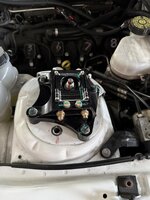
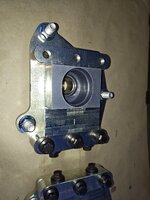
These. about $1000. Each.Multimatic camber plates.jpg
 
Dave, I think you missed the part where I said that dedicated track cars will want a more precise alignment, and perhaps also the part where the OP said he has a dual use car and doesn't want to get an alignment every time he goes to the track. Let me also emphasize, I totally respect your expertise (I love your build by the way) and agree that toe out kills the inside of tires on the street. But my experience has not been at all what you describe.

For context, I have a dual use S197 that I drive year round on the street and in advanced group HPDE-type events on track with a dedicated set of track tires. So not W2W racing but dozens and dozens of track days over the years. I started using the method I described on the advice of Vorshlag many years ago when my car had about 40,000 miles on it and I bought some of their camber plates as I started getting into the sport. Now almost a decade later the car has 200,000 miles on it, tons of track days, many sets of tires on street and track, and I have yet to wear out a set of tires on the inside edge despite 3.5-4 degrees of neg camber and lots of toe out when I'm at the track. It just isn't happening for me. Not saying it can't but that hasn't been my experience. Mostly I get very even wear across the width of the tire. If anything, the challenge in my experience remains excessive outside shoulder wear on track when I use the really fun and sticky tires like GY SC3R's, even with all that neg camber and toe out.
Everyone's mileage may very, I didn't/don't mean to sound argumentative at all. I should not have used an absolute in my statement. And I am not sure how many people actually do the full Vorshlag procedure, carefully. And not everyone buys good plates like Terry's :) Remember, Google is a thing and someone with Pedders plates reads your post and then repeats it to 84 people who all see it as gospel without understanding you are advanced level person with skill, and proper parts.

However, I bet I align 10-15 cars per year where the customer was doing their own adjustments for track and street and they just destroy a set of tires. We put the car on the rack in the street setup and it has 1/4" toe out.

I don't hammer anything down my customer's throats, but when I get one who hesitates at my advice and we have time, we just do the street/track adjustment while on the rack. Once they see how non repeatable it is, they usually change their mind. As you mentioned, for people who drive aggressively, the outside wear from lack of camber (or even proper camber) far outweigh inside wear on tires designed to wear quickly anyway.

No argument or disrespect intended. IMO we are both right. :)

DaveW
 
To kind of get back to what @DaveW said, when we go to the track, the car gets set up at the shop on a plate. The car goes to the track, the scales are set up, the car placed on them and those numbers recorded. Now you have a difference of what you have from.the shop to the track, but you're not done. After you establish track scale numbers, the car goes to IMSA tech, on their scales ( actually a plate of sorts) to get those numbers which are the official numbers you will live by. So you now have 3 sets of numbers which don't match, but you can correlate so that any adjustsments are transferable . I think youre allowed to go through IMSA tech 3 times, that's all, so day 1, then 2 more,usually the last time is day of the race.
After the race, the car again goes through tech, then back to the shop, hopefully all those numbers will correlate to the " after the event" numbers, but not always. To further confound the issues, the car is teched at 30psi all around, so you lose all your cold numbers for tire pressures.
So... you might just want to put a set of alignment numbers on it an leave it. I'd go 3 degrees camber in front,all the caster I could get as long as it matched both sides, and maybe 1/8 of toe or even 1/16. I don't know what they run on the IRS because that's not my end of the car. .

Which is why I like stick axles
 
To kind of get back to what @DaveW said, when we go to the track, the car gets set up at the shop on a plate. The car goes to the track, the scales are set up, the car placed on them and those numbers recorded. Now you have a difference of what you have from.the shop to the track, but you're not done. After you establish track scale numbers, the car goes to IMSA tech, on their scales ( actually a plate of sorts) to get those numbers which are the official numbers you will live by. So you now have 3 sets of numbers which don't match, but you can correlate so that any adjustsments are transferable . I think youre allowed to go through IMSA tech 3 times, that's all, so day 1, then 2 more,usually the last time is day of the race.
After the race, the car again goes through tech, then back to the shop, hopefully all those numbers will correlate to the " after the event" numbers, but not always. To further confound the issues, the car is teched at 30psi all around, so you lose all your cold numbers for tire pressures.
So... you might just want to put a set of alignment numbers on it an leave it. I'd go 3 degrees camber in front,all the caster I could get as long as it matched both sides, and maybe 1/8 of toe or even 1/16. I don't know what they run on the IRS because that's not my end of the car. .

Which is why I like stick axles
Love how even the tire master sees the multiple variances on the team scales, shop setup and IMSA tech platform. And it isn't operator error or lack of precision equipment. We showed the USAC guys that their setup was out of level laterally causing some crazy camber readings one practice day. But in the end, sanctioning scales and tools have the final say. Many rabbit holes. In the end I ask Nick how it feels and we look at lap times over a stint to decide on adjustments.
 
First and foremost, the GT350 isn't a GT with stickers on it. It's different car developed by a different engineering group. Various bits of structure, like the aluminum front knuckles, are very different from the GT. If you're running stock GT350 rims and tires, the recommendations in the "Owner's Supplement" are based on extensive track time and testing by Ford Performance. If you follow them, you'll get good results. If you change to lighter (more bendy) wheels, you'll need more camber. If you change springs, the shock calibration might not be optimal. Making a GT350 underperform is easy - the aftermarket is loaded with goodies that promise greatness and miss the mark. Making it better is a challenge, it can be done, but it's expensive, to say the least.

You are giving entirely too much credit to Ford on their track tuning work and attributing far too much difference to the knuckle change. At the end of the day, it's a Mac Strut. I don't care what the particulars are, struts *always* need a high amount of static camber. This is true in a Toyota, BMW, Porsche or whatever car you want to point towards. The subtle steering and roll center differences of the Shelby AL upright don't change the basic attributes of the design. My guess is that if we were just looking to optimize the front tire (on any S550/650) wear, we'd be at -4+ degrees of camber statically, regardless of the wheel used. What limits the camber you end up running is not it's effect mid-corner, it's the braking performance and the fragility of the inner tire sidewall which limits what you can run.
 
When I asked Vorshlag how much negative camber I should run at the track they laughed and said, "All of it." I thought that was a very Texas response (in the best way possible), and it's proven to be about right in my limited HPDE experience.
 
You are giving entirely too much credit to Ford on their track tuning work and attributing far too much difference to the knuckle change. At the end of the day, it's a Mac Strut. I don't care what the particulars are, struts *always* need a high amount of static camber. This is true in a Toyota, BMW, Porsche or whatever car you want to point towards. The subtle steering and roll center differences of the Shelby AL upright don't change the basic attributes of the design. My guess is that if we were just looking to optimize the front tire (on any S550/650) wear, we'd be at -4+ degrees of camber statically, regardless of the wheel used. What limits the camber you end up running is not it's effect mid-corner, it's the braking performance and the fragility of the inner tire sidewall which limits what you can run.

When I asked Vorshlag how much negative camber I should run at the track they laughed and said, "All of it." I thought that was a very Texas response (in the best way possible), and it's proven to be about right in my limited HPDE experience.
That was maxed on the front. Worked very well for me.
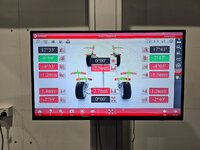
Wheel Alignment Gordon Robertson.jpg
 
You are giving entirely too much credit to Ford on their track tuning work and attributing far too much difference to the knuckle change. At the end of the day, it's a Mac Strut. I don't care what the particulars are, struts *always* need a high amount of static camber. This is true in a Toyota, BMW, Porsche or whatever car you want to point towards. The subtle steering and roll center differences of the Shelby AL upright don't change the basic attributes of the design. My guess is that if we were just looking to optimize the front tire (on any S550/650) wear, we'd be at -4+ degrees of camber statically, regardless of the wheel used. What limits the camber you end up running is not it's effect mid-corner, it's the braking performance and the fragility of the inner tire sidewall which limits what you can run.
I was using the aluminum knuckle as an example of the differences. If you think about the forces at work in a high-g turn, the wheel wants to bend out at the top and in at the bottom. The hub and knuckle assembly wants to bend out at the top and in at the bottom. The strut wants to bend so that it bows outwards, moving the knuckle out at the top and in at the bottom. And, finally, the strut-top bearing assembly wants to let the top of the strut move outwards from the pressure on the rubber isolators that keep noise under control, which would move the knuckle out at the top and in at the bottom. All of these movements reduce negative camber.

So, given that all of the parts I just mentioned on a GT350 were unique to the GT350, isn't it possible that a stiff 30 pound rim, and a stiff knuckle (no pad knockback with those things), a stronger bearing assembly (borrowed from an SUV), a stiffer strut body (on the Magride shocks) and higher durometer rubber (in the upper strut mount) might just have reduced the need for high camber levels? I'm no stranger to running -3.6 degrees of negative camber - my S197 2014 GT500 needed that just to drive ok. It was a pleasant surprise that my 2016 GT350 could get by with more than a degree less while delivering even tire temps, even wear and great handling.
 
I need to just have this auto post every 45-60 days, but the above is a terrible idea. I do alignments, mostly on performance cars as a decent part of my living. Average about 250/year. And lots of camber plates.

Any non threaded adjustment is not reliably repeatable. Especially camber plates (and eccentrics). Moving a plate back and forth to the same "mark" is really only getting it withing 3-5 tenths of a degree from where it was before. That is not a huge deal but the toe change certainly is. In fact, sometimes you move the camber plate and you watch it move 1/4" and no camber change, but only the toe moves.

Unless you check your toe every time you move the plates, you are risking having your toe be wildly off, likely toed out which will kill tires faster than even 4 degrees of camber.

One thing that is dead nuts reliable and repeatable is threaded adjustments like on tie rods. If you like toe out at the track for the turn in, you can mark the two spots really easily while on the machine and then just move between the paint marks at the track.


DaveW

How does one go about finding a shop with employees who do 250 alignments a year with lots of camber plates and can set up things properly for HPDE and street? I am near Atlanta.

When I asked Vorshlag how much negative camber I should run at the track they laughed and said, "All of it." I thought that was a very Texas response (in the best way possible), and it's proven to be about right in my limited HPDE experience.
So what do you run for camber?
I started using the method I described on the advice of Vorshlag many years ago when my car had about 40,000 miles on it and I bought some of their camber plates as I started getting into the sport. Now almost a decade later the car has 200,000 miles on it, tons of track days, many sets of tires on street and track, and I have yet to wear out a set of tires on the inside edge despite 3.5-4 degrees of neg camber and lots of toe out when I'm at the track. It just isn't happening for me. Not saying it can't but that hasn't been my experience. Mostly I get very even wear across the width of the tire. If anything, the challenge in my experience remains excessive outside shoulder wear on track when I use the really fun and sticky tires like GY SC3R's, even with all that neg camber and toe out.
So do you change the camber and toe for street driving when you are finished with the HPDE day?

Also, how many HPDE days do you get out of GY SC3R tires, and do you drive them on the street, or are they dedicated wheels and tires for track?
 
If you were a little closer I would say come up to my place and we could get the car setup. As for changing setting after track day, it depends on how much street driving you do. Daily driving I would consider it if DIY, occasional fun driving and you are paying a shop $125 I would not. Also I would have a set of street wheels/tires if running 60-200 TW type ultra performance tires like SC3R or PSCup2 or Yoko A052 that wear easily. Michelin is my preference PS4 is a decent street tire with good wet performance, I have that on the wifes' Mercedes instead of the run flat hockey pucks it came with.
 
If you were a little closer I would say come up to my place and we could get the car setup. As for changing setting after track day, it depends on how much street driving you do. Daily driving I would consider it if DIY, occasional fun driving and you are paying a shop $125 I would not. Also I would have a set of street wheels/tires if running 60-200 TW type ultra performance tires like SC3R or PSCup2 or Yoko A052 that wear easily. Michelin is my preference PS4 is a decent street tire with good wet performance, I have that on the wifes' Mercedes instead of the run flat hockey pucks it came with.
I do not yet have a second set of wheels and tires, but that is what I plan to do.

Street driving right now are the stock Ford 10.5 and 11" wheels with 305/30R 19 and 315/30R19 Michelin PS4S, which I installed because the Trofeo RS tires, while an absolute blast to drive, were not a good replacement item in December when they wore out. At any temperature under 50° F, it was difficult even to accelerate from a stop without them slipping and chattering across the asphalt. But when hot, wow, they stuck like glue. They were 180 tread wear. I quickly found out what that meant on the 100 yards or so of gravel driveway from the road to my house . . .

LOL, what a ridiculous tire for a manufacturer to install! But they put many a smile on my face.

I'll probably run a square 11" set up, probably 19 x 11 Apex VS5RS or maybe their Enduro version of the same wheel VS5RE, instead of Sprint for more strength in the wheel. I considered downsizing to 18" wheels, as Apex wheels have a concave barrel design that can physically clear the brake calipers, but I am concerned about the clearance to the brakes and things off the track getting stuck between the calipers and the wheel and ruining the wheel (not sure if that is a realistic concern, as it is just something I read about, but this is the 15.3" (390 mm) brake rotors up front).

I haven't decided on tires, yet. Cost is a factor. Endurance is a factor, because it affects cost. Grip is a huge factor. After having fun on the track with the Pirelli Trofeo RS, I would really not like to take a step down in grip. I want a tire that grips that well or better. I think the tires are a major factor in this car having the shortest stopping distance of any production car tested in the history of Motor Trend magazine. I have not tracked with the Michelin Pilot Sport 4S, and I am not sure that I intend to do so (although I have not ruled it out).

Alignment:

Don't laugh, but when I went to the track, I did not touch the alignment. I still haven't touched it. Sigh. 😳

Only the outside three inches or so of the Trofeo RS tires looked absolutely melted at the track, while the rest of the 315 and 305 tread looked untouched. This was for both the front and the rear tires. This leads me to believe that the car could benefit from more camber. Even as it was, the lateral acceleration read 1.17 G with those tires at that camber setting, riding the outside edge of the tread.

This is my regular car. If I go to the gym, I drive it. If I decide to go in to the office, I drive it. If I run my kid to baseball practice because my wife is taking the other kid to girl scouts, I drive it. Swapping wheels and tires will be the best way to handle tracking and driving the car on the street. Alignment is an issue I would like to address, as I have not touched it yet.

Thanks for the offer. I wish you were closer!

:D
 
Last edited:
So what do you run for camber?

So do you change the camber and toe for street driving when you are finished with the HPDE day?

Also, how many HPDE days do you get out of GY SC3R tires, and do you drive them on the street, or are they dedicated wheels and tires for track?
So here is how I do it on my dual purpose S197 with Vorshlag cc plates. First, keeping the cc plates in their original caster position, I slide them into the most upright position possible and get the car aligned to zero toe. (On an S197, stock camber and caster isn't adjustable.) This gives me essentially stock alignment specs, approx. 1 degree camber, 7 degree caster, zero toe. This is my baseline setup and what I use for street driving. When I get to the track, I jack up the front of the car and move the cc plates as far inward as possible. I've never precisely measured it on an alignment machine but this creates approx. 3.5-4 degrees neg camber and a bunch of toe out. (This is the part where Vorshlag said, "all of it.") This setup would quickly destroy the inside edges of your tires on the street, but on track, where the constant challenge is reducing wear on the outside edge, the tire wears evenly (outside can still tend to wear more than inside, especially with sticky tires). At the end of the day I return the cc plates to their most upright position (stock alignment specs) and drive home.

I get about 3-4 track days out the 3R's depending, using as a dedicated track tire. They are awesome on track but personally I wouldn't love them on street. They suck when cold, are an on-off switch in terms of grip, wear out quickly, are bad in rain, etc. On occasion I've driven on them short distances on nice days to local tracks but not usually. I use my street tires and wheels (275/40/18 MPSS) on track on rain days.
 
So, given that all of the parts I just mentioned on a GT350 were unique to the GT350... might just have reduced the need for high camber levels?

The deflection of the bushings would be the biggest player here. They're all gone in my car and for many who spend time on track. Deflection of things like uprights and wheels exists, but it's quite small in comparison with the camber loss due to chassis roll. Long story short, I don't think there's much difference in alignment on any S550/650. They're all very similar because the basic strut design is what it is.

As far as tire temps go, we generally want the inside of the tire to be significantly hotter than the outer edge, say 30-40* F, for best tire performance. Even tire temps generally produce a lot of outside shoulder tire wear. If you find you have a good car balance with a modest front camber setting, then you are probably going to be better off as a whole to do something to gain rear grip to allow you to increase front camber. Having said that, if you can't use it, you can't use it. Camber will always be a cornering/braking compromise, so what you gain laterally will have at least somewhat of a loss longitudinally. As you get to higher numbers (~-3.5*+) this becomes more apparent.
 
I'll probably run a square 11" set up, probably 19 x 11 Apex VS5RS or maybe their Enduro version of the same wheel VS5RE, instead of Sprint for more strength in the wheel. I considered downsizing to 18" wheels, as Apex wheels have a concave barrel design that can physically clear the brake calipers, but I am concerned about the clearance to the brakes and things off the track getting stuck between the calipers and the wheel and ruining the wheel (not sure if that is a realistic concern, as it is just something I read about, but this is the 15.3" (390 mm) brake rotors up front).
There are generally better tire options with 18" wheels and a little extra sidewall height is not a bad thing. It is possible to catch a rock and destroy a wheel, but it's rare. Having everything tighter to the disc/caliper might make is less likely to happen, but more of a problem if it does. It's hard to know, but I don't think that would be the decider for me either way.

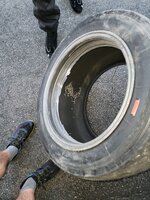
Cut wheel.jpeg
 
Alignment Topics are always my favourite so many misconceptions about what makes tires happy on track. First as steveespo pointed out Alignment is very track dependent especially the toe part as this affect how the car balance is on turn-in/corner exit more than Camber does. Camber is mostly there to protect the outer shoulder during mid corner and hopefully to provide enough support during braking events (aka ideal camber).

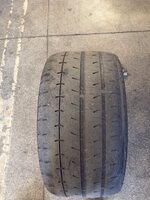
I personally run F: -3.2 camber, 0.2 toe-out total, R: -1.5 camber 0.2 toe-in rear here is how my front tires Yoko A052 (295/35/19) looked after 130 laps (242 miles) and around 6000 miles of road use. IMG_0008 (2).jpeg

So even though A052 prefer a lot of camber I was actually cording them on the inside edge. This tires were never rotated front to back and left to right so that's mostly why but As you can see from the threads this held amazing. And was actually even more impressive as a street tire than as a very fast Track Tire multiple new PB's on this set. For 8 season of track driving that is the only tire I bought second time.

In terms of alignment it's remarkable how the alignment change after a few days on track so I suggest you do it often and have a repeatable process. I work with a shop that change my tires and set my alignments for the past 6 seasons so we have a very repeatable way of doing the prep for track.
 
Last edited:

Latest posts

Buy TMO Apparel

Buy TMO Apparel
Top