The Mustang Forum for Track & Racing Enthusiasts

Taking your Mustang to an open track/HPDE event for the first time? Do you race competitively? This forum is for you! Log in to remove most ads.

  • Welcome to the Ford Mustang forum built for owners of the Mustang GT350, BOSS 302, GT500, and all other S550, S197, SN95, Fox Body and older Mustangs set up for open track days, road racing, and/or autocross. Join our forum, interact with others, share your build, and help us strengthen this community!

Suspension soft?

This site may earn a commission from merchant affiliate links, including eBay, Amazon, and others.

That is a lot of information flowing from the southern hemisphere to North America. Thank you. Excellent explanation. Great pictures to illustrate your points. The only thing I could not figure out was "stub axle." But, since you mentioned it is slotted and can gain or lose camber by adjusting it, I think it is one of the mounting areas for the knuckle onto the coil over, with the top of the two bolts holding the knuckle onto the coil over being visible in your photograph taken behind the wheel with the coil over set up showing increased room for the 305 between the wheel and the new coil over assembly as compared to the prior, stock set up.

I had no idea that the stock spring perch on the strut interfered so badly. I need to crawl under and look at mine one of these days. My front wheel and tire, from Ford, are 10.5" wide and 305/30R19.

I do have Magneride. It looks like AJ Hartman has a coil over kit that is compatible with Magneride, but the only one I can find is for 15-17. The one Gunslinger55 posted in a screen capture is 2018-2023, but I cannot find it on the site (AJ Hartman's site is not so user friendly to search). What I notice, however, in looking at the photo, is that it uses the stock spring perch, so it is not going to increase clearance at that point. I don't even know if it would work on my 2024 Dark Horse.

I am also not sure what the advantage would be, other than maybe a wider selection of springs.

It looks like the photo you posted is KW, and they have some sort of Magneride compatible setup that does not utilize the stock spring perch. Looking around at Steeda, there are apparently lots of Magneride compatible options. I guess I have a lot of research to do.

Anyway, thank you for making so much effort to explain this. It is appreciated.
 
Last edited:
That is a lot of information flowing from the southern hemisphere to North America. Thank you. Excellent explanation. Great pictures to illustrate your points. The only thing I could not figure out was "stub axle." But, since you mentioned it is slotted and can gain or lose camber by adjusting it, I think it is one of the mounting areas for the knuckle onto the coil over, with the top of the two bolts holding the knuckle onto the coil over being visible in your photograph taken behind the wheel with the coil over set up showing increased room for the 305 between the wheel and the new coil over assembly as compared to the prior, stock set up.

I had no idea that the stock spring perch on the strut interfered so badly. I need to crawl under and look at mine one of these days. My front wheel and tire, from Ford, are 10.5" wide and 305/30R19.

I do have Magneride. It looks like AJ Hartman has a coil over kit that is compatible with Magneride, but the only one I can find is for 15-17. The one Gunslinger55 posted in a screen capture is 2018-2023, but I cannot find it on the site (AJ Hartman's site is not so user friendly to search). What I notice, however, in looking at the photo, is that it uses the stock spring perch, so it is not going to increase clearance at that point. I don't even know if it would work on my 2024 Dark Horse.

I am also not sure what the advantage would be, other than maybe a wider selection of springs.

It looks like the photo you posted is KW, and they have some sort of Magneride compatible setup that does not utilize the stock spring perch. Looking around at Steeda, there are apparently lots of Magneride compatible options. I guess I have a lot of research to do.

Anyway, thank you for making so much effort to explain this. It is appreciated.
The spring perch sits above the tyre in a stock setup. No clearance issue. Adjustable coilovers it can become an issue dependent on spring rate and therefore length as the adjuster moves up and down the strut leg..

Yeah stub axle was the wrong term, its the knuckle, the part with the wheel bearing assemble bolted to it.
My front wheel and tire, from Ford, are 10.5" wide and 305/30R19.
Can't see you really gaining any camber from the bolts at the bottom of the strut. Ford have really pushed the limit on the stock setup to what everyone has been doing the previous years.
I am also not sure what the advantage would be, other than maybe a wider selection of springs.
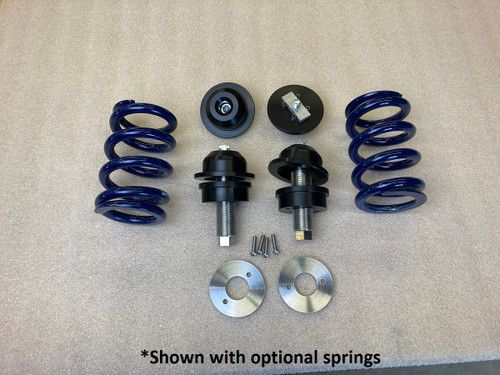
100% this, spring selection. Worth its weight in gold if looking to be quick on track. Team that up with his rear kit to allow simple rear spring selection in any rate and you can tune your ride to suit your requirements.
Pretty sure the magnaride struts are externally the same so his kit will fit all. Give him a call, he has been great to deal with even all the way from Australia. Love his parts. Just wish our dollar was stronger and delivery wasn't drug money levels.

1775565476109.png
 
Last edited:
My biggest stock complaint was feeling the rear steer as the bushes flexed, that unnervered me. Easy fix with spherical bushes, but noisy / clunky. At least I now know what all the clunks relate too.
RLCA Bearings or other bushes ? Control arms bushings are the only bushings left in my car I wonder if I want to change them or not because of NVH lot's other potholes on my streets though.
 
So what is a good spring rate for the front if you track the car, but tracking is not your main use of the car?

I am talking about us poors who have to drive our Mustangs when we go to the grocery store, because we can afford neither a trailered track car nor a trailer nor a truck with which to tow it.

I know, I know, "Stop being poor." Ok, I get it, but humor me. What spring rate would you install for better lap times while still taking the car to church and the grocery store and to meet clients and so on.
 
Who sells the hurst stage 1? Anyone use the nuremburgring setup from steeda? Need to call about spring rates. 211 sounds pretty weak sauce.
AJH setup enticing.

Meanwhile I got 2 more track weekends coming up so this will
be later a later date as tires are front and center
 
So what is a good spring rate for the front if you track the car, but tracking is not your main use of the car?

I am talking about us poors who have to drive our Mustangs when we go to the grocery store, because we can afford neither a trailered track car nor a trailer nor a truck with which to tow it.

I know, I know, "Stop being poor." Ok, I get it, but humor me. What spring rate would you install for better lap times while still taking the car to church and the grocery store and to meet clients and so on.
Are you happy with what you got? It’s better than most. But a 3-400 sounds better for dual use
 
So what is a good spring rate for the front if you track the car, but tracking is not your main use of the car?

I am talking about us poors who have to drive our Mustangs when we go to the grocery store, because we can afford neither a trailered track car nor a trailer nor a truck with which to tow it.

I know, I know, "Stop being poor." Ok, I get it, but humor me. What spring rate would you install for better lap times while still taking the car to church and the grocery store and to meet clients and so on.
All the Springs packages on the market that are just springs are sadly too soft on the front. But the go to at least for the S550 was the BMR SP083, because the rates were very close to the GT350R rates and from the factory the GT350R for me is the car that handles the best. Now the S650 chassis are stiffer than the S550's so you can get away probably with softer springs. Personally I think 450 lbs springs is the minimum upfront for a reasonable track performance. Fun story My car dropped 3 seconds just by adding more Rebound on the Ohlins in other words there is no such thing as too stiff street car for track.
To be fair my Ohlins with the 500 lbs springs upfront ride reasonable well on the street when is on the Street Rebound settings (-14 clicks from full stiff) and is fast on track on the track settings (-6 clicks from full stiff).

So to answer your question if you want to keep Magneride the Dark Horse HP setup is your best bet for a dual car and the AJ coilover kit the best bet for a track car with Magneride. If you want to get serious just move to coilovers and have full control of your suspension.
 
All the Springs packages on the market that are just springs are sadly too soft on the front. But the go to at least for the S550 was the BMR SP083, because the rates were very close to the GT350R rates and from the factory the GT350R for me is the car that handles the best. Now the S650 chassis are stiffer than the S550's so you can get away probably with softer springs. Personally I think 450 lbs springs is the minimum upfront for a reasonable track performance. Fun story My car dropped 3 seconds just by adding more Rebound on the Ohlins in other words there is no such thing as too stiff street car for track.
To be fair my Ohlins with the 500 lbs springs upfront ride reasonable well on the street when is on the Street Rebound settings (-14 clicks from full stiff) and is fast on track on the track settings (-6 clicks from full stiff).

So to answer your question if you want to keep Magneride the Dark Horse HP setup is your best bet for a dual car and the AJ coilover kit the best bet for a track car with Magneride. If you want to get serious just move to coilovers and have full control of your suspension.

Ok, so one vote for 450 minimum (a minimum 213% increase in spring over my stock Dark Horse handling package springs and 50 lbs stiffer than the options AJ Hartman offers on his web site - although we can call him to get stiffer ones). 500 was reasonable on the street, but this was with an after market coil over system.

Thank you, bnight, for responding.

My car is definitely a street car and is not going to be a dedicated track car at any time in the near future. I enjoy driving it on the street, and it is my primary vehicle (the "family" primary vehicle is an Explorer ST, which is my wife's car). This thread has me thinking about using the AJ coilover kit and stiffer springs.

"Fun story My car dropped 3 seconds just by adding more Rebound on the Ohlins in other words there is no such thing as too stiff street car for track." - LOL, that is akin to the difference between removing all weather tires and installing racing slicks. I wonder why the rebound setting had such a drastic effect? I would have thought that rebound would have the least effect, compared to compression.
 
"Fun story My car dropped 3 seconds just by adding more Rebound on the Ohlins in other words there is no such thing as too stiff street car for track." - LOL, that is akin to the difference between removing all weather tires and installing racing slicks. I wonder why the rebound setting had such a drastic effect? I would have thought that rebound would have the least effect, compared to compression.
Mostly was because I had my suspension setup really soft and the car was just so soft taking tons of time to settle in corners. When I stiffen it the car started responding quicker:

This is the original setup:
Build List:
Steeda Oil Separator
FP Strut Tower Brace
Nankang AR-1 305/30/19
Steeda Camber Plates
Steeda Front SwayBar
K&N Air Filter
KB Jacking Rails
Gloc F: R10 R: R8
Goodridge Brake Lines
Exedy Pro-Kit Clutch
Ohlins R&T (515/800)
Apex SM-10 19x11

Settings:
Swaybar: +2 (2nd hole from full soft)
Ohlins: -17 / -19 (clicks from full stiff)


Notice the brakes dive and body roll into corners and how much time it took for car to settle into corners. And how the front is understeering very obvious into the hairpin.

And this is with more rebound:

Build List (bold are differences):
Steeda Oil Separator
FP Strut Tower Brace
Yokohama A052 295/35/19
Steeda Camber Plates
Steeda Front SwayBar
FP Power Pack 3
KB Jacking Rails
Ferodo F: DSUno R: DS2500
Goodridge Brake Lines
Exedy Pro-Kit Clutch
Ohlins R&T
Apex SM-10 19x11
Steeda IRS Base Kit
FP Knuckle Bearings
Steeda Toe-Links
Vorshlag Brake Ducts
Steeda 3" Catback
Front/Rear 2 Piece Rotors
Steeda Diff Inserts
GT500 Valve Covers
GT350 Oil Separator

Settings:
Swaybar: +2 (2nd hole from full soft)
Ohlins: -6/ -6 (clicks from full stiff)


The engine helped but notice how reduced the brakes dive is and how much more planted the car is into corners. This suspension confidence helps a ton in putting the car exactly where you want it. So I was running the soft settings for a long time until at one event I started dialling them up first at that event to -13/-15 that alone dropped 1 second of time to 1:30.5 and then on a second event all the way to -6/-6 dropping lap times to 1:28.875.

The final 1 second to 1:27.75 come when I fixed a bunch of stuff last season Torn Diff bushing and Valve Covers to stop an oil leak and lose of oil pressure as well as finally sort the ABS Ice Mode (DSUno/DS2500 brake pads) and install new A052 tires.

But yeah suspension adds a ton of seconds if you know what you are doing and why.
 
Ok, so one vote for 450 minimum (a minimum 213% increase in spring over my stock Dark Horse handling package springs and 50 lbs stiffer than the options AJ Hartman offers on his web site - although we can call him to get stiffer ones). 500 was reasonable on the street, but this was with an after market coil over system.

Thank you, bnight, for responding.

My car is definitely a street car and is not going to be a dedicated track car at any time in the near future. I enjoy driving it on the street, and it is my primary vehicle (the "family" primary vehicle is an Explorer ST, which is my wife's car). This thread has me thinking about using the AJ coilover kit and stiffer springs.

"Fun story My car dropped 3 seconds just by adding more Rebound on the Ohlins in other words there is no such thing as too stiff street car for track." - LOL, that is akin to the difference between removing all weather tires and installing racing slicks. I wonder why the rebound setting had such a drastic effect? I would have thought that rebound would have the least effect, compared to compression.
If you wanted to add stiffness for the track while maintaining street manners, I think your best option would be AJ's kit at 400 lbs. The factory magneride shocks work quite well for a dual-duty car. Additionally, I hear great things about DSC controllers for magneride. You could look into that option as well.
 
If you wanted to add stiffness for the track while maintaining street manners, I think your best option would be AJ's kit at 400 lbs. The factory magneride shocks work quite well for a dual-duty car. Additionally, I hear great things about DSC controllers for magneride. You could look into that option as well.
I know the Corvette guys have a former Chevrolet engineer with an aftermarket DSC programming that makes both street driving and track driving better. Softer and more comfortable on the street and reduced lap times on the track. They rave about it online. I'd be interested in hearing more about Ford and a DSC controller making improvements. I don't really see any discussion about that, even here on TrackMustangsOnline.

Thanks for chiming in on the spring rate! ;)
 
Mostly was because I had my suspension setup really soft and the car was just so soft taking tons of time to settle in corners. When I stiffen it the car started responding quicker:

This is the original setup:
Build List:
Steeda Oil Separator
FP Strut Tower Brace
Nankang AR-1 305/30/19
Steeda Camber Plates
Steeda Front SwayBar
K&N Air Filter
KB Jacking Rails
Gloc F: R10 R: R8
Goodridge Brake Lines
Exedy Pro-Kit Clutch
Ohlins R&T (515/800)
Apex SM-10 19x11

Settings:
Swaybar: +2 (2nd hole from full soft)
Ohlins: -17 / -19 (clicks from full stiff)


Notice the brakes dive and body roll into corners and how much time it took for car to settle into corners. And how the front is understeering very obvious into the hairpin.

And this is with more rebound:

Build List (bold are differences):
Steeda Oil Separator
FP Strut Tower Brace
Yokohama A052 295/35/19
Steeda Camber Plates
Steeda Front SwayBar
FP Power Pack 3
KB Jacking Rails
Ferodo F: DSUno R: DS2500
Goodridge Brake Lines
Exedy Pro-Kit Clutch
Ohlins R&T
Apex SM-10 19x11
Steeda IRS Base Kit
FP Knuckle Bearings
Steeda Toe-Links
Vorshlag Brake Ducts
Steeda 3" Catback
Front/Rear 2 Piece Rotors
Steeda Diff Inserts
GT500 Valve Covers
GT350 Oil Separator

Settings:
Swaybar: +2 (2nd hole from full soft)
Ohlins: -6/ -6 (clicks from full stiff)


The engine helped but notice how reduced the brakes dive is and how much more planted the car is into corners. This suspension confidence helps a ton in putting the car exactly where you want it. So I was running the soft settings for a long time until at one event I started dialling them up first at that event to -13/-15 that alone dropped 1 second of time to 1:30.5 and then on a second event all the way to -6/-6 dropping lap times to 1:28.875.

The final 1 second to 1:27.75 come when I fixed a bunch of stuff last season Torn Diff bushing and Valve Covers to stop an oil leak and lose of oil pressure as well as finally sort the ABS Ice Mode (DSUno/DS2500 brake pads) and install new A052 tires.

But yeah suspension adds a ton of seconds if you know what you are doing and why.
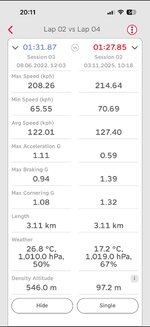
Ok, that makes more sense. That is a lot of changes contributing each a bit to that 3 second reduction. Getting rid of ice mode. Brake pads. Suspension upgrades. power upgrades (your top speed was 13kph higher). But yes, the car does seem more composed when braking and changing directions. Thank you for sharing all of this information.
 
Ok, that makes more sense. That is a lot of changes contributing each a bit to that 3 second reduction. Getting rid of ice mode. Brake pads. Suspension upgrades. power upgrades (your top speed was 13kph higher). But yes, the car does seem more composed when braking and changing directions. Thank you for sharing all of this information.
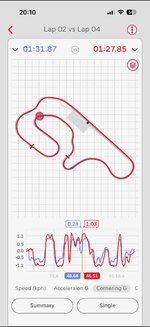
The other changes surely helped as well but if we look more closely into the data you will notice a huge increase in both braking performance (R10/R8) vs (DSuno/OEM Rears) and most importantly cornering G forces: IMG_1523.jpeg

IMG_1524.jpeg

So big difference in grip is mostly from the suspension and Tires. And sure top speed is up as well thanks to the lovely Power Pack 3 and the Steeda Catback but it's not up by that much to account for the difference especially not in the almost 0.3G more lateral grip.
 
And just to add to the topic here is a great video from Suspension Secrets UK where they fit coilovers and tires to a F80 M3 (very similar suspension to the Mustang). I hope you guys enjoy it as this is the closest to a perfect test before/after.

 
So what is a good spring rate for the front if you track the car, but tracking is not your main use of the car?

I am talking about us poors who have to drive our Mustangs when we go to the grocery store, because we can afford neither a trailered track car nor a trailer nor a truck with which to tow it.

I know, I know, "Stop being poor." Ok, I get it, but humor me. What spring rate would you install for better lap times while still taking the car to church and the grocery store and to meet clients and so on.

Second thing first: Unless you're running GT3 car in big-boy racing, if you're driving a Mustang at the track, you're the broke guy in the crowd. That's just how it goes. If you even think you have money, you're in a different car. That's just reality. "Stop being poor" would be great advice for any of us.

On to springs. If I were a chassis guy for Ford, I'd have chosen something like 300/550 for the base GT. If you want a good dual purpose compromise, the 400 front is a good start, but you'll want more front spring if you spend more time on the track. I feel like the stiffer front gets over a lot of bumps better because of the reduced travel. Stock spring rates are less comfortable to me because the damn thing moves too much. I have a bigger problem with rear rates going up than front for ride.

I feel like the stock rear spring rate is what controlled the entire setup at Ford. It feels like to me that the rear spring stiffness was as stiff as the engineers felt they could go for each model and maintain whatever ride metrics they use. The base model should be on a 550 rear. PP, maybe 650? Keep in mind, this is with the stiffer front. You could keep the overall stiffness level about where it is and proportion it to the front. I know what they're trying to do, but it works a lot better on the computer screen than the street or track.

If you run a 400 front and a stock rear, I think you'll have a good street/track comprise. The advantage of AJ's kit with a 750 over stock (same basic rate) is being able to adjust rear ride height. That's a very powerful tuning tool.

The Shelby Magneride dampers are key to the whole thing. Without these, you don't have enough damping to control anything over about 300 #/in. Adding spring without the necessary damping doesn't work nearly as well. I think the Magneride Shelby dampers are about topped out with the 500#/in spring. If I go stiffer, it has to be on a real damper. They are not designed in a way to give high enough damping forces with small piston motion. I think that's an issue with the passive cars, too. They don't have dampers which will really control the stiffness they need without spending some cash. All the 'sport' type dampers are limited by architecture as much as the actual valving.

So there's my guess 400/750.


P.S. The bullish!t spring differences that Ford made from model to model tells me they aren't great on car tuning. They have these 10-20#/in steps that are just meaningless, especially considering how far out of the performance window they were. If someone told me they wanted a 10#/in spring change at the track, I'd laugh at them. FFS, we're talking about a 2-ton car, not a 1/4 midget.
 
The other changes surely helped as well but if we look more closely into the data you will notice a huge increase in both braking performance (R10/R8) vs (DSuno/OEM Rears) and most importantly cornering G forces: View attachment 109695

View attachment 109696

So big difference in grip is mostly from the suspension and Tires. And sure top speed is up as well thanks to the lovely Power Pack 3 and the Steeda Catback but it's not up by that much to account for the difference especially not in the almost 0.3G more lateral grip.
Very nice. I gotta say that max acceleration G may be off on first run. Lateral looks good i
pulled 1.2 in my stock dark horse on track mode. Has more in it. But all it takes is money to get more. That’s why we are here lol
 
Second thing first: Unless you're running GT3 car in big-boy racing, if you're driving a Mustang at the track, you're the broke guy in the crowd. That's just how it goes. If you even think you have money, you're in a different car. That's just reality. "Stop being poor" would be great advice for any of us.

On to springs. If I were a chassis guy for Ford, I'd have chosen something like 300/550 for the base GT. If you want a good dual purpose compromise, the 400 front is a good start, but you'll want more front spring if you spend more time on the track. I feel like the stiffer front gets over a lot of bumps better because of the reduced travel. Stock spring rates are less comfortable to me because the damn thing moves too much. I have a bigger problem with rear rates going up than front for ride.

I feel like the stock rear spring rate is what controlled the entire setup at Ford. It feels like to me that the rear spring stiffness was as stiff as the engineers felt they could go for each model and maintain whatever ride metrics they use. The base model should be on a 550 rear. PP, maybe 650? Keep in mind, this is with the stiffer front. You could keep the overall stiffness level about where it is and proportion it to the front. I know what they're trying to do, but it works a lot better on the computer screen than the street or track.

If you run a 400 front and a stock rear, I think you'll have a good street/track comprise. The advantage of AJ's kit with a 750 over stock (same basic rate) is being able to adjust rear ride height. That's a very powerful tuning tool.

The Shelby Magneride dampers are key to the whole thing. Without these, you don't have enough damping to control anything over about 300 #/in. Adding spring without the necessary damping doesn't work nearly as well. I think the Magneride Shelby dampers are about topped out with the 500#/in spring. If I go stiffer, it has to be on a real damper. They are not designed in a way to give high enough damping forces with small piston motion. I think that's an issue with the passive cars, too. They don't have dampers which will really control the stiffness they need without spending some cash. All the 'sport' type dampers are limited by architecture as much as the actual valving.

So there's my guess 400/750.


P.S. The bullish!t spring differences that Ford made from model to model tells me they aren't great on car tuning. They have these 10-20#/in steps that are just meaningless, especially considering how far out of the performance window they were. If someone told me they wanted a 10#/in spring change at the track, I'd laugh at them. FFS, we're talking about a 2-ton car, not a 1/4 midget.
Agree on most points. That’s why i’m going to buy a purpose built race car if i get serious. But these things can run good on a track and street. And a good trainer
 
Second thing first: Unless you're running GT3 car in big-boy racing, if you're driving a Mustang at the track, you're the broke guy in the crowd. That's just how it goes. If you even think you have money, you're in a different car. That's just reality. "Stop being poor" would be great advice for any of us.

On to springs. If I were a chassis guy for Ford, I'd have chosen something like 300/550 for the base GT. If you want a good dual purpose compromise, the 400 front is a good start, but you'll want more front spring if you spend more time on the track. I feel like the stiffer front gets over a lot of bumps better because of the reduced travel. Stock spring rates are less comfortable to me because the damn thing moves too much. I have a bigger problem with rear rates going up than front for ride.

I feel like the stock rear spring rate is what controlled the entire setup at Ford. It feels like to me that the rear spring stiffness was as stiff as the engineers felt they could go for each model and maintain whatever ride metrics they use. The base model should be on a 550 rear. PP, maybe 650? Keep in mind, this is with the stiffer front. You could keep the overall stiffness level about where it is and proportion it to the front. I know what they're trying to do, but it works a lot better on the computer screen than the street or track.

If you run a 400 front and a stock rear, I think you'll have a good street/track comprise. The advantage of AJ's kit with a 750 over stock (same basic rate) is being able to adjust rear ride height. That's a very powerful tuning tool.

The Shelby Magneride dampers are key to the whole thing. Without these, you don't have enough damping to control anything over about 300 #/in. Adding spring without the necessary damping doesn't work nearly as well. I think the Magneride Shelby dampers are about topped out with the 500#/in spring. If I go stiffer, it has to be on a real damper. They are not designed in a way to give high enough damping forces with small piston motion. I think that's an issue with the passive cars, too. They don't have dampers which will really control the stiffness they need without spending some cash. All the 'sport' type dampers are limited by architecture as much as the actual valving.

So there's my guess 400/750.


P.S. The bullish!t spring differences that Ford made from model to model tells me they aren't great on car tuning. They have these 10-20#/in steps that are just meaningless, especially considering how far out of the performance window they were. If someone told me they wanted a 10#/in spring change at the track, I'd laugh at them. FFS, we're talking about a 2-ton car, not a 1/4 midget.
One problem is if you are self made it takes a while to stop bring poor. That is an issue of great significance in racing but spending my kids inheritance to do what i always wanted to do is a good thing as well lol. I may end up in miata’s but i can afford better stuff now. I kinda wish i just bought a TA2 car but the dark horse is pretty nice and i am learning a lot. You guys are great for my catch up ;)
 

Buy TMO Apparel

Buy TMO Apparel
Top