The Mustang Forum for Track & Racing Enthusiasts

Taking your Mustang to an open track/HPDE event for the first time? Do you race competitively? This forum is for you! Log in to remove most ads.

  • Welcome to the Ford Mustang forum built for owners of the Mustang GT350, BOSS 302, GT500, and all other S550, S197, SN95, Fox Body and older Mustangs set up for open track days, road racing, and/or autocross. Join our forum, interact with others, share your build, and help us strengthen this community!

Advice on setting up my car for gain confidence

This site may earn a commission from merchant affiliate links, including eBay, Amazon, and others.

14
17
Exp. Type
HPDE
Exp. Level
Under 3 Years
Miami
Hello everyone, I have been reading the forums for a while and have gotten great advice but I am at a point with my car where I am not sure what to do.
I have a 2017 mustang Gt PP that I am taking to HPDE events and I want to learn how to drive the car but is doing things that are making me not comfortable to try and push it and learn.

I had the car since 2017 and began HPDE in 2019 but life happened and I could not afford to go anymore, but I recently started going again and I am experiencing a lot of instability in the car and not sure what to do to try and minimize this. On hard braking on the straight the car moves around allot and also sometimes when turning back feels like its kind of bouncy or something. I'm not sure if this is the suspension or the brakes. I will put a full mod list bellow and then get back to details.

A lot of these mods are not recent as I was prepping it for the track back in the day. Will note when something is newer.


For the front I have:
-Steeda bump steer kit
-Lateral Link w/ extended Ball joint

Rear:
-BMR vertical link
-BMR cradle lock out
-BMR Subframe Bushings,
-BMR rear LCA bushing
-BMR Diff Inserts
-BMR Toe Links
-Steeda Strut Mount(Als have a set of BMR)


DBA t3 4000 rotors, Stock Brembo Pads
Stock PP wheels with Nitto 555
Tires and brakes got installed this year

I currently have a 2 way coil over setup that was gifted to my by a friend that started a suspension company. It's called Cerberus. Its 32 way adjustable for rebound and compression.
The cars ride heigh is about 24.25/24.5inch from the bottom of the rim to the wheel arch.
Camber is F -2.7 R -2
Toe F 0 R -1/16
Spring rates:
Front: 12KG = 672
Rear: 15KG = 840

Last time out on track (Homestead) I had Rebound 14 and Compression at 7 Overall the car performed well but under hard braking the car started moving around allot, not uncontrollable but scary and something I had to get used to.

After, I got the car re aligned for my next event but i did notice that the rear was slightly off side to side with settings. One side was R 14 C7 The other was R13/12 C 6/5 the clicks are a little weird so its hard to tell sometimes where it is.

I tried R18 C8 all around and car felt really stable but when i Braked the front felt like it was skipping. ( on the street)

After I tried R12 C6 in the front and left the rear as is. It felt more stable. so i tried putting front and rear to R12 C6. The car feels soft in general but it felt better. I did a few more hard brake test but after a few test on the street it felt like it was moving again, even pulling to one side, so not sure if this a brake thing or a suspension thing. I have a track day coming up and will try different setting to see.
Also sometimes when turning the rear feels like its getting unsettled and almost bouncing up, especially on softer settings.

Before this I had a FFP struts with the BMR handling springs combo. I think that setup was pretty nice. I am thinking of ditching these coil overs and going back to them. I just want to simply drive and learn and not have to deal with this. But at the same time I am not sure if it is a possible brake issue since the brakes are new. Not sure If i should spend the time to swap them out or just keep trying to dial this in but then what if I swap it and nothing changes.

I still drive this on the street but ultimately i don't mind having it setup for the track mostly

Any advice would be greatly appreciated. Thanks in advanced!
 
Are you still in touch with your friend that built the 2-way shocks? Google pointed me in the general direction of this defunct Shopify site - www.cerberusgarage.com. Are they adjusting high- or low-speed damping? Did he give you a dyno sheet for each shock showing adjustment sweep? How did you determine the original R14/C7 settings; are they based on critical damping for the spring rates? How much experience tuning shocks do you have?

With just what you've told us, my shoot-from-the-hip advice would be to put the FRPP shocks & BMR springs back on. It's a popular set of items with good reputations and you liked the feel. If you have a brake problem, you'll still have it afterwards and you've used the suspension swap to diagnose it. But I have a feeling that it's the shocks that are giving you grief.

If you want to take a final swing at the 2-ways, try (assuming equal steps in each adjustment, and a lower number is "softer") R12/C8 in front, and R8/C6 in the rear. This is just me spit-ballin' with no dyno charts or knowledge of what the adjusters do, solely based on your descriptions of how the car feels. The front R12 is to keep the front suspension from "pattering" over small bumps and the C8 is to give "support" under braking and turn-in. For the rear, the R8 is to let the shock extend under braking, and C6 is to keep from generating too much load transfer to the outside rear in the transition from straight-line braking to turning while trail-braking. I could be completely wrong with all of this. I'm not even sure if you're talking about rear-end stability under initial braking, trail-braking, or both.

Here's the thing -- the more knobs you have to play with, the more chances you have of getting the settings wrong. If you're still developing your track skills, you want a stable, consistent car that you can trust, not one that is a white-knuckle thrill ride of evil, snappy handling constantly trying to put you into the nearest tire wall. When you want to learn to ride a horse, do they put you on the bucking bronco or Steady Eddie?

It could be that the fancy shocks need a rebuild, or the adjusters aren't doing what you think they're doing (no fault of your own - see horror stories in link below). Your friend may have had all the best intentions, but designing and building "good or better" adjustable shocks at small scale and maintaining consistency is extremely difficult. Especially if they're supposed to work with higher spring rates. And all high-end shocks need regular service, as in every few months to every few years, and that's when just driving on smooth tracks. Hitting a pothole can bend a shaft, damage a seal, etc.

Also, what tires are you running? I'm not up on S550 rear spring rates, but the front spring rates are up there for street tires.
 
Are you still in touch with your friend that built the 2-way shocks? Google pointed me in the general direction of this defunct Shopify site - www.cerberusgarage.com. Are they adjusting high- or low-speed damping? Did he give you a dyno sheet for each shock showing adjustment

Also, what tires are you running? I'm not up on S550 rear spring rates, but the front spring rates are up there for street tires.
The front rate is right where he needs to be. I have no idea what type of adjuster you're dealing with or how you're counting the clicks, but you want to run the front compression relatively stiff and the front relatively soft. Just wildly guessing at his the shocks might be valve, if recommend starting at 75% of full stiff front compression and 25% of full stiff front rebound.

This will support the nose while braking and keep the front end from packing down over brake zone bumps. On the rear, do the opposite. Stiffer rebound and softer compression.

Also, a lower rear ride height (or potentially even a higher front) could help as well. You've got enough spring rate that you're not nose-diving the car excessively. Less static rake in the chassis will help.

Keep your front hot pressures 2 psi higher than your rears.
 
Hello everyone, I have been reading the forums for a while and have gotten great advice but I am at a point with my car where I am not sure what to do.
I have a 2017 mustang Gt PP that I am taking to HPDE events and I want to learn how to drive the car but is doing things that are making me not comfortable to try and push it and learn.

I had the car since 2017 and began HPDE in 2019 but life happened and I could not afford to go anymore, but I recently started going again and I am experiencing a lot of instability in the car and not sure what to do to try and minimize this. On hard braking on the straight the car moves around allot and also sometimes when turning back feels like its kind of bouncy or something. I'm not sure if this is the suspension or the brakes. I will put a full mod list bellow and then get back to details.
My 2017 is also moving to the Right during braking most noticeably on the braking after the long straight:


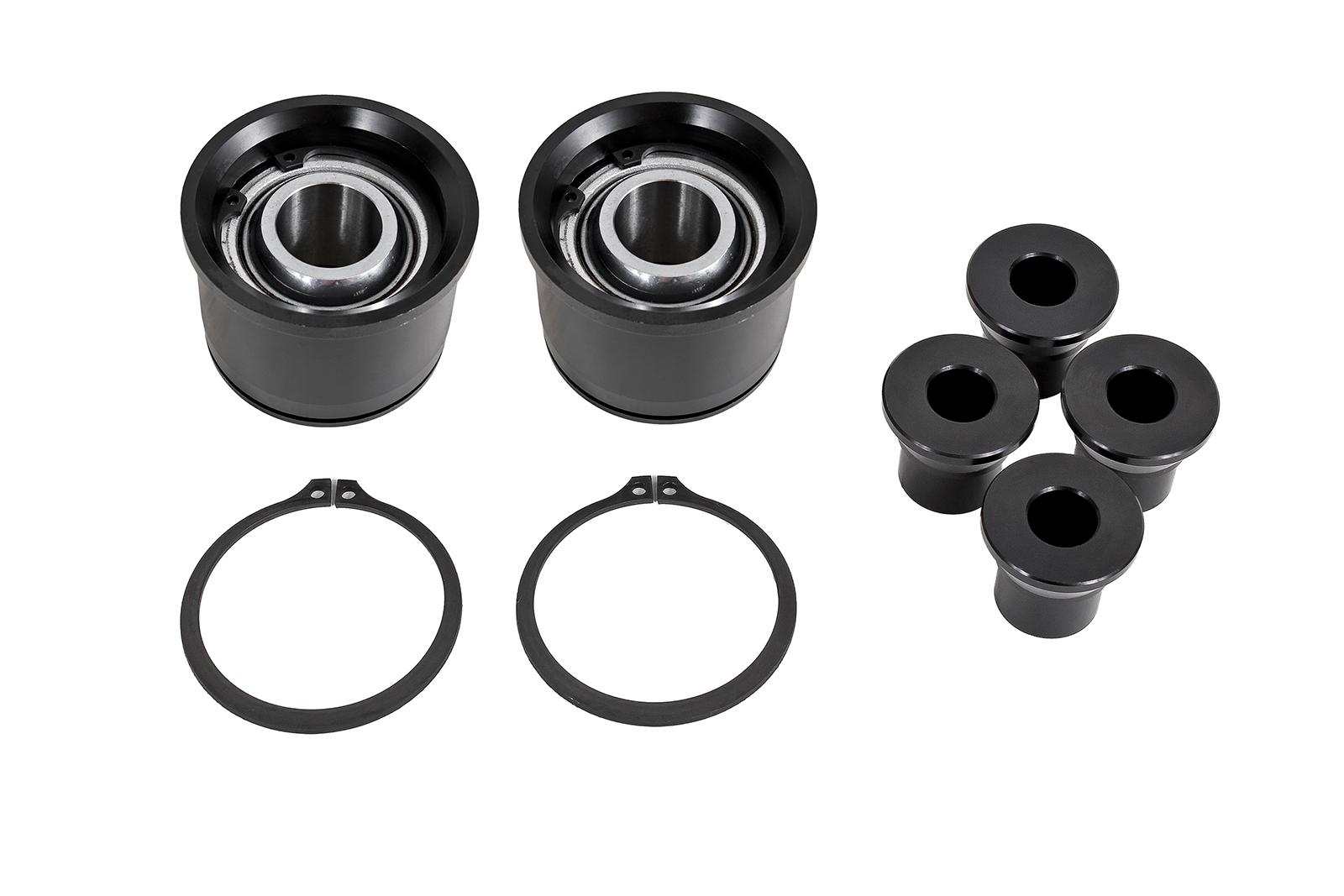
It's doing it for some time actually. I would advice you to first start by checking your rear wheel hubs because the bouncy feeling especially over bumps is usually wheel hubs most often left rear wheel hub. Once you checked that on lowered cars control arms bushings are the next to cause issues that's why most track cars actually run solid bearings in the case of factory track cars for Ford that bearings are Cortex:


I personally am still on the soft rubber bushings and will be changing them as my wheel hubs are actually ok. Hope this helps.
 
Are you still in touch with your friend that built the 2-way shocks? Google pointed me in the general direction of this defunct Shopify site - www.cerberusgarage.com. Are they adjusting high- or low-speed damping? Did he give you a dyno sheet for each shock showing adjustment sweep? How did you determine the original R14/C7 settings; are they based on critical damping for the spring rates? How much experience tuning shocks do you have?

With just what you've told us, my shoot-from-the-hip advice would be to put the FRPP shocks & BMR springs back on. It's a popular set of items with good reputations and you liked the feel. If you have a brake problem, you'll still have it afterwards and you've used the suspension swap to diagnose it. But I have a feeling that it's the shocks that are giving you grief.

If you want to take a final swing at the 2-ways, try (assuming equal steps in each adjustment, and a lower number is "softer") R12/C8 in front, and R8/C6 in the rear. This is just me spit-ballin' with no dyno charts or knowledge of what the adjusters do, solely based on your descriptions of how the car feels. The front R12 is to keep the front suspension from "pattering" over small bumps and the C8 is to give "support" under braking and turn-in. For the rear, the R8 is to let the shock extend under braking, and C6 is to keep from generating too much load transfer to the outside rear in the transition from straight-line braking to turning while trail-braking. I could be completely wrong with all of this. I'm not even sure if you're talking about rear-end stability under initial braking, trail-braking, or both.

Here's the thing -- the more knobs you have to play with, the more chances you have of getting the settings wrong. If you're still developing your track skills, you want a stable, consistent car that you can trust, not one that is a white-knuckle thrill ride of evil, snappy handling constantly trying to put you into the nearest tire wall. When you want to learn to ride a horse, do they put you on the bucking bronco or Steady Eddie?

It could be that the fancy shocks need a rebuild, or the adjusters aren't doing what you think they're doing (no fault of your own - see horror stories in link below). Your friend may have had all the best intentions, but designing and building "good or better" adjustable shocks at small scale and maintaining consistency is extremely difficult. Especially if they're supposed to work with higher spring rates. And all high-end shocks need regular service, as in every few months to every few years, and that's when just driving on smooth tracks. Hitting a pothole can bend a shaft, damage a seal, etc.

Also, what tires are you running? I'm not up on S550 rear spring rates, but the front spring rates are up there for street tires.
I am, I asked him and he told me he does not have a dyno sheet and that the coils are high speeds dampening, although I am not sure that is the case because whenever I adjust settings what changes to me are the way the car transfers weight, like body roll/ brake dive/ squat under acceleration. This is my first time tuning shocks, after some research online people said to do a 2:1 or 3:1 compression ratio for rebound and compression. Read that softer is usually better so I started soft until some of the rear instability went away and kept the ratio in mind.

The instability under braking comes from threshold braking, it is initially fine but when the car begins to slow down more that's when it starts to wiggle I actually went to the track yesterday and got some footage that I will be posting once I find a good lap to clip.
I had brought the car to get an alignment and my guy has been racing for years. He tested the rear shock by pressing on the rear quarter panels and I could notably see that one side was softer then the other. Went back home and redid the settings, everything matched and one side was still softer so i put one click of Compression down on one side and it seemed to even out more, so my suspicion is that the shock are not behaving the same and are off a tad. I also noticed that in the front One shock had 32 clicks of rebound and the other had 33 ( weird as hell)

My tires are Nitto 555 g2, I have stock PP1 wheels so 255 and 275. I eventually want to get an 11 square setup not sure If i will do 19 or 18 just yet.

I plan to go back on track in June and will most likely go back to my FFP/BMR setup.
 
The front rate is right where he needs to be. I have no idea what type of adjuster you're dealing with or how you're counting the clicks, but you want to run the front compression relatively stiff and the front relatively soft. Just wildly guessing at his the shocks might be valve, if recommend starting at 75% of full stiff front compression and 25% of full stiff front rebound.

This will support the nose while braking and keep the front end from packing down over brake zone bumps. On the rear, do the opposite. Stiffer rebound and softer compression.

Also, a lower rear ride height (or potentially even a higher front) could help as well. You've got enough spring rate that you're not nose-diving the car excessively. Less static rake in the chassis will help.

Keep your front hot pressures 2 psi higher than your rears.
When i turn the rebound knob to the higher setting the shaft come sup slower which is a softer rebound I think? So 5 click of rebound the shaft comes up faster and 32 it comes up very slowly.
And when I turn the compression to the higher setting its harder to press the shaft in.
So 75% front compression would be 24 clicks and 25% rebound would be 8 Clicks? Or should this be reversed ?|

My rear is slightly higher right now I believe But the entire car is already lowered a fair amount.

I tried the 2 psi higher in the front. It felt OK
 
My 2017 is also moving to the Right during braking most noticeably on the braking after the long straight:


It's doing it for some time actually. I would advice you to first start by checking your rear wheel hubs because the bouncy feeling especially over bumps is usually wheel hubs most often left rear wheel hub. Once you checked that on lowered cars control arms bushings are the next to cause issues that's why most track cars actually run solid bearings in the case of factory track cars for Ford that bearings are Cortex:


I personally am still on the soft rubber bushings and will be changing them as my wheel hubs are actually ok. Hope this helps.
Looking at the video I think my cars moves in a similar way, I will post a video later this week when I have some time of one of my laps.

I already have the upgrade LCA for the rears but not Cortex( they are beautiful btw)
The front has the the Steeda extended lower control arms but I think the bushings are stock.
 
Looking at the video I think my cars moves in a similar way, I will post a video later this week when I have some time of one of my laps.

I already have the upgrade LCA for the rears but not Cortex( they are beautiful btw)
The front has the the Steeda extended lower control arms but I think the bushings are stock.
The Steeda Extended control arms have poleretan bushings in them at least that's my understanding they are different than stock. If you already had your LCA's done assuming it's Bearings (Uniballs) than that should be enough to tame it. Again I suggest to check your wheel hub bearings as they fail a lot on track.
 
When i turn the rebound knob to the higher setting the shaft come sup slower which is a softer rebound I think? So 5 click of rebound the shaft comes up faster and 32 it comes up very slowly.
And when I turn the compression to the higher setting its harder to press the shaft in.
So 75% front compression would be 24 clicks and 25% rebound would be 8 Clicks? Or should this be reversed ?|

My rear is slightly higher right now I believe But the entire car is already lowered a fair amount.

I tried the 2 psi higher in the front. It felt OK

I was speaking about forces, not clicks when saying 25/75%. There are several different ways at providing adjustment on a damper. It's tough to know whether your adjuster is a needle/seat adjuster or something that preloads a spring/shim stack.

A slower shaft return means higher damping forces. Because of this, my recommendation means Front Comp: 24 clicks and Front Reb: 8 clicks. Reverse it on the rear.

Having said this, I think I was jumping the gun and BNight gave you some really good ideas. The stock car has rear bushings in the rear lower forward tub mount and the rear toe-link tub mount. Both of these should be replaced with monoballs to avoid the rear steer that happens due to bushing deflection. The rear subframe bushings are the same story. Stiffening all of these up makes a big difference to the stability of the rear of the car. The rear wheel bearings are very important maintanance items and will cause a lot of instability if they've started to go wrong.

FWIW, because apparently this to be a big deal lately, I have a dyno in my garage and build a fair number of dampers.
 
The Steeda Extended control arms have poleretan bushings in them at least that's my understanding they are different than stock. If you already had your LCA's done assuming it's Bearings (Uniballs) than that should be enough to tame it. Again I suggest to check your wheel hub bearings as they fail a lot on track.
For the LCA this is what I have.

Forgot to mention that I replaced both rear wheel hubs not to long ago along with the Steeda Extended control arms( I had them already and they went bad) Front Wheels hubs seemed to be in good condition at the time. I checked for wheel play before my last event, and everything seemed to be solid.
 
I was speaking about forces, not clicks when saying 25/75%. There are several different ways at providing adjustment on a damper. It's tough to know whether your adjuster is a needle/seat adjuster or something that preloads a spring/shim stack.

A slower shaft return means higher damping forces. Because of this, my recommendation means Front Comp: 24 clicks and Front Reb: 8 clicks. Reverse it on the rear.

Having said this, I think I was jumping the gun and BNight gave you some really good ideas. The stock car has rear bushings in the rear lower forward tub mount and the rear toe-link tub mount. Both of these should be replaced with monoballs to avoid the rear steer that happens due to bushing deflection. The rear subframe bushings are the same story. Stiffening all of these up makes a big difference to the stability of the rear of the car. The rear wheel bearings are very important maintanance items and will cause a lot of instability if they've started to go wrong.

FWIW, because apparently this to be a big deal lately, I have a dyno in my garage and build a fair number of dampers.
Got it! I was just trying to translate it into clicks when you mentioned the percentages. I believe it is a needle/seat adjuster.

The rear has been upgraded pretty well. I have the solid Spherical bearing from BMR and the Ford performance bearing for the toe-link tub mount. I replaced this when I did the wheels hubs not to long ago.
https://www.steeda.com/knuckle-to-t...lEJMfwFmXDDPkTrfjCy-ODa9WFEerZtUxZJt9BOLNy5-d

Since most of these things have been addressed I think it's either the suspension setting or the quality of the suspension/coil overs them self. I think that the amount of click don't adjust the same amount on either side.

I will test out your suggestion for coil adjustments and test it out on the street. I think ultimately I think I will go back to my FFP/ BMR combo for my next track day.
 
I will test out your suggestion for coil adjustments and test it out on the street. I think ultimately I think I will go back to my FFP/ BMR combo for my next track day.

Quality coil-overs have the potential to be much better than the stock-type damper because they have a better internal architecture. The problem is that sometimes the people valving them don't have the faintest clue what they're doing. Also, there's very few which I could call 'quality.' If it's not an inverted strut, then I really don't want to know about it.

Here is kind of a low-cost coil-over progression of what you can get with a manufacturer I'd trust.

The Bilstein B12 is $1300. That's not too bad for a start. They use funky springs.
The KW V1's are $2300. I think there's probably more thought put into the valving with the KW's. They use normal springs.
H&R TrackPro is $3200. These are the first version with an inverted strut, which means they're the first actually worth owning.
Ohlins are $4000 with camber plates and rear damper mounts. These are the bang/buck winner. Ford should make these an option.
MCS doubles package is $6k. Triples are $7500.
Penskes come over a broad range that starts at $8k and goes as far as you want to take it.
Mutlimatic DSSV's off the GT4 are $20k-ish?
I don't know how much the DHR dampers go for. They might be an interesting option?


It's all about how much going faster is worth to you.
 
Got it! I was just trying to translate it into clicks when you mentioned the percentages. I believe it is a needle/seat adjuster.

The rear has been upgraded pretty well. I have the solid Spherical bearing from BMR and the Ford performance bearing for the toe-link tub mount. I replaced this when I did the wheels hubs not to long ago.
Based on your parts list looks like you have everything installed but you are lacking one very important component (Endlinks) my car was very annoying because the OEM toe links got soft and there were knocks over bumps etc. I went with Whiteline and that solved the rear feeling uneasy over bumps.

Regarding shock settings they are timing devices Rebound control how fast the car transfer weight front-to-back and Compression how the car recover from hitting curbs and potholes (overall you want compression to be as soft as possible) while Rebound especially on Mustang is a bit more complicated: Stiffening the front (More rebound) makes it more responsive but it also leads to understeer in mid corner and corner exit since the rear been Softer has more grip.

Overall when you are setting your suspension you always have to start with the front: Start from full soft Rebound or some neutral settings like middle of the adjustment range go on track and notice how the car changes add 2 clicks or so to front rebound until the point the car starts to understeer on Entry (it will be doing it when full soft as well so hard to judge) then ones you start skipping under braking and car understeer into the entry dial 2 clicks back. Now you can focus on the rear ether same number of clicks or +-2 depending on what you like in a car (Understeer/Neutral/Oversteer) rule of thumb is that the car has to oversteer on entry and to be Neutral on corner exit so you overall want to keep the rear 2 clicks or so Softer than the front (this will result in better corner exit).

Hope this helps and explains the logic.
 
Last edited:
Quality coil-overs have the potential to be much better than the stock-type damper because they have a better internal architecture. The problem is that sometimes the people valving them don't have the faintest clue what they're doing. Also, there's very few which I could call 'quality.' If it's not an inverted strut, then I really don't want to know about it.

Here is kind of a low-cost coil-over progression of what you can get with a manufacturer I'd trust.

The Bilstein B12 is $1300. That's not too bad for a start. They use funky springs.
The KW V1's are $2300. I think there's probably more thought put into the valving with the KW's. They use normal springs.
H&R TrackPro is $3200. These are the first version with an inverted strut, which means they're the first actually worth owning.
Ohlins are $4000 with camber plates and rear damper mounts. These are the bang/buck winner. Ford should make these an option.
MCS doubles package is $6k. Triples are $7500.
Penskes come over a broad range that starts at $8k and goes as far as you want to take it.
Mutlimatic DSSV's off the GT4 are $20k-ish?
I don't know how much the DHR dampers go for. They might be an interesting option?


It's all about how much going faster is worth to you.
This is a great list that I will keep in mind for the future.

I would much rather spend my money on consumables and track days at this point before I invest more into a new suspension setup.
 
Based on your parts list looks like you have everything installed but you are lacking one very important component (Endlinks) my car was very annoying because the OEM toe links got soft and there were knocks over bumps etc. I went with Whiteline and that solved the rear feeling uneasy over bumps.

Regarding shock settings they are timing devices Rebound control how fast the car transfer weight front-to-back and Compression how the car recover from hitting curbs and potholes (overall you want compression to be as soft as possible) while Rebound especially on Mustang is a bit more complicated: Stiffening the front (More rebound) makes it more responsive but it also leads to understeer in mid corner and corner exit since the rear been Softer has more grip.

Overall when you are setting your suspension you always have to start with the front: Start from full soft Rebound or some neutral settings like middle of the adjustment range go on track and notice how the car changes add 2 clicks or so to front rebound until the point the car starts to understeer on Entry (it will be doing it when full soft as well so hard to judge) then ones you start skipping under braking and car understeer into the entry dial 2 clicks back. Now you can focus on the rear ether same number of clicks or +-2 depending on what you like in a car (Understeer/Neutral/Oversteer) rule of thumb is that the car has to oversteer on entry and to be Neutral on corner exit so you overall want to keep the rear 2 clicks or so Softer than the front (this will result in better corner exit).

Hope this helps and explains the logic.
I have been looking at end links for a while, will put it on my list.

My car is stranded right now because my rear brakes got cooked. But as soon as parts come in I will go and test it out. Will try both your suggestions and TeeLew.
Will let you know how the car feels after.
 
This is a great list that I will keep in mind for the future.

I would much rather spend my money on consumables and track days at this point before I invest more into a new suspension setup.
Tires and track time (with instruction) may be your best investment.
 
Top