The Mustang Forum for Track & Racing Enthusiasts

Taking your Mustang to an open track/HPDE event for the first time? Do you race competitively? This forum is for you! Log in to remove most ads.

  • Welcome to the Ford Mustang forum built for owners of the Mustang GT350, BOSS 302, GT500, and all other S550, S197, SN95, Fox Body and older Mustangs set up for open track days, road racing, and/or autocross. Join our forum, interact with others, share your build, and help us strengthen this community!
ED1_2507.jpg

S550 Honey Badger GT350 Build Build Thread Profile - S550 Mustangs

Modified GT350 called the Honey Badger

This site may earn a commission from merchant affiliate links, including eBay, Amazon, and others.

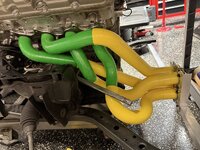
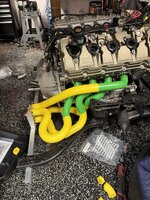
okay - I might have figured out the driver side. need to do some final checks tomorrow before ordering pipe. 10in of 1.875", 18in of 2.0" into collectors. Cylinders 5/8 and 6/7 are paired together to maximize scavenging.

View attachment 106067

Took a couple of hours collectively of playing around. used a combo of 2.5 and 3in CLR and straight blocks for the 1.875 section and then a collection 3, 4, 6 CLR and straight for the 2in section.
I am so excited to see the results! This is epic (I mean this whole build has been epic over the years, but still, custom equal length headers?! I'm in love even more!
 
Okie dokie - sitll in a waiting period on the exhaust as I wait for the last of my materials to get in. In the meantime, I've started working on wiring updates. I've moved the PDM/Ecu to the front passenger a-pillar wall, so I am adding some new sensors and reconfiguring stuff.

Now that I've got a year plus of using the car under my belt, I have a better idea of what I want to measure. I'm really focused on measuring cooling efficiency and getting some more data points to predict early engine issues. Here's a comprehensive list of I've built (which help from ChatGPT to format/strategize)


Engine sensors used now
  • MAP — main plenum
    • Use: Primary load signal for speed-density fueling, ignition, and baro-corrected torque modeling. Helps diagnose air leaks (idle MAP drift).
  • IAT — plenum/runner, fast tip
    • Use: Air-density calc + temp-based spark trims. Heat-soak vs airflow diagnostics (IAT drop vs RPM/MPH).
  • Oil pressure — remote filter/engine feed (post-filter)
    • Use: Primary protection: min-pressure vs RPM curve, staged trims/cuts. Trend bearing health (hot-idle P).
  • Oil temperature — remote filter/engine feed (post-filter)
    • Use: Viscosity window (target 100–120 °C), warm-up logic, derates if oil too hot. Correlate with pressure to spot thinning/cavitation.
  • Fuel pressure — rail feed/end
    • Use: Maintain ΔP_fuel = Rail − MAP at regulator setpoint. Alarms/cuts on drop; diagnose pump, filter, or pickup issues.
  • Fuel temperature — Fuel return off rails (combined with ethanol sensor)
    • Use: Vapor-lock/hot-soak management, compensation for density; diagnose return-line heat.
  • Ethanol content — Fuel return off rails
    • Use: Blend maps (fuel, spark, cold start) and failsafe if content swings suddenly.
  • Cylinder-head water temp (L/R) — each head
    • Use: Spot bank imbalance/hotspots; protect against localized boiling; drive fan/pump bias if supported.
  • Coolant temp (hot/outlet) — head Y-block
    • Use: True engine outlet temp for fans, pump duty, and over-temp protection. (This replaces swirl-pot temp.)
  • Coolant pressure (hot side) — Y-block/upper hose
    • Use: Boiling margin & head-lift detection; look for throttle-correlated spikes. Use with cool-side P for ΔP_radiator.
  • Lambda per bank (×2) — each collector
    • Use: Bank-specific fueling safety/trims, misfire/lean detection, lambda-target control.
  • Oil tank temp (bulk) — mid-tank in moving oil
    • Use: Warm-up timing and trend logging (bulk thermal state). Not for protection.
  • OEM CHT — passenger head (aluminum temp)
    • Use: Backup over-temp channel; great for rate-of-rise alarms if coolant sensor fails or de-primes.
Sensors I am adding now
  • Crankcase pressure (dry-sump vac) — cam cover/catch-can
    • Use: Ring seal & scavenge efficiency. Alarm if vacuum collapses at WOT; correlate with tank pressure.
  • Coolant pressure (cool side) — radiator outlet
    • Use: Cavitation margin at pump inlet; with hot-side P gives ΔP_radiator (restriction/airlock indicator).
    • Action: Warn if cool-side P < ~3–5 psi at pace or ΔP_radiator > ~10–12 psi.
  • Coolant temp (cool side) — radiator outlet
    • Use: ΔT_radiator = Thot − Tcold → cooling effectiveness; ducting/fan strategy tuning.
  • Oil pressure (pre-filter) — pressure pump outlet
    • Use: With post-filter P gives ΔP_filter; rising ΔP hot = filter restriction. Early warning before gallery starvation.
  • Oil temp (hottest) — scavenge-out or tank return jet
    • Use: Peak oil temp & cooler sizing check; ensures bulk/tank temp isn’t hiding abuse.
  • Oil tank headspace pressure — tank top, away from return
    • Use: Vent health & NPSH for pressure stage. High +P = vent restriction; too much vacuum = cavitation risk.
  • Exhaust gas temp on each primary — 100–150 mm from ports
    • Use: Per-cyl balance, lean-out/misfire detection, header leak diagnosis, timing limit validation.

Handy derived channels & how you’ll use them
  • ΔP_fuel = Rail − MAP: maintain regulator setpoint; instant lean-risk flag.
  • ΔP_radiator = P_hot − P_cool: restriction/airlock; guides ducting, pump maps.
  • ΔT_radiator = T_hot − T_cool: cooling effectiveness vs speed/fans.
  • ΔP_filter = P_pre-filter − P_post-filter: filter clog monitor.
  • Crankcase_inHg: scavenge/ring seal; loss at WOT triggers check.
  • Bank λ delta: injector/exhaust leak or sensor drift.
 
Okie dokie - sitll in a waiting period on the exhaust as I wait for the last of my materials to get in. In the meantime, I've started working on wiring updates. I've moved the PDM/Ecu to the front passenger a-pillar wall, so I am adding some new sensors and reconfiguring stuff.

Now that I've got a year plus of using the car under my belt, I have a better idea of what I want to measure. I'm really focused on measuring cooling efficiency and getting some more data points to predict early engine issues. Here's a comprehensive list of I've built (which help from ChatGPT to format/strategize)


Engine sensors used now
  • MAP — main plenum
    • Use: Primary load signal for speed-density fueling, ignition, and baro-corrected torque modeling. Helps diagnose air leaks (idle MAP drift).
  • IAT — plenum/runner, fast tip
    • Use: Air-density calc + temp-based spark trims. Heat-soak vs airflow diagnostics (IAT drop vs RPM/MPH).
  • Oil pressure — remote filter/engine feed (post-filter)
    • Use: Primary protection: min-pressure vs RPM curve, staged trims/cuts. Trend bearing health (hot-idle P).
  • Oil temperature — remote filter/engine feed (post-filter)
    • Use: Viscosity window (target 100–120 °C), warm-up logic, derates if oil too hot. Correlate with pressure to spot thinning/cavitation.
  • Fuel pressure — rail feed/end
    • Use: Maintain ΔP_fuel = Rail − MAP at regulator setpoint. Alarms/cuts on drop; diagnose pump, filter, or pickup issues.
  • Fuel temperature — Fuel return off rails (combined with ethanol sensor)
    • Use: Vapor-lock/hot-soak management, compensation for density; diagnose return-line heat.
  • Ethanol content — Fuel return off rails
    • Use: Blend maps (fuel, spark, cold start) and failsafe if content swings suddenly.
  • Cylinder-head water temp (L/R) — each head
    • Use: Spot bank imbalance/hotspots; protect against localized boiling; drive fan/pump bias if supported.
  • Coolant temp (hot/outlet) — head Y-block
    • Use: True engine outlet temp for fans, pump duty, and over-temp protection. (This replaces swirl-pot temp.)
  • Coolant pressure (hot side) — Y-block/upper hose
    • Use: Boiling margin & head-lift detection; look for throttle-correlated spikes. Use with cool-side P for ΔP_radiator.
  • Lambda per bank (×2) — each collector
    • Use: Bank-specific fueling safety/trims, misfire/lean detection, lambda-target control.
  • Oil tank temp (bulk) — mid-tank in moving oil
    • Use: Warm-up timing and trend logging (bulk thermal state). Not for protection.
  • OEM CHT — passenger head (aluminum temp)
    • Use: Backup over-temp channel; great for rate-of-rise alarms if coolant sensor fails or de-primes.
Sensors I am adding now
  • Crankcase pressure (dry-sump vac) — cam cover/catch-can
    • Use: Ring seal & scavenge efficiency. Alarm if vacuum collapses at WOT; correlate with tank pressure.
  • Coolant pressure (cool side) — radiator outlet
    • Use: Cavitation margin at pump inlet; with hot-side P gives ΔP_radiator (restriction/airlock indicator).
    • Action: Warn if cool-side P < ~3–5 psi at pace or ΔP_radiator > ~10–12 psi.
  • Coolant temp (cool side) — radiator outlet
    • Use: ΔT_radiator = Thot − Tcold → cooling effectiveness; ducting/fan strategy tuning.
  • Oil pressure (pre-filter) — pressure pump outlet
    • Use: With post-filter P gives ΔP_filter; rising ΔP hot = filter restriction. Early warning before gallery starvation.
  • Oil temp (hottest) — scavenge-out or tank return jet
    • Use: Peak oil temp & cooler sizing check; ensures bulk/tank temp isn’t hiding abuse.
  • Oil tank headspace pressure — tank top, away from return
    • Use: Vent health & NPSH for pressure stage. High +P = vent restriction; too much vacuum = cavitation risk.
  • Exhaust gas temp on each primary — 100–150 mm from ports
    • Use: Per-cyl balance, lean-out/misfire detection, header leak diagnosis, timing limit validation.

Handy derived channels & how you’ll use them
  • ΔP_fuel = Rail − MAP: maintain regulator setpoint; instant lean-risk flag.
  • ΔP_radiator = P_hot − P_cool: restriction/airlock; guides ducting, pump maps.
  • ΔT_radiator = T_hot − T_cool: cooling effectiveness vs speed/fans.
  • ΔP_filter = P_pre-filter − P_post-filter: filter clog monitor.
  • Crankcase_inHg: scavenge/ring seal; loss at WOT triggers check.
  • Bank λ delta: injector/exhaust leak or sensor drift.
I blame you. Thank you.
;)
I'm pretty sure you are responsible for the largest amount of money being spent on this site. There should be a #tag "Inspired by the HoneyBadger."
1759729939135.png1759730008670.png
 
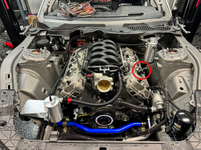
Inevitably I've found myself back here as I plot my dry sump shenanigans. Is the circled object a filter of some sort? Haven't seen one like that before.

View attachment 106982
The item in question i believe.
And an interesting article as to why
 
Yep - you'll want a regulator. the Dailey system will pull north of 20in of vacuum and you can have issues with the main seal, etc. I just threaded that hole with a HUGE 12an tap I bought off Amazon. I have mine set for 14in of vacuum.
 
Yep - you'll want a regulator. the Dailey system will pull north of 20in of vacuum and you can have issues with the main seal, etc. I just threaded that hole with a HUGE 12an tap I bought off Amazon. I have mine set for 14in of vacuum.
Vacuum under the pistons is like an in sump supercharger. Helps in many ways. But as you say too much of a good thing isn't always good. Love the dry sump life. Wish I didn't have so many wish items and not enough $$$$
 
Just a note for those interested - AN fittings use the common SAE UNF "nut & bolt" thread standard.
 
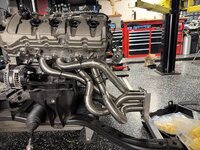
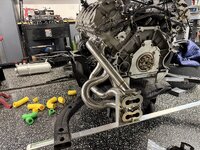
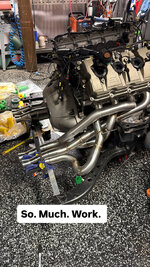
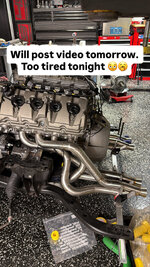
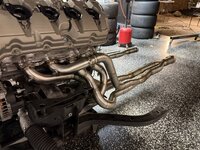
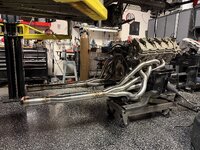
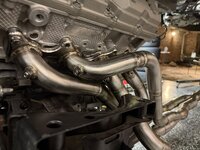
Wow - just realizing how long its been since I've updated this thread. Good lord this project has been more work than I anticipated and I'm STILL not done. Stopped tracking hours on the this exhaust - but well over 100 hours into the headers at this point. I've re-done quite a few parts now to get the fit and finish where I wanted. Learned a lot. Journey below.

As mentioned previously - I used the building blocks to do the routing and figure out what I needed. I'd say they get you 90% of the way there on fitment. Meaning if you take them and translate real tubing to exactly those bits, you'll be 90% accurate. Point I'm trying to make, at these lengths, the real tubing will need some additional massaging to work. This became very clear in two areas - the steering shaft and the starter. Even though I verified like 6x I had clearance, when I did real fit up, I had interference on both 🤪

IMG_0014.jpeg

Tacked real tubing

IMG_0205.jpegIMG_0206.jpeg


Lesson #2, the driver side was not in fact the harder side. I started with that one because I thought working around the steering shaft would be the hardest obstacle. It was not. Turns out I forgot that cylinder number 1 is physically a little further (about 1in) ahead of cylinder 5 due to the offset of the heads/crank. that was just enough to make a similar routing on the passenger unusable. Even with an absolute straight shot from #1, I was over my tolerance limit of +/- 0.5in for equal length primaries. To make it work, I had to rotate the orientation of the first set of collectors from stacked to side by side. Compare this side to aboveIMG_0211.jpeg

I dont really have any pics between this stage and the final weld-up, but let's just say we were in revision hell. I think I re-did like 6 different primaries at some point. Long story short, I tweaked passenger side until I got it right. Then I went back over to the driver side and re-did that one because it would have driven me insane having one set of collectors stacked and one set side-by-side.

0B62AC85-5352-4314-8E41-6B029A6EAE78.jpeg
4ECA6BD1-20B6-4DB2-97FF-F997FF9F5679.jpeg

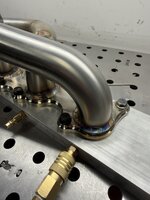
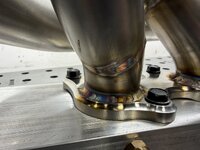
So the primaries are all welded and ready to go. Time to weld them on the flanges! This part was the most fun. Very satisfying welding. To ensure they didn't warp, I got an 18in long, 4in wide, and 1in thick aluminum bar and drilled holes into to make a manifold. The block acted as a heat sink and manifold for distributing purging gas. Can post more if interested.

IMG_0255.jpeg
IMG_0256.jpeg

Once done, I put them on the engine and test fit in the car. We're all done now, right?!?! Lesson #3 incoming. IMG_0261.jpeg

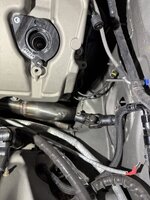
Despite verifying endless times, I proved to be an absolute muppet and literally put a primary directly in the way of the steering. UGH. This is where I stopped taking pictures of progress. Work and life got too busy and I was stealing time in the garage here and there for some me time. so i focused on that. But I did make a ton of progress. I ended up fixing the above by cutting into the frame rail a bit and adding more clearance to shift the shaft over. I also ended up moving the primary tube over towards the head. Will post a pic once I get the engine back in the car. My k-member and motor mounts still needed to be painted.

Then I moved on to the secondaries and final set of collectors. This is where lesson #4 comes in. I had, naively, assumed that once the collectors were in the right general location, I could figure out a routing that worked between the first set of collectors and second. Wrong. I ended up needing to tweak two primaries once again to get them bit more parallel with each other. And then I still had to get creative with the secondary routing. So unfortunately, they're not symmetrical. But they're close enough for me. I thought the secondaries and final collectors would be a night or two to button up. Nope. About 40 hours worth. Good thing no one is paying for my slow ass. ha.

IMG_0305.jpegIMG_0302.jpeg

I also welded in bungs for EGT sensors. So I'll be able to track temps of each cylinder for tuning optimization and catching bad cylinders (i.e. clogged injectors, etc.) early.
IMG_0306.jpeg

Despite the struggles, I think they came out awesome. I'm finalizing the engine mounts and k-member. I ended up getting the engine another 1/2in lower and 1in back, so I'm excited about that. Will share more in the next 2 days or so. Start a 3 week long vacation Wednesday, so hoping to get the beast buttoned up and ready for 2026.
 
Every time i look at your posts i get sent down the rabbit hole. Platinum Racing Products, they are on my side of the globe and have bought from there, so what and why becomes the question.
Just got a lesson on the limits of stock coils and ecu triggering. Don't think I'll ever need the upgrade.
You just keep knocking these mods out of the park, seriously amazed at the lengths you have gone to. Hope it sounds awesome when you get to fire it up. And maybe some more HP or is it torque.
 
Wow - just realizing how long its been since I've updated this thread. Good lord this project has been more work than I anticipated and I'm STILL not done. Stopped tracking hours on the this exhaust - but well over 100 hours into the headers at this point. I've re-done quite a few parts now to get the fit and finish where I wanted. Learned a lot. Journey below.

As mentioned previously - I used the building blocks to do the routing and figure out what I needed. I'd say they get you 90% of the way there on fitment. Meaning if you take them and translate real tubing to exactly those bits, you'll be 90% accurate. Point I'm trying to make, at these lengths, the real tubing will need some additional massaging to work. This became very clear in two areas - the steering shaft and the starter. Even though I verified like 6x I had clearance, when I did real fit up, I had interference on both 🤪

View attachment 107149

Tacked real tubing

View attachment 107148View attachment 107147


Lesson #2, the driver side was not in fact the harder side. I started with that one because I thought working around the steering shaft would be the hardest obstacle. It was not. Turns out I forgot that cylinder number 1 is physically a little further (about 1in) ahead of cylinder 5 due to the offset of the heads/crank. that was just enough to make a similar routing on the passenger unusable. Even with an absolute straight shot from #1, I was over my tolerance limit of +/- 0.5in for equal length primaries. To make it work, I had to rotate the orientation of the first set of collectors from stacked to side by side. Compare this side to aboveView attachment 107146

I dont really have any pics between this stage and the final weld-up, but let's just say we were in revision hell. I think I re-did like 6 different primaries at some point. Long story short, I tweaked passenger side until I got it right. Then I went back over to the driver side and re-did that one because it would have driven me insane having one set of collectors stacked and one set side-by-side.

View attachment 107150
View attachment 107151

So the primaries are all welded and ready to go. Time to weld them on the flanges! This part was the most fun. Very satisfying welding. To ensure they didn't warp, I got an 18in long, 4in wide, and 1in thick aluminum bar and drilled holes into to make a manifold. The block acted as a heat sink and manifold for distributing purging gas. Can post more if interested.

View attachment 107143
View attachment 107144

Once done, I put them on the engine and test fit in the car. We're all done now, right?!?! Lesson #3 incoming. View attachment 107142

Despite verifying endless times, I proved to be an absolute muppet and literally put a primary directly in the way of the steering. UGH. This is where I stopped taking pictures of progress. Work and life got too busy and I was stealing time in the garage here and there for some me time. so i focused on that. But I did make a ton of progress. I ended up fixing the above by cutting into the frame rail a bit and adding more clearance to shift the shaft over. I also ended up moving the primary tube over towards the head. Will post a pic once I get the engine back in the car. My k-member and motor mounts still needed to be painted.

Then I moved on to the secondaries and final set of collectors. This is where lesson #4 comes in. I had, naively, assumed that once the collectors were in the right general location, I could figure out a routing that worked between the first set of collectors and second. Wrong. I ended up needing to tweak two primaries once again to get them bit more parallel with each other. And then I still had to get creative with the secondary routing. So unfortunately, they're not symmetrical. But they're close enough for me. I thought the secondaries and final collectors would be a night or two to button up. Nope. About 40 hours worth. Good thing no one is paying for my slow ass. ha.

View attachment 107140View attachment 107139

I also welded in bungs for EGT sensors. So I'll be able to track temps of each cylinder for tuning optimization and catching bad cylinders (i.e. clogged injectors, etc.) early.
View attachment 107138

Despite the struggles, I think they came out awesome. I'm finalizing the engine mounts and k-member. I ended up getting the engine another 1/2in lower and 1in back, so I'm excited about that. Will share more in the next 2 days or so. Start a 3 week long vacation Wednesday, so hoping to get the beast buttoned up and ready for 2026.
Very nice,! Your welding has improved dramatically.
 
Damn, dude! Impressive. I can feel the frustration re: installing the unit in the car and the steering (still) doesn't fit. Any challenges welding in-between the bolts and primaries on your manifold jig? Man that exhaust looks awesome. Good stuff!!!!!!!!!!
 
Honeybadger, watching you through this project has given me so much inspiration towards my own...keep up the FANTASTIC WORK and inspiration to us all!!!
Appreciate it! I'm just passing on the inspo so many other threads have given me (like Sal's, Nick's, Fred's etc.)
Damn, dude! Impressive. I can feel the frustration re: installing the unit in the car and the steering (still) doesn't fit. Any challenges welding in-between the bolts and primaries on your manifold jig? Man that exhaust looks awesome. Good stuff!!!!!!!!!!
Welding the primaries to the flange was fairly easy. I'd remove the bolt that was in my weld path. And since the flange is thick, it's not nearly as sensitive to heat/torch angle like the 18g tubing is. Pulse settings on the welder also really help keep you from getting in trouble. Some of the EGT bungs were a real bugger, tho. I had to use the bent tungsten trick to get a few spots. I should've put those on before I welded the primaries to the flange, but I forgot.
Very nice,! Your welding has improved dramatically.
I'm definitely getting there! having a ton of fun under the hood!
Every time i look at your posts i get sent down the rabbit hole. Platinum Racing Products, they are on my side of the globe and have bought from there, so what and why becomes the question.
Just got a lesson on the limits of stock coils and ecu triggering. Don't think I'll ever need the upgrade.
You just keep knocking these mods out of the park, seriously amazed at the lengths you have gone to. Hope it sounds awesome when you get to fire it up. And maybe some more HP or is it torque.
Haha. Similarly, I'm learning lots from all the smart folks on your side of the globe. There's a ton of expertise and tremendous pride in workmanship from the folks and businesses I've worked with so far. I hope someday to get to come down and check out your time attack scene. Tons of really nice cars and love the attention to detail so many of the builders have
 
Wow - just realizing how long its been since I've updated this thread. Good lord this project has been more work than I anticipated and I'm STILL not done. Stopped tracking hours on the this exhaust - but well over 100 hours into the headers at this point. I've re-done quite a few parts now to get the fit and finish where I wanted. Learned a lot. Journey below.

As mentioned previously - I used the building blocks to do the routing and figure out what I needed. I'd say they get you 90% of the way there on fitment. Meaning if you take them and translate real tubing to exactly those bits, you'll be 90% accurate. Point I'm trying to make, at these lengths, the real tubing will need some additional massaging to work. This became very clear in two areas - the steering shaft and the starter. Even though I verified like 6x I had clearance, when I did real fit up, I had interference on both 🤪

View attachment 107149

Tacked real tubing

View attachment 107148View attachment 107147


Lesson #2, the driver side was not in fact the harder side. I started with that one because I thought working around the steering shaft would be the hardest obstacle. It was not. Turns out I forgot that cylinder number 1 is physically a little further (about 1in) ahead of cylinder 5 due to the offset of the heads/crank. that was just enough to make a similar routing on the passenger unusable. Even with an absolute straight shot from #1, I was over my tolerance limit of +/- 0.5in for equal length primaries. To make it work, I had to rotate the orientation of the first set of collectors from stacked to side by side. Compare this side to aboveView attachment 107146

I dont really have any pics between this stage and the final weld-up, but let's just say we were in revision hell. I think I re-did like 6 different primaries at some point. Long story short, I tweaked passenger side until I got it right. Then I went back over to the driver side and re-did that one because it would have driven me insane having one set of collectors stacked and one set side-by-side.

View attachment 107150
View attachment 107151

So the primaries are all welded and ready to go. Time to weld them on the flanges! This part was the most fun. Very satisfying welding. To ensure they didn't warp, I got an 18in long, 4in wide, and 1in thick aluminum bar and drilled holes into to make a manifold. The block acted as a heat sink and manifold for distributing purging gas. Can post more if interested.

View attachment 107143
View attachment 107144

Once done, I put them on the engine and test fit in the car. We're all done now, right?!?! Lesson #3 incoming. View attachment 107142

Despite verifying endless times, I proved to be an absolute muppet and literally put a primary directly in the way of the steering. UGH. This is where I stopped taking pictures of progress. Work and life got too busy and I was stealing time in the garage here and there for some me time. so i focused on that. But I did make a ton of progress. I ended up fixing the above by cutting into the frame rail a bit and adding more clearance to shift the shaft over. I also ended up moving the primary tube over towards the head. Will post a pic once I get the engine back in the car. My k-member and motor mounts still needed to be painted.

Then I moved on to the secondaries and final set of collectors. This is where lesson #4 comes in. I had, naively, assumed that once the collectors were in the right general location, I could figure out a routing that worked between the first set of collectors and second. Wrong. I ended up needing to tweak two primaries once again to get them bit more parallel with each other. And then I still had to get creative with the secondary routing. So unfortunately, they're not symmetrical. But they're close enough for me. I thought the secondaries and final collectors would be a night or two to button up. Nope. About 40 hours worth. Good thing no one is paying for my slow ass. ha.

View attachment 107140View attachment 107139

I also welded in bungs for EGT sensors. So I'll be able to track temps of each cylinder for tuning optimization and catching bad cylinders (i.e. clogged injectors, etc.) early.
View attachment 107138

Despite the struggles, I think they came out awesome. I'm finalizing the engine mounts and k-member. I ended up getting the engine another 1/2in lower and 1in back, so I'm excited about that. Will share more in the next 2 days or so. Start a 3 week long vacation Wednesday, so hoping to get the beast buttoned up and ready for 2026.
Wow. In addition to all this diligent, long, hard work, you're getting the engine another 1/2in lower and 1in back! Good on the individual sensors too. Super excited to hear equal length primaries. Should be like the GT3, no? Then there's a trip to the dyno for a fresh tune, I'm bettin'.
 

Buy TMO Apparel

Buy TMO Apparel
Top