3MIN READ
I did a long research on every possible option from hardware prospective to find out if the solution might be the OEM system with better ABS. please bare with me 3minutes.
Where I'm at: 2018+ S550 Performance Pack, moving to sustain 40min NASA ST2, 30–40 min races. car is extremely fast but Ive done only TT with it .
Fronts are the factory 6-piston Brembo, 380x34, running CSG C1 pads
Rear is the OEM single-piston floating caliper, but on a 14" (355.6mm) x 28mm 2-piece rotor with ( now) DTC-30 pads.
I' trying to find a solution to have more braking power in the rear ( to help with stopping time, help more the front especially now I have more rear weight with fuel cell) without hitting ABS ice mode,
which caps how much pad I can run at either end ,sharper front trips it, grippier rear snaps the car. C1/DTC-30 is the compromise I landed on. ( and I tried many pads)
The three options I looked at:
- AP Racing / Essex CP9450 rear kit — $4,849
- Wilwood AERO4-MC4 rear kit — $2,353
- Do nothing, chase it with compound
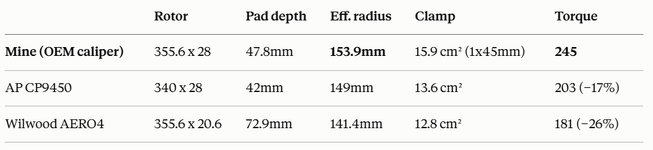
Effective radius = rotor radius − (pad radial depth ÷ 2). That's the lever arm. Torque ∝ clamp area × eff radius × μ. For a floating caliper the single piston area counts once; for a fixed caliper you count one side only.
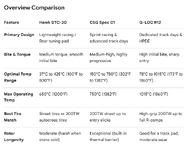
CHECK THE FIRST PICTURE
results :OEM is actually the best for clamping force.
550 OEM rear — 355.6mm x 28mm 2-piece rotor, 47.8mm pad, single 45mm floating piston, 15.9 cm² clamp, 153.9mm eff. radius, torque index 245
Wilwood AERO4 — 355.6mm x 20.6mm rotor, 72.9mm pad, 4-piston fixed (2x 28.4mm per side), 12.8 cm² clamp, 141.4mm eff. radius, torque index 181 (−26%)
AP Racing CP9450 — 340mm x 28mm rotor, 42mm pad, 4-piston fixed, 13.6 cm² clamp, 149mm eff. radius, torque index 203 (−17%)
Both kits are nominally weaker than what I already have. My 45mm floating piston is simply more clamp area than either fixed caliper brings, and my 14" ring already matches the Wilwood's diameter.
Watch the Wilwood line — biggest rotor, shortest lever arm. That 6617 pad is 72.9mm deep and eats 36mm of radius. Rotor diameter alone tells you nothing.
So case close? not yet.
Why the strongest option is still the worst one
A single 45mm piston loads a 149mm-long pad from one point in the middle. Consequences:
Heat concentrates. Same energy into a fraction of the pad. The center band cooks past the compound's ceiling while the pad ends stay cool and contribute nothing. Once μ starts dropping with temperature, it drops in the loaded zone first. it other words, the clamping force is still higher BUT cannot be use 100%.
another point on the single-piston list, and I suspect it's the biggest one:
we said that A floating caliper doesn't push the outboard pad with a piston. The piston pushes the inner pad, and the caliper body slides on its pins and reacts backwards to pull the outer pad in. Every bit of pin friction, stiction and bridge flex is clamp force that never reaches the pad. (I'd estimate 10–15% loss??), worse once the pins are hot and full of cooked grease
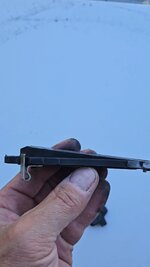
It tapers. The piston pushes at the pad center, friction drag acts at the rotor face, and the offset rotates the pad against its abutment. Nothing resists that with one central piston. My OEM pads came off with one side at end-of-life and the other still half thickness. That's mechanical, not thermal — and I suspect the cocked leading edge clipping into the slots accelerates it, especially on a soft compound.
As it tapers, contact area collapses, so torque bleeds away through a session rather than fading cleanly.
Fluid heat. A 45mm piston face is a wide conduction path from the hottest part of the pad straight into the fluid.
I want to be clear that I can put hard numbers on the torque table but not on these. Iunderstand the concept. but cant talk about real numbers.
The case for 4-piston despite less clamp
Two pistons spread along the pad length apply load at two points and resist the rotation that causes taper. More of the pad works, local pressure drops, heat spreads, wear stays even. Fixed mounting removes slide-pin stiction and hysteresis — which also matters for ABS, since the controller modulates at 10–20 Hz and needs torque to track pressure without lag.
another point on the single-piston list, and I suspect it's the biggest one:
A floating caliper doesn't push the outboard pad with a piston. The piston pushes the inner pad, and the caliper body slides on its pins and reacts backwards to pull the outer pad in. Every bit of pin friction, stiction and bridge flex is clamp force that never reaches the pad. I'd estimate 10–15% loss, worse once the pins are hot and full of cooked grease
The thing that made the decision for me: grippier rear pads make my car snap. So I'm not rear-torque-limited — I have surplus rear torque I can't spend. Losing that 17% ( AP racing kit) nominal costs me nothing usable, and it converts into headroom to run a higher-temperature rear compound and land back near the same axle torque. Right now DTC-30 is my ceiling purely because anything grippier is unstable.
Bias goes from 21.4% rear to 18.4% rear — recoverable with compound. so again, not optimal but is an option.
Where I've landed: AP CP9450, rear only, front untouched. The Wilwood does the same trade but hands me a 20.6mm ring when I'm already on 28mm, which is backwards on the one thing my current setup is genuinely good at. less rotational mass tho. but how much bad would be ?
ONE LAST TEST : pulling the DTC-30s to see if they taper like the OEM pads did ( SEE THE PIC),which I use to helping me with snapping but of course no good for more than 3 laps ( time trials) and checking the slide pins. If the pins are binding that's a chunk of my taper for $50, and it changes the answer.
Questions for YOU :
- What's your thought on this?
- $7K ABS or 9k hardware?
Alessandro
ps.AP RACING front kit is smaller than my oem .Why go below OEM rather than match it? Less piston area means less fluid displacement, so a firmer pedal and with far better pad volume and cooling you don't need more torque. I dont need the peak; I need concistency. and maintain the bias with their smaller rear.
Last edited: