The Mustang Forum for Track & Racing Enthusiasts

Taking your Mustang to an open track/HPDE event for the first time? Do you race competitively? This forum is for you! Log in to remove most ads.

  • Welcome to the Ford Mustang forum built for owners of the Mustang GT350, BOSS 302, GT500, and all other S550, S197, SN95, Fox Body and older Mustangs set up for open track days, road racing, and/or autocross. Join our forum, interact with others, share your build, and help us strengthen this community!

Pulsating braking and turning rotors

This site may earn a commission from merchant affiliate links, including eBay, Amazon, and others.

63
40
Exp. Type
HPDE
Exp. Level
5-10 Years
Indy 46038
I am experiencing pulsating braking during hard braking on track at my last two events.

This is a first for my car. Maybe 10 track weekends with these brakes with no issues before now. Need some experienced input.

  • GT350 brakes
  • OEM rotors and pads (Ferodo) near half life
  • Ti shims added before first of the two events

  • I swapped out the wheels and tried some moderately hard braking on the highway from 80mph. The symptom remains.
  • I checked runout on the outside rotor faces and they were true.
  • I can measure runout of all the wheels, but I think they are true and not the problem.
  • I plan to take out the shims and swap over to my street pads, which are like new.

I want to have this solved before my next event in two weeks, but I prefer not to raise my car and pull back the calipers over and over.

I don't see evidence of non-uniform pad distribution, but maybe that is not scientific anyway.
I tried sanding rotors in the past but I did not observe any material getting removed from the rotor.

Is there any good reason that I cannot simply have the rotors turned to remove pad buildup and start fresh? They have worn only 1/2mm from new thickness.

Thanks.
 
Turning them will help, but you would need to repeat the bedding in process. As far as clearing the original deposits, it takes some repeated hard braking, or a track session to do the job. Look up the gt350 brake bedding procedure to get an example.
 
I am experiencing pulsating braking during hard braking on track at my last two events.

This is a first for my car. Maybe 10 track weekends with these brakes with no issues before now. Need some experienced input.

  • GT350 brakes
  • OEM rotors and pads (Ferodo) near half life
  • Ti shims added before first of the two events

  • I swapped out the wheels and tried some moderately hard braking on the highway from 80mph. The symptom remains.
  • I checked runout on the outside rotor faces and they were true.
  • I can measure runout of all the wheels, but I think they are true and not the problem.
  • I plan to take out the shims and swap over to my street pads, which are like new.

I want to have this solved before my next event in two weeks, but I prefer not to raise my car and pull back the calipers over and over.

I don't see evidence of non-uniform pad distribution, but maybe that is not scientific anyway.
I tried sanding rotors in the past but I did not observe any material getting removed from the rotor.

Is there any good reason that I cannot simply have the rotors turned to remove pad buildup and start fresh? They have worn only 1/2mm from new thickness.

Thanks.
Are you positive it's not the rear brakes?

An easy way to get pulsing is to come off the track at the end of a session, roll into the paddock, come to a stop and hold your foot on the brake pedal. The pressure and heat can cause some pads to leave a deposit where they're held against the rotor. Also, if you have a car with the handbrake that actuates the rear hydraulic caliper, putting on the handbrake on with the brakes still hot from the track could cause pulsing from the rear.

That's about all I can think of.
 
Are you positive it's not the rear brakes?

An easy way to get pulsing is to come off the track at the end of a session, roll into the paddock, come to a stop and hold your foot on the brake pedal. The pressure and heat can cause some pads to leave a deposit where they're held against the rotor. Also, if you have a car with the handbrake that actuates the rear hydraulic caliper, putting on the handbrake on with the brakes still hot from the track could cause pulsing from the rear.

That's about all I can think of.

No, I am not sure that is not the rear brakes. It just feels like it is in the front.

And I know about returning to the paddock. My car is automatic so that is not the issue.
 
No, I am not sure that is not the rear brakes. It just feels like it is in the front.

And I know about returning to the paddock. My car is automatic so that is not the issue.
Presumably, if you can feel it through the steering wheel, then it's the front. The weird thing is that you can't see any problems on the rotors, and I assume you've looked at both the inner and outer faces.

From the feel of it, do you think it's happening on one side or both?

I'm grasping at straws here because I've been doing track days for 25 years and I've had pulsing exactly once and that was from holding the brake in the paddock. It went away over the next couple of sessions that day as the brake rotors got scraped clean by the pads and it didn't come back because I knew better...
 
Over the years I’ve noticed I get this problem more if I swap between street and track pads, even if I swap the rotors too. If I leave my track pads in when commuting, the braking stays nice and smooth. My understanding is that when the brakes are cold, as in normal street driving, the pads mechanically grind down the pad deposits that cause pulsing.

Downsides are dust and noise but the braking stays smooth. Just try to apply light brake pressure and keep the brakes cool as much as possible. Maybe worth a try, it’s free and you don’t have to turn a wrench!
 
Over the years I’ve noticed I get this problem more if I swap between street and track pads, even if I swap the rotors too. If I leave my track pads in when commuting, the braking stays nice and smooth. My understanding is that when the brakes are cold, as in normal street driving, the pads mechanically grind down the pad deposits that cause pulsing.

Downsides are dust and noise but the braking stays smooth. Just try to apply light brake pressure and keep the brakes cool as much as possible. Maybe worth a try, it’s free and you don’t have to turn a wrench!
I left the track pads on between the two events because they were two weeks apart. Normally I put on low dust Power Stop pads for street driving. I drive the speed limit with easy early braking.

I do know that this particular set of pads has a chunk out of the middle of one.

I am digging into all this tomorrow.
 
Last edited:
The only time I had this was when swapping between pad compounds as well. OEM to Hawk HP+ without sanding in between. But as others have said, once I went to a much more aggressive, true track pad compound, they tend to grind themselves smooth at street speeds/temps.
 
UPDATE

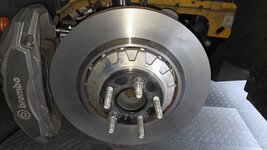
Okay, so I took the front rotors into O'Reilly's. The manager runs the Bosch machine and we talked shop while the lathe turn both faces of the rotors. Overall, it required ~0.010" off from each face to get them true. (I cleaned the backsides of the hats really well beforehand so as to provide a good reference plane.)

Here is a photo. It shows how he left a narrow hint of the face untouched - it is the darker crescent shaped stripe near the hub.

I am running a new set of OEM GT350 pads up front, so that the base pad material will be that of track pads. I switch to my street compound for longer periods between track events.

I have yet to take my car up to speed to try a hard stop. At today's gas prices, I need someplace to go first! (I'm retired.)

20260922_145739.jpg
 
Top