The Mustang Forum for Track & Racing Enthusiasts

Taking your Mustang to an open track/HPDE event for the first time? Do you race competitively? This forum is for you! Log in to remove most ads.

  • Welcome to the Ford Mustang forum built for owners of the Mustang GT350, BOSS 302, GT500, and all other S550, S197, SN95, Fox Body and older Mustangs set up for open track days, road racing, and/or autocross. Join our forum, interact with others, share your build, and help us strengthen this community!
ED1_2507.jpg

S550 Honey Badger GT350 Build Build Thread Profile - S550 Mustangs

Modified GT350 called the Honey Badger

This site may earn a commission from merchant affiliate links, including eBay, Amazon, and others.

I'm fairly certain in my case its the master cylinder size. There's a long joutney I plan to share at some point, but the short version is Tilton originally recommend I use 13/16 size masters front and rear. The result was way too much rear brake bias (45% front, 55% rear) and I was running out of the adjuster threads to try and get it where it should be. So I swapped in a smaller master I had to see if the brake bias would be fixed (I ran a .7 front and .8125 last track weekend) and the bias was finally in the ballbark, but I was running out of the pedal (bottoming it out under heavy braking). Tilton warned me that too small of a front diameter could cause problems because it simply wouldn't push enough fluid into the calipers to do the job (even tho the pressures would be higher).

So I have a new pair coming - one larger for each (.75 front, .835 rear) which should keep the bias the same but make the pedal stiffer. WE'll see.

I am running Ferodo DS3.12s, which have a fairly high mu and a flat torque curve. but we'll see once I get the masters worked out. might need to switch

View attachment 99170

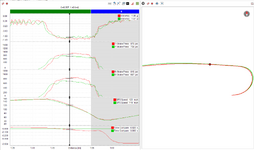
I was running .7 and .812 at COTA last weekend. Pressure peaked at a reasonable spot (1350 psi fronts), but it fell off even though I had the pedal all the way to end of its travel. If we compare a lap where i made the brake zone and one where I didn't, we can see front pressure is dropping off and not quite as high - I can assure you that pedal physically wouldn't move any further no matter how hard you pushed it. My theory is the pressure is peaking and then starts to drop as the pistons move and I run out of pedal to keep the pressures up (i.e. I can't push enough fluid in the caliper at the pressure needed for how far the pistons are moving).

View attachment 99171
Very interesting, what pedal ratio are you running? I am having a similar issue using a 13/16 front and a 3/4 rear (just felt the brakes were lacking overal). I don't have any real time line pressure data but with gauges in my shop, the rears are showing 100psi or so higher. If i max the balance bar to the F then I can get them even..

Are you sure your balance bar isnt binding up at full travel? Make sure they are set perpendicular at full push, not rest.
 
I'm fairly certain in my case its the master cylinder size. There's a long joutney I plan to share at some point, but the short version is Tilton originally recommend I use 13/16 size masters front and rear. The result was way too much rear brake bias (45% front, 55% rear) and I was running out of the adjuster threads to try and get it where it should be. So I swapped in a smaller master I had to see if the brake bias would be fixed (I ran a .7 front and .8125 last track weekend) and the bias was finally in the ballbark, but I was running out of the pedal (bottoming it out under heavy braking). Tilton warned me that too small of a front diameter could cause problems because it simply wouldn't push enough fluid into the calipers to do the job (even tho the pressures would be higher).

So I have a new pair coming - one larger for each (.75 front, .835 rear) which should keep the bias the same but make the pedal stiffer. WE'll see.

I am running Ferodo DS3.12s, which have a fairly high mu and a flat torque curve. but we'll see once I get the masters worked out. might need to switch

View attachment 99170

I was running .7 and .812 at COTA last weekend. Pressure peaked at a reasonable spot (1350 psi fronts), but it fell off even though I had the pedal all the way to end of its travel. If we compare a lap where i made the brake zone and one where I didn't, we can see front pressure is dropping off and not quite as high - I can assure you that pedal physically wouldn't move any further no matter how hard you pushed it. My theory is the pressure is peaking and then starts to drop as the pistons move and I run out of pedal to keep the pressures up (i.e. I can't push enough fluid in the caliper at the pressure needed for how far the pistons are moving).

View attachment 99171
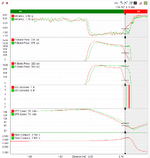
Okay - that's interesting. The red line in the line pressure graph shows the front pressure dropping about 250 PSI (call it 20% or so) through the brake zone. Presumably that's because the pedal assembly that's stuck against the limit can't provide more fluid to backfill the calipers as things change in the calipers. But what's changing? Perhaps the change is from the brake pad face wearing away during this single braking event, or maybe the front calipers are heating up and expanding. I guess it doesn't take a large volume change in the system volume to change the pressure when the pedal is stopped at the limit, but something is increasing the volume enough to drop the pressure by that 20%. It might be worth talking to a real brake expert (ie - call England and talk to someone at AP Racing - they're nice folks - I've talked to them) about the pressure drop. If it's normal, that's great, but it could be a signal of some weird but important problem that should be looked at separately from getting more fluid from the master cylinder setup.

Another interesting thing about the red g-trace is that it looks like ABS is working. The little peaks and valleys show braking effort is cycling up and down. And what's more interesting is that even though the line pressure is dropping, your deceleration isn't decreasing very much. Pressure drop is a gradual 20% but braking -g force drops quickly from -1.25 G to about -1.1 G and then it just sits there even as the pressure fades. Maybe that's something else to check with a brake expert.

The green traces show something else worth thinking about. The front line pressure is similar to the red line, but everything is a little lower this time. Until the end. When the rear pressure drops away at the start of the grey zone, the front pressure is almost stable and it stays that way until you release the pedal. When the rear pressure starts to drop, the g-trace starts to ramp to lower -g levels, so brake performance is declining a bit, even though the front brakes are stable. Again, it might be worth finding out what this data is trying to tell you. There could be a heat problem in the rear caliper that's responsible for the drop. Or maybe the rear tires are losing grip and the rear ABS is kicking in. Hard to say. But whatever it is, front-rear brake bias is changing on its own deep in a braking zone. Might be worth knowing why.
 
Okay - that's interesting. The red line in the line pressure graph shows the front pressure dropping about 250 PSI (call it 20% or so) through the brake zone. Presumably that's because the pedal assembly that's stuck against the limit can't provide more fluid to backfill the calipers as things change in the calipers. But what's changing? Perhaps the change is from the brake pad face wearing away during this single braking event, or maybe the front calipers are heating up and expanding. I guess it doesn't take a large volume change in the system volume to change the pressure when the pedal is stopped at the limit, but something is increasing the volume enough to drop the pressure by that 20%. It might be worth talking to a real brake expert (ie - call England and talk to someone at AP Racing - they're nice folks - I've talked to them) about the pressure drop. If it's normal, that's great, but it could be a signal of some weird but important problem that should be looked at separately from getting more fluid from the master cylinder setup.

Another interesting thing about the red g-trace is that it looks like ABS is working. The little peaks and valleys show braking effort is cycling up and down. And what's more interesting is that even though the line pressure is dropping, your deceleration isn't decreasing very much. Pressure drop is a gradual 20% but braking -g force drops quickly from -1.25 G to about -1.1 G and then it just sits there even as the pressure fades. Maybe that's something else to check with a brake expert.

The green traces show something else worth thinking about. The front line pressure is similar to the red line, but everything is a little lower this time. Until the end. When the rear pressure drops away at the start of the grey zone, the front pressure is almost stable and it stays that way until you release the pedal. When the rear pressure starts to drop, the g-trace starts to ramp to lower -g levels, so brake performance is declining a bit, even though the front brakes are stable. Again, it might be worth finding out what this data is trying to tell you. There could be a heat problem in the rear caliper that's responsible for the drop. Or maybe the rear tires are losing grip and the rear ABS is kicking in. Hard to say. But whatever it is, front-rear brake bias is changing on its own deep in a braking zone. Might be worth knowing why.
Good eye on the ABS. I have that data, but didn't have it visible. The entire reason I haven't had MAJOR issues with the brakes is because the Bosch ABS is so damn good at managing stuff. Whenever I had the bias whacked, it would make sure the car was stable under the brakes. It's true magic. Well, not really. But feels like it haha

In the trace I shared earlier, it's kicking on right at the end of the brake zone when I am keeping the pressure higher than I typically would, later than I typically would, because the initial "bite" isn't there and I am still carrying too much speed. You can see it kicks on as I turn in for the corner. Crazy enough, I can still make the apex even though I am going "too fast" for stock ABS.

1728970818969.png

Here's some additional data why I think this is a master cylinder size issue. Here's a brake trace from Turn 1 at VIR where I had the .812 sized cylinders front and rear and a 50/50 brake bias was the best I could manage on the adjuster (Bosch ABS recommend was 62% front based on actual slip data it was seeing). I am braking at much less pressure (peak of a little over 900 PSI) but my deceleration G is barely lower from Turn 12 at COTA (-1.18G at VIR vs -1.23 at COTA). And notice how the line pressure stays the same (well, the variance is from my foot). With these master cylinders, total pedal movement was maybe 1in before it was uncomfortable work for my leg. So it was pushing a ton more volume (relatively speaking, of course).

1728970767078.png

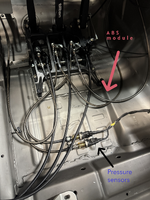
One thing to note the way the system is designed - the Bosch is measuring pedal pressure coming directly out of the master cylinders off a separate line than the one that goes to ABS module. So I don't have the pressures that go the wheels - only what's going into the ABS module. My theory is with the smaller master cylinder, pressure peaks quickly at the sensor and then trails off as volume fills up the caliper.

Design.png

I do like your push to contact AP though. I've been chatting with Tilton and lots of what I am sharing is coming from their engineering department, but I think you're right, I should contact AP and see what they say. I'll see what they say and report back.
 
Very interesting, what pedal ratio are you running? I am having a similar issue using a 13/16 front and a 3/4 rear (just felt the brakes were lacking overal). I don't have any real time line pressure data but with gauges in my shop, the rears are showing 100psi or so higher. If i max the balance bar to the F then I can get them even..

Are you sure your balance bar isnt binding up at full travel? Make sure they are set perpendicular at full push, not rest.
I’m running the 6.1:1 ratio. I’m surprised you’re running the smaller cylinder on the rear - that should cause you to have higher pressure in the rear. Are you not locking the rears?

I highly recommend adding pressure sensors if you can - should be easy with your logger, ya? It’ll really help you fine tune the brakes

Re: balance bar, yep. Learned that one the hard way at Road America. I overlooked that on a last min cylinder swap and chased down “dynamic bias adjustment” for a day or so before I figured out what I missed.
 
Good eye on the ABS. I have that data, but didn't have it visible. The entire reason I haven't had MAJOR issues with the brakes is because the Bosch ABS is so damn good at managing stuff. Whenever I had the bias whacked, it would make sure the car was stable under the brakes. It's true magic. Well, not really. But feels like it haha

In the trace I shared earlier, it's kicking on right at the end of the brake zone when I am keeping the pressure higher than I typically would, later than I typically would, because the initial "bite" isn't there and I am still carrying too much speed. You can see it kicks on as I turn in for the corner. Crazy enough, I can still make the apex even though I am going "too fast" for stock ABS.

View attachment 99182

Here's some additional data why I think this is a master cylinder size issue. Here's a brake trace from Turn 1 at VIR where I had the .812 sized cylinders front and rear and a 50/50 brake bias was the best I could manage on the adjuster (Bosch ABS recommend was 62% front based on actual slip data it was seeing). I am braking at much less pressure (peak of a little over 900 PSI) but my deceleration G is barely lower from Turn 12 at COTA (-1.18G at VIR vs -1.23 at COTA). And notice how the line pressure stays the same (well, the variance is from my foot). With these master cylinders, total pedal movement was maybe 1in before it was uncomfortable work for my leg. So it was pushing a ton more volume (relatively speaking, of course).

View attachment 99181

One thing to note the way the system is designed - the Bosch is measuring pedal pressure coming directly out of the master cylinders off a separate line than the one that goes to ABS module. So I don't have the pressures that go the wheels - only what's going into the ABS module. My theory is with the smaller master cylinder, pressure peaks quickly at the sensor and then trails off as volume fills up the caliper.

View attachment 99183

I do like your push to contact AP though. I've been chatting with Tilton and lots of what I am sharing is coming from their engineering department, but I think you're right, I should contact AP and see what they say. I'll see what they say and report back.
It'll be interesting to hear their perspective on this. You're going (in the first chart) from 160 MPH to about 50 MPH, and at -1.1 G that takes about 4.5 seconds. I have a hard time believing that it takes that long for brake fluid to move through the system to fill the calipers, especially since the rapid pressure rise at the start of the brake zone confirms that there's no air or knockback to deal with. I'm not wondering about the master cylinder issue, I'm questioning whether there's something else that could be a problem as your brakes absorb 3.5 megajoules of kinetic energy in 4 seconds.

It's very likely not a problem - "they all do that" is the likely answer.
 
It'll be interesting to hear their perspective on this. You're going (in the first chart) from 160 MPH to about 50 MPH, and at -1.1 G that takes about 4.5 seconds. I have a hard time believing that it takes that long for brake fluid to move through the system to fill the calipers, especially since the rapid pressure rise at the start of the brake zone confirms that there's no air or knockback to deal with. I'm not wondering about the master cylinder issue, I'm questioning whether there's something else that could be a problem as your brakes absorb 3.5 megajoules of kinetic energy in 4 seconds.

It's very likely not a problem - "they all do that" is the likely answer.

So had a chat with Mike Oneil at Essex this afternoon. Very helpful guy and perfect to help me work through my issues - used to work at Tilton designing their systems and now works at Essex and worked on the FP350S project with Ford.

Mike ran the numbers and got the same results as Tilton on master cylinder size recommendations - specifically that both front and rear masters should be the same size. For me, this resulted in a significant rear bias--according to the Bosch ABS data. However, according to Mike, this should put balance at 70% front. His recommendation was to turn off ABS and actually get data the old school way - adjust the bias until the fronts lock just before the rears. And then turn ABS back on once I've dialed in the brakes manually. He said this is how they tuned the FP350S system as well.

Re: the dropping pressures, he said that was likely air in the system or a bias bar issue. He gave some tips on how to ensure all those are good (distance between clevis', run out on the front master vs rear, and how to ensure no air is in the line).

So the summary is I am going to swap the front back to the .812 (same as rear), re-bleed the system, and then test at the track without ABS on. I plan to make a more formal post on setting up the pedal box, brakes, etc. so hopefully I can help others in future (as this has been quite a bit of work and there's a crap load of nuance to it).
 
So had a chat with Mike Oneil at Essex this afternoon. Very helpful guy and perfect to help me work through my issues - used to work at Tilton designing their systems and now works at Essex and worked on the FP350S project with Ford.

Mike ran the numbers and got the same results as Tilton on master cylinder size recommendations - specifically that both front and rear masters should be the same size. For me, this resulted in a significant rear bias--according to the Bosch ABS data. However, according to Mike, this should put balance at 70% front. His recommendation was to turn off ABS and actually get data the old school way - adjust the bias until the fronts lock just before the rears. And then turn ABS back on once I've dialed in the brakes manually. He said this is how they tuned the FP350S system as well.

Re: the dropping pressures, he said that was likely air in the system or a bias bar issue. He gave some tips on how to ensure all those are good (distance between clevis', run out on the front master vs rear, and how to ensure no air is in the line).

So the summary is I am going to swap the front back to the .812 (same as rear), re-bleed the system, and then test at the track without ABS on. I plan to make a more formal post on setting up the pedal box, brakes, etc. so hopefully I can help others in future (as this has been quite a bit of work and there's a crap load of nuance to it).
So his theory (and I mean theory in a positive way) is that there's an obstruction in the flow of brake fluid to the front calipers. When you hit the pedal, the rear brakes go to full braking effort but the fronts lag, giving you the F/R imbalance you're experiencing. It would also account for the slow drop in front pressure as fluid finds its way past the obstruction into the front calipers. Question: can you see the same fast rise and slow fade in the front brake pressure with your car in the garage? Perhaps check that before you take it apart.

It does begin to sound like there might be two separate problems - the master cylinder/balance question and a second one about something messing with front braking effort. I wonder if the ABS unit has a stuck valve or something.
 
So his theory (and I mean theory in a positive way) is that there's an obstruction in the flow of brake fluid to the front calipers. When you hit the pedal, the rear brakes go to full braking effort but the fronts lag, giving you the F/R imbalance you're experiencing. It would also account for the slow drop in front pressure as fluid finds its way past the obstruction into the front calipers. Question: can you see the same fast rise and slow fade in the front brake pressure with your car in the garage? Perhaps check that before you take it apart.

It does begin to sound like there might be two separate problems - the master cylinder/balance question and a second one about something messing with front braking effort. I wonder if the ABS unit has a stuck valve or something.
My understanding was that it was likely a combination of being compressed and balance bar binding up under such long pedal travel. The masters have a 1in stroke, but he said you really shouldn't be moving them more than a half inch max. If you are getting the full stroke, something is wrong (like having to compress air).
 
My understanding was that it was likely a combination of being compressed and balance bar binding up under such long pedal travel. The masters have a 1in stroke, but he said you really shouldn't be moving them more than a half inch max. If you are getting the full stroke, something is wrong (like having to compress air).
Okay, so maybe it was my theory... In any event, I just downloaded and went through the install manual for the Bosch M5 kit. The bleeding procedure sounds positively harrowing.

What I took away from that read, though, is that it's definitely possible that the problem is just air in the front brake system. Mike's suggestion to sort the brakes out with the ABS disconnected makes sense (here's hoping it just works like a normal brake system when the ABS switch is in the "deactivated" position). If there's air in the lines or a problem with an obstruction or something wrong with a caliper, then you'll be able to find it and fix it without the ABS either hiding it or making it worse.
 
the Bosch is measuring pedal pressure coming directly out of the master cylinders off a separate line than the one that goes to ABS module.
Probably a silly question, but looking at the pic under this comment, did you bleed those hoses from the masters to the sensors? If there's air in that hose, it would compress under M/C pressure just like air in the caliper, right?
 
Probably a silly question, but looking at the pic under this comment, did you bleed those hoses from the masters to the sensors? If there's air in that hose, it would compress under M/C pressure just like air in the caliper, right?
Ha - funny you should mention that. Last night I was swapping the front master and I went to screw in the hose for the front sensor and I had the exact same thought. I literally just paused for a moment and was like "ahhh, f***"

I know I did it on the original brake bleed because the entire line was dry - but I don't think I did it when I swapped masters this summer. Watch this whole thing be because of that....sigh
 
Thought some of you might enjoy this. HB mkIII vs a GT350R on slicks drag racing down the back straight. HB really pulls hard out of the corners - the sequential effectively has 2x as many gears and shifts in 20ms, so it makes a huge difference.


Manny was a great sport about it -said he never lifted and loved it, until the shifts shot fireballs at him :D
 
Thought some of you might enjoy this. HB mkIII vs a GT350R on slicks drag racing down the back straight. HB really pulls hard out of the corners - the sequential effectively has 2x as many gears and shifts in 20ms, so it makes a huge difference.


Manny was a great sport about it -said he never lifted and loved it, until the shifts shot fireballs at him :D
How do you contain yourself piloting the HB at speed ?? The sounds are making me all warm & fuzzy 🔥💥💥🔥
 
How do you contain yourself piloting the HB at speed ?? The sounds are making me all warm & fuzzy 🔥💥💥🔥
you can pretty much guarantee under that helmet I'm either giggling like a child or pooping my pants.

I won't lie, it's boyhood dream type of stuff..especially this year getting to drive at COTA, Road America and VIR
 
HB really pulls hard out of the corners
Out of the corners and all the way down the straights. Geez Louise, that thing is insanely fast. I figured you could take the first car from your apex speed and acceleration, but you completely walked the second one just as easily, and the engine's still pulling hard at a buck-fifty when you hit the brakes. It's like you're using cheat codes in real life. Congratulations on an awesome build!
 
Out of the corners and all the way down the straights. Geez Louise, that thing is insanely fast. I figured you could take the first car from your apex speed and acceleration, but you completely walked the second one just as easily, and the engine's still pulling hard at a buck-fifty when you hit the brakes. It's like you're using cheat codes in real life. Congratulations on an awesome build!
yeah - it's a rocketship. I've gain 7 mph down the back straight and almost 10 on the front and I have more drag now. Should improve when I get the flat floor and can attack the brake zones as well (i'm maxing at 1.25g decel right now and previous car was a 1.55g, so I'm still super cautious in the brake zones while I iron them out).

At VIR I really realized how fast this car really is. it's really best on track with other race cars. It just has crazy closing speeds and its vmin are just so much higher than most street cars. For example, look at how "slow" it feels when I catch the Lambo and AMG in the video below. It feels like I'm coasting (because I pretty much am) and then the car is so easy to pass with. Go right around the outside like it's the ideal racing line - immediately on power.


As someone not experienced in proper race cars, it's been a fairly big adjustment. super awesome, though. Can't wait to start competing with it in '25.
 
Just wait til i show up
i'm still not convinced you're going to show up - don't want to get your cheeks clapped by a car with half the power and the world record for a power slide exiting t15, in a gray mustang, on Sunday Oct 6th, with full sunlight.
 
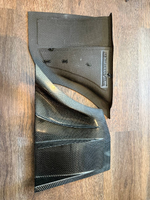
Got a delivery from @AJ Hartman today. Getting ready to make a new splitter and start my underfloor - while a splitter is enough to DIY, I'll leave the dark magic of tunnels to the pros. Fairly sure these are the best "low-ish" profile tunnels on the market (I didn't want super aggressive ones as i'm trying to balance performance with "temperamental-ness."

1729796745007.png
 

Latest posts

Buy TMO Apparel

Buy TMO Apparel
Top