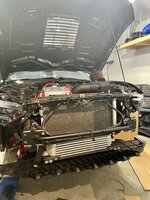
Any tips on fabricating a radiator & intercooler duct setup for this? As you can see a lot of air can escape on the sides. But there are support pieces and crash bars and harnesses everywhere that would make putting anything there quite difficult.

This site may earn a commission from merchant affiliate links, including eBay, Amazon, and others.

Not those guys, but what was CHT?Alright voodoo cooling experts….(ahem @5.2 liters of democracy and @honeybadger) I think the time has come for additional preventative measures. Hood vents did me good for a long while but yesterday at Buttonwillow I hit 270 degrees indicated oil temp. Granted, it was 85, sunny, a calculated (not true) reading, and we were pushing it hard but 260+ is definitely uncomfortable territory.
Shane, what do I need to plumb a 960? I’ll duct it like yours (guess I need the cad for Send cut send too) but I am keeping the AC condenser for now. Kevin, am I being dumb not touching the water/rad system? That is totally OEM.
Plus you count as someone with enough knowledge. Sal tooNot those guys, but what was CHT?


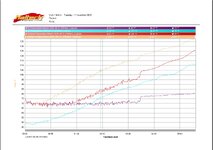
Don't have the before and after but have some data post upgrade.
960 cooler infront of AC condensor and radiator. Radiator is triple pass thicker core.
Oil Temp OUT is picked up on inlet of Improved Racing Themostat/Filter housing. Oil RETURN is on return line from cooler. 212F/100C thermostat
View attachment 106682
Road drive one night. Air temp is a sensor in front of the cooler to get an idea of air start temp. Probably should have put one behind radiator as well in hind sight.View attachment 106680
Track session on a cold day.View attachment 106681
Same session with just oil temps and pressure.
Fair amount of time wide open.View attachment 106683
Shroud setup for cooler, rest stockView attachment 106684
Just started logging for that very reason. Wanted to find out what was happening and what actually works to improve it.
Alright voodoo cooling experts….(ahem @5.2 liters of democracy and @honeybadger) I think the time has come for additional preventative measures. Hood vents did me good for a long while but yesterday at Buttonwillow I hit 270 degrees indicated oil temp. Granted, it was 85, sunny, a calculated (not true) reading, and we were pushing it hard but 260+ is definitely uncomfortable territory.
Shane, what do I need to plumb a 960? I’ll duct it like yours (guess I need the cad for Send cut send too) but I am keeping the AC condenser for now. Kevin, am I being dumb not touching the water/rad system? That is totally OEM.
You rock, as always.Ahhh. this is some GREAT data. thank you for sharing. I suspected putting coolers in front of the rad would affect efficiency and I think your data shows a lot of credibility to that. If im reading your charts right, you're under 10 degree difference between inlet and outlet. that's gotta' be pretty inefficient. I'm curious to see what I am measuring after adding more sensors. I'm planning on doing the same - measuring at inlet and outlet.
Would be super cool to try testing the oil cooler behind the rad too
I'm actually not too uncomfortable with 260+ oil temps with a high quality oil. I've run Amsoil Dominator in my car for years - before the latest build, I regularly saw 260-280 temps and my oil analysis never showed issues in 3-5 hours of run time. More than that and it started to break down.I analyzed every oil change, so I am fairly confident in the results.
That said, being in the 215-240 range with oil temps is ideal based on my testing. Wont stress anything by over cooling the oil and not hot enough to cause issues.
Re: water cooling. I think before I give any advice with confidence, I'd want to know what cylinder head temps you're seeing and what your real water temps are. Ideally below 200 degrees water temps, CHTs below 230, etc. Water temp needs to be measured separately of course since the OEM CHT sensor isn't exposed to water.
All in all, I'd be more concerned about water than oil at your temps. if you start seeing 280+ peaks during a session, then I'd get worried.


Ahhh. this is some GREAT data. thank you for sharing. I suspected putting coolers in front of the rad would affect efficiency and I think your data shows a lot of credibility to that. If im reading your charts right, you're under 10 degree difference between inlet and outlet. that's gotta' be pretty inefficient. I'm curious to see what I am measuring after adding more sensors. I'm planning on doing the same - measuring at inlet and outlet.
Would be super cool to try testing the oil cooler behind the rad too
I'm actually not too uncomfortable with 260+ oil temps with a high quality oil. I've run Amsoil Dominator in my car for years - before the latest build, I regularly saw 260-280 temps and my oil analysis never showed issues in 3-5 hours of run time. More than that and it started to break down.I analyzed every oil change, so I am fairly confident in the results.
That said, being in the 215-240 range with oil temps is ideal based on my testing. Wont stress anything by over cooling the oil and not hot enough to cause issues.
Re: water cooling. I think before I give any advice with confidence, I'd want to know what cylinder head temps you're seeing and what your real water temps are. Ideally below 200 degrees water temps, CHTs below 230, etc. Water temp needs to be measured separately of course since the OEM CHT sensor isn't exposed to water.
All in all, I'd be more concerned about water than oil at your temps. if you start seeing 280+ peaks during a session, then I'd get worried.
You rock!@Voodoo Stoned my man! I was just thinking of you the other day. Hopefully I didn't will any temperature-based anxiety into existence!
I feel similarly to Kevin regarding the temperature. I'd be curious how much worse those temps would be though if it were 100 degree day at BW but I'd still bet it wouldn't hit 280. With that being said, I'm going to do a write up on everything I used for my ducting which of course will still include free access to the files. What I did just find out is SendCutSend changed their tolerances so now I have to revise said files otherwise there are bend errors. Once I resolve those I'll probably start a new post since I've had several request in the last few days. More to follow!
I wasn’t paying super close attention to CHT - the oil temp reading had me glued to it - but I don’t think I noticed CHTs were higher than 235.

Have you spoken with @AJ Hartman about this. He has a kit for the S550. It might work or need a small tweak to fit yours.I would like the relocate the coolant expansion tank to help the airflow from the back of the radiator to the hood vents. Can’t find any decent online though

 ajhartmanaero.com
I have, he said the brackets won’t fit the s197. Didnt mention anything about the coolant plumbing/routing.Have you spoken with @AJ Hartman about this. He has a kit for the S550. It might work or need a small tweak to fit yours.S550 Mustang Coolant Reservoir Relocation Kit
Shop now for racing aerodynamics including wings, splitters, and canards. We carry carbon fiber body panels, hood vents, and more for your Race Car

And removing the top and bottoms ducting of the oil cooler

Two quick questions.run a radiator with quite a bit smaller surface area (but more depth) and my temps are crazy cool - like 180-200 head temps in max heat. I also dont run a fan shroud. Just a fan bolts on the back. I have to imagine running the big oil cooler with 280* oil in front of the radiator is killing efficiency.
Sorry but would you also be willing to dm me the cad aswell if you wouldnt mind.Of course! Shoot me a PM with your e-mail address and I can share the file.