The Mustang Forum for Track & Racing Enthusiasts

Taking your Mustang to an open track/HPDE event for the first time? Do you race competitively? This forum is for you! Log in to remove most ads.

  • Welcome to the Ford Mustang forum built for owners of the Mustang GT350, BOSS 302, GT500, and all other S550, S197, SN95, Fox Body and older Mustangs set up for open track days, road racing, and/or autocross. Join our forum, interact with others, share your build, and help us strengthen this community!

S197 Anti Squat Numbers/ Theory/ Real World Results/ Etc

This site may earn a commission from merchant affiliate links, including eBay, Amazon, and others.

I've read about people doing this since. At the time, all I really knew was that it was a handful to drive no matter what I did. The SN95 didn't exist when I was polishing my '79 Indy Pace Car turd. I had decided that understeer was the enemy and so anything that made me saw on the wheel more must be fast. At the very least, it was both an entertaining and educational time.

Side note: Understeer is *not* the enemy.

The biggest issue I had with my Fox body and SN95 stuff was when all that bound up suspension went looking for center coming off a corner and it went into snap oversteer.
 
Its amazing the difference in rear suspension design. My 94 was all poly bushings in the 4 link. Full lateral load and any light throttle provoked oversteer, every time. In the S197 the suspension squats and bites on the outside tire. Adding throttle only provokes the diff to open up. Its surprisingly docile. Obviously I can set it up more aggressively, but its a good place to start out of the box.
 
The biggest issue I had with my Fox body and SN95 stuff was when all that bound up suspension went looking for center coming off a corner and it went into snap oversteer.

I think this was an inherent part of the car for a bunch of reasons. I know I harp on weight distribution, but when you're starting with 58-59% on the front axle, you know it's gonna be an uphill battle. The standard mid-corner push to lurid snap-loose exits was always pretty much par for the course. I'm not aware of any of them that truly handled well. I think Grigg's torque arm setup was probably the biggest single step forward, but I never had enough scratch to find out personally.
 
More thinking about the front, where with spring has to fit the factory style upper and lower mounts. Limited options with the stock style springs. It seems like most anything with a high rate has significant lowering (+1.5" drop). Like H&R or MM race springs.

Trying to keep the front geometry near stock. Target is 15" hub to fender which is about 3/4" drop. During my first search for springs, I read some great posts from @Norm Peterson. He advocated for the BMR GT500 handling springs because of the minimal drop in the front (on a GT) and the relatively stiff straight rate of 260lbs. They are pretty cheap too. That's the route I plan to go.

For anti-squat, I am going with the idea that a 1" trailing arm rise is better than a 1" trailing arm drop. At least for now.
I just remembered this. The 2013-2014 GT500 PP cars have 260 straight rate springs in the front. May be an option for you if you don't want to lower it much.
 
HOWEVER... the rules said nothing about bushing material, so we used poly bushings on 3 of the 4 links and roll bar padding on the 4th, basically allowing the PHB to center the diff, and freeing up the entire POS so it would work... sort of.
I love this sort of stuff!

The Mark Donahue book The Unfair Advantage is full of tidbits like this.
 
My general experience has been that if they go (rear) higher than level under compression, it is like a light switch to enable wheelspin.

So, you want them at least a little lower in the back/axle side and not start level. You are no where near roll oversteer level.

And I don't think the stock setup is really relevant, it is pretty compromised and really only hooks up because giant rubber bushings.

DaveW
 
Coming back to this discussion. Besides the Steeda (non-bolt in) is there another bracket design that offers an upper mount hole closer than 2” to the stock mount point? My control arms were level stock, I would like to bring them back. I am lowered about 1.5”.

Looking around, these seem to have a closer than typical upper hole.

https://www.teamzmotorsports.net/product_p/tzm-lcab-05-14-4h.htm
The problem is that to get any less than a 2" drop the brackets will have to be welded on. The bolt on brackets use a bolt and sleeve where the LCA originally mounted. That means that you have to have the next hole down 2"+ or the bolt/sleeve with be occupying the same spot as that end of the LCA.

I've put a spread sheet together with all sorts of different combinations and their AS results. Assuming that you want 50% AS (I got this from a LOT of sources) there is no way to do it without some fab work on the axle. Something along the lines of weld in brackets and drilling your own holes. I can't remember exactly what the Steeda brackets are (can't find my chart). They are less than 2" but more than 1". I know that for sure.

Assuming you're working with a 26in tall tire here are some results:

-Stock ride height no correction (all stock >) 32.93% AS/ 97.49" IC length

-Lowered 1.5", LCA drop 2" > 82.79% AS/ 43.5" IC length <<<I've been driving around on this. I think it's too much unless you just want to go straight.

-Lowered 1.5, LCA drop 0", UCA drop .75" > 57.89% AS/ 39.89" IC length

Without going custom with the drop brackets lowering the UCA is the closest solution. The IC length is pretty short though.

_______________________________________________________________________________________
If some sort of custom drop bracket situation is an option there are better results to be had:

-Lowered 1.5", LCA drop .50" > AS 51.3%/ 59.21" IC length.

-Lowered 1.5", LCA drop .75" > AS 59.15%/ 56.82" IC length.

^^^^^Eventually I think this is what I'm going to do for my GT500. It's going to be a bit of work.

---------------------------------------------------------------------------------------------------------------------------------
Out of these two solutions I am guessing that the one with the longer IC length is the more preferable. And it gets you a AS closer to 50%:

-Lowered 1.5, LCA drop 0", UCA drop .75" > 57.89% AS/ 39.89" IC length

-Lowered 1.5", LCA drop .50" > AS 51.3%/ 59.21" IC length.
 
The problem is that to get any less than a 2" drop the brackets will have to be welded on. The bolt on brackets use a bolt and sleeve where the LCA originally mounted. That means that you have to have the next hole down 2"+ or the bolt/sleeve with be occupying the same spot as that end of the LCA.
Just trying to visualize this. Wouldn’t the interference depend on the size of the LCA end?
 
Just trying to visualize this. Wouldn’t the interference depend on the size of the LCA end?
Yes. And I see where my mistake is at. I run bushed LCA's on almost everything so that is what I'm trying to solve for. If you run a rod end style LCA you can get the stock hole and the drop hole closer to each other. How close? I don't know. I've got a set of rod end arms for my drag car around here somewhere. I could pull them out and measure them up. I can't imagine they can be any closer than 1.25" though. Still quite a bit further away than ideal.
 
Confirmed the brackets I referenced (Team Z) are a 2" drop to the top hole.

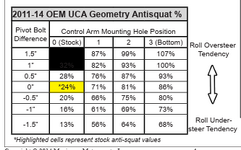
Seems like that is the minimum for anything that bolts in. According to this from MM, 1-1.5" drop will put you around 56-61% AS if using the 1st hole. Which I assume their design is a 2" drop difference. This seems pretty close to ideal if your target is 50%.

1745854260346.png
 
You are going to have to do better than that!

Maybe the difference in tire diameter? You are referencing a 26". Typical S197 sizes are 27"+.
-You would have to lower the car 3" and run a 25" tire to get 55.92% of AS using a LCA bolt hole 2" from stock.

-A 26" tire gets you 65.88%

-A 27" tire gets you 69.9%.

Maximum Motorsports is not just wrong. They're WAY wrong.

The only way to solve it is to get the LCA bolt hole closer to stock.
 
Last edited:
Maximum Motorsports is not just wrong. They're WAY wrong.
Using your calculations, I would agree. Seems curious they would produce such specific information that is so far off. They must be using a different figure for something. How do you calculate CG height?
 
Using your calculations, I would agree. Seems curious they would produce such specific information that is so far off. They must be using a different figure for something. How do you calculate CG height?
I didn't calculate anything. I'm just firing numbers into a online calculator here Instant Center Calculator and then keeping track of combinations in spreadsheet.

I don't know how much you know about the aftermarket (I work in it)............but the vast majority of it is wrong and the parts they produce are trash. It doesn't surprise me one little bit. My starting point with the aftermarket is that they are wrong, stupid or lying. Just like I assume all politicians are crooks. I'm going to be right about my assumptions at a much much higher percentage than I am wrong. ;)

CG height for the most part defaults to the height of the camshaft because in the vast majority of situations the equipment/ budget isn't there to measure it. Camshaft height being the most accurate facsimile. In the case of a Mod motor you use the height where the cam would be if it was a cam in-block design. I did not measure this. Car & Driver magazine did K&C testing back in the day and came up with 21". How close is that to the "cam location" method? I don't know. But it is the closest thing we have to reality to work with.

Let's say that CG is an unknown bogey though. Here is what the calculator spits out when you change it:

-Car lowered 1.5", LCA in the first hole CG at 19.5" (21" stock height minus 1.5") = 82.79% AS

-Car lowered 1.5", LCA in the first hole CG at 21" = 76.87% AS

-Car lowered 1.5", LCA in the first hole CG at 18" = 89.68% AS

The CG isn't the bogey that makes the Maximum Motorsports numbers right.

Hell, you have to make the CG 32" to get a 50.45%v AS.
 
Totally agree on the “distrust but verify” with the aftermarket. That said, the calculator you are using is provided by an aftermarket vendor right?

Not only that but the calculator states the following:

Please Read:
Baseline Suspensions IC Calculators are designed specifically for our products.
Using them for any other kit WILL give false information that we will
NOT be held liable for


Did you have another source of calculations you are using? Really just asking. Not saying your numbers are wrong, but what else can we use to verify them?
 
Totally agree on the “distrust but verify” with the aftermarket. That said, the calculator you are using is provided by an aftermarket vendor right?

Not only that but the calculator states the following:

Please Read:
Baseline Suspensions IC Calculators are designed specifically for our products.
Using them for any other kit WILL give false information that we will
NOT be held liable for


Did you have another source of calculations you are using? Really just asking. Not saying your numbers are wrong, but what else can we use to verify them?
Just to entertain your theory I went searching for another calculator. There sure aren't may. I could only find one that was free.

-I found this one but it has you measuring how far off centerline the suspension pickup points are from the axle centerline. I don't know what those numbers are on a 8.8 so I guessed them at zero. With that guess thrown in it gives me a AS of 26.36% for a stock car. The other calculator gives me 32.93%. Considering how much dropping the LCA one hole changes the AS (65%) that is a pretty small percentage.

Without purchased software it's not getting any closer (assuming it's off). And it's good enough for me. Right now my 09' GT has a AS of 77.45%. My GT500 has a AS of 34.67%. And it feels like it. It's a LOT different. The GT500 feels like it can use a bit more and the GT feels like it has too much. Keep in mind I spent 10yrs roadracing motorcycles at the pointy end (7 championships, too many wins to remember and 6 outright 2 wheel lap records). From year four to year ten I was paying for that racing (and then some) by doing suspension work track-side (not on race weekends). Out back roadrace bikes are all about getting the anti squat dialed in. Get it wrong in one direction and you're going sideways and not driving forward. Get it wrong the other way and it will snap sideways, grip, then throw you over the high side.......most of the time breaking bones. Most good riders can tell if you change the rear ride height (and therefore the AS) as little as 3mm in a "blind taste test". A really good rider can feel 1mm. My point being that my "AS butt dyno" is pretty dialed. And it matches what the calculator is telling me. The real tell will be if I ever get around to changing my GT500 so it has 50%ish AS. If it feels like the Goldilocks zone it matches the calculator and theory.
 
Last edited:
This article on BMR upper & lower mount relocation products mentions the same IC calculator that @RoadRacer78 linked to, and provides some AS info for different settings. Note that it is written by a BMR employee, and seems to be oriented towards drag racing, but the basic calculations don't matter if you're drag racing or road racing (though the "preferred" AS range may).


Buy TMO Apparel

Buy TMO Apparel
Top