The Mustang Forum for Track & Racing Enthusiasts

Taking your Mustang to an open track/HPDE event for the first time? Do you race competitively? This forum is for you! Log in to remove most ads.

  • Welcome to the Ford Mustang forum built for owners of the Mustang GT350, BOSS 302, GT500, and all other S550, S197, SN95, Fox Body and older Mustangs set up for open track days, road racing, and/or autocross. Join our forum, interact with others, share your build, and help us strengthen this community!

Why buy one brake deflector over another? Vorshlag vs Bamberg/GTP vs Versus or some other?

This site may earn a commission from merchant affiliate links, including eBay, Amazon, and others.

Those look like the GT3 brake duct plates that I ordered for my Cayman GTS only to find they were smaller than what came stock. I prefer the Vorshlag because the Porsche ones do seem to work fine on a 3200 lb Cayman but hauling down a 3700-4000 lb Mustang needs even more airflow. Sure the Vorshlag ones cost more but I give Terry his due as they tried various designs and these worked well. I am old fashioned in that I often prefer a product tested by someone who loves the breed than getting something for less that is a guess it will work well. Have been putting Porsche brake deflectors on cars since 1999 and have found them to be pretty successful on lightweight small cars, but have also found cars where we slapped them on full duct work was the only real solution. Just my personal view and nothing more.
 
The goal is to force air into the interior channels of the vented rotor, so it cools both rotor faces from the inside. The rotation of the rotor at speed creates air movement through the channels naturally, acting like a centrifugal fan. Some rotors have the interior vanes angled or curved to promote this action, and have distinct left and right versions.

Here's a video that shows Raybestos testing racing pad compounds on a brake dyno. Note how quickly the rotor gets glowing hot, and how it cools off.

Creating a higher-pressure area at the intake of the vent channels in the center of the rotor increases the cooling air flow. The cooler that air is, the better as well - ducted from the bumper is going to be better than radiator outflow. But that's a small difference compared to the temperature of the rotor being cooled. It can also help to create a lower-pressure area for the air coming out of the rotor to get pulled into, using things like nose canards, tire spats, or venting the wheel well area.

Cooling the caliper is a secondary concern, as the brake pads typically insulate the caliper from a good deal of the heat at the rotor face. The main challenge is keeping the fluid from boiling. You can add titanium pad shims to increase the insulation the pads provide. That's not to say caliper heat is never a concern, but anything you're doing to cool the rotor is also going to help keep the caliper cool. There are extreme cases where calipers have dedicated cooling ducts/flow (who knows what's going on in the "cake tins" around F1 brakes), and there are also systems that circulate the brake fluid through the calipers, as well as calipers designed for a separate fluid cooling system.

In the FIA European Truck Racing Championship, the trucks are allowed to spray water into the rotors to help cool them. Some rally cars use similar systems, and I think the Aussie V8s do (or did) as well. There are DIY versions using windshield washer spray nozzles and a pump wired into the brake light circuit.

[Edit to add this] Note that some newer Mustangs (2015+?) have "inverted cooling" for the rotors, where the inner opening of the cooling channels is on the "outside" face of the rotor (towards the wheel) instead of the "inside" face (towards the hub). For these, cooling deflectors or ducting on the insidde of the wheel won't be able to feed more air to the cooling channels.
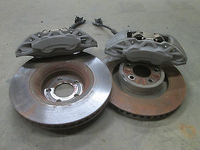
courtesy bexleycorona on Mustang6G.com
 
Last edited:
I can add plus 1 to the Porsche deflectors. For the price, (I got them when they were 7 bucks a piece), quality, and function you really can't beat them. @Bill Pemberton I think they run these same ducts on the GT4RS and thats not a small rotor.

Ive been running these deflectors for awhile now and when I took temps with & without the temp was noticeably different. (don't recall what is was but it was a win).
I've ran the Porsche deflectors for 5-6 years and they've worked great for me
 
They are probably fine for many, but for those of us who run W2W, Time Trials or are super aggressive, I have found the Porsche deflectors not sufficient enough. Since I never know how hard some folks use their brakes unless I am Instructing I always go for the most effective methods I am aware of.
 
On the porsches, the deflectors are designed to scoop from under the car, or match up to a small tunnel in the undertray/fender liner to grab the air and redirect. On their GT cars, there is a large upper deflector above that to grab radiator outflow and send it to the back of the wheel also. Pretty neat.
Its interesting ford removes the deflectors on gt350 and gt500s. They know how it works, I wonder if there was a tire interference tolerance that got too small with the wider front wheels? I have some vorshlag ones I need to get mounted.
 
Airflow around the front fascia can be critical, we tried Porsche deflectors on Gen II Vipers and they were beyond worthless. The laminar flow of air never really got to the deflectors and therefore like some cars the only cure is ducting ( hoses ) and more.

Great comments from Stan , he has both machines so the boy do know what he be saying!!
 
I sold a set to a customer because he had to cut down his Vorshlag plates at the inner upper corner for sufficient clearance to his wheel. So the effective area was reduced, and the Bamberg deflector starts out with more area anyway, with a large inner edge radius. He then also added spherical bearings to his front arms, and my design accommodates any rotational "set" of the arm angle. This also is to prevent interference with the wheel.

It is hard to know whether there is truly any air "flow" within the wheel well, instead of simply turbulence. I suspect it is a bit of both mechanisms. Fender vents would probably help the flow contribution.

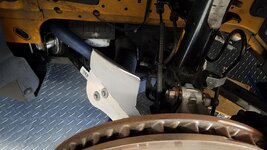
This photo shows how my deflector was bent at the dotted line so as to keep the main area vertical. Check how the spherical bearing has taken a rearward rotational set.

20240315_145506.jpg
 
Top