The Mustang Forum for Track & Racing Enthusiasts

Taking your Mustang to an open track/HPDE event for the first time? Do you race competitively? This forum is for you! Log in to remove most ads.

  • Welcome to the Ford Mustang forum built for owners of the Mustang GT350, BOSS 302, GT500, and all other S550, S197, SN95, Fox Body and older Mustangs set up for open track days, road racing, and/or autocross. Join our forum, interact with others, share your build, and help us strengthen this community!

S650 GT Track Alignment & Camber Arms

This site may earn a commission from merchant affiliate links, including eBay, Amazon, and others.

95
119
Exp. Type
HPDE
Exp. Level
Under 3 Years
Georgia
This is my first post in this forum, but I know often when people ask questions like I am about to, the main responses are "use the search function". I have searched and read many posts about alignment on this forum and other places. However, I still have some questions and am hoping some people with much more experience than me can help me out.

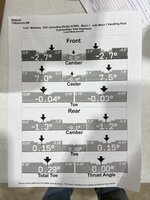
Here's some background. I have a 24 GT PP with MagneRide, and I've added several Steeda suspension components including front camber plates. The full list is included under my vehicle profile. I am new to tracking my car, and I have only taken my car to The FIRM in Starke, Florida. That is where I plan to track my car 90% of the time. Jamie with Steeda in Valdosta, GA did my alignment a couple months back after my first track day, a copy of which I have attached. He did say he didn't set the specs too aggressive since I would also be driving my car on the street. I have since purchased the Longacre digital caster camber gauge kit to enable me to adjust the alignment from track to street use. I don't daily drive my car, but I do put a few thousand miles a year on it just driving around, so I don't want to run an aggressive track alignment on the street.

My question concerns what the ideal alignment for my setup would be for running at The FIRM. The front camber is no big deal to adjust since I have the camber plates, but I don't have any camber arm installed in the rear. I know camber in the rear can be adjusted from the factory, but I understand it is a real pain to do and is limited to round -2.0. The second part of my question is whether I should add rear camber arms, and if so, what are people's recommendations for brands? I've looked at Steeda (which seems to be the most expensive), MMR and AAD. I like the AAD design because it looks like it would be easiest to switch between track and street specs once I got everything dialed in.

I look forward to hanging out in the forums, and I appreciate any input you who are more experienced can provide.
Steeda Alignment 7.25.24.jpg
 
Last edited:
The S550 and S650 from what I have heard are very similar in camber settings. The thing is your track and street driving. For example: my buddy has a car set up just like mine. I am faster so my camber is more aggressive than his. It works for my skill set on the track. His settings are good for him on the track. To me 2.7 is a good spot to be. I was at 2.9 on my FP springs and went with stiffer springs and the same camber. Well, I destroyed the inside of my tires at 2.9 and I decided to pull back to 2.5. We will see what happens
 
This is my first post in this forum, but I know often when people ask questions like I am about to, the main responses are "use the search function". I have searched and read many posts about alignment on this forum and other places. However, I still have some questions and am hoping some people with much more experience than me can help me out.

Here's some background. I have a 24 GT PP with MagneRide, and I've added several Steeda suspension components including front camber plates. The full list is included under my vehicle profile. I am new to tracking my car, and I have only taken my car to The FIRM in Starke, Florida. That is where I plan to track my car 90% of the time. Jamie with Steeda in Valdosta, GA did my alignment a couple months back after my first track day, a copy of which I have attached. He did say he didn't set the specs too aggressive since I would also be driving my car on the street. I have since purchased the Longacre digital caster camber gauge kit to enable me to adjust the alignment from track to street use. I don't daily drive my car, but I do put a few thousand miles a year on it just driving around, so I don't want to run an aggressive track alignment on the street.

My question concerns what the ideal alignment for my setup would be for running at The FIRM. The front camber is no big deal to adjust since I have the camber plates, but I don't have any camber arm installed in the rear. I know camber in the rear can be adjusted from the factory, but I understand it is a real pain to do and is limited to round -2.0. The second part of my question is whether I should add rear camber arms, and if so, what are people's recommendations for brands? I've looked at Steeda (which seems to be the most expensive), MMR and AAD. I like the AAD design because it looks like it would be easiest to switch between track and street specs once I got everything dialed in.

I look forward to hanging out in the forums, and I appreciate any input you who are more experienced can provide.
The guys that did my initial setup had an alignment for the front that would toe out at max -ve camber and come back to a less aggressive setting when the struts were pulled back to minimum.
Used that about once as the spring pressure made it a prick of a job to pull them back to minimum. Pushing them in was easy.

My question becomes why don't you want to run an "aggressive" track alignment on the street. You aren't daily driving it and a few thousand miles compared to track miles in nothing in the grand scheme. Tyre life isn't a huge issue at that distance with multiple track days for a year. You are also running a pretty normal road tyre compared to a soft or very soft compound track spec tyre.

The rear end on the stock S550 walked around a lot so i did change everything to get rid of the rubber bushings back there. It's also complicated as far as alignment goes and just adjusting one arm to change camber does more than that to the whole hub.

What i'm getting at is, get it aligned for the track and get used to driving it like that. I have learned that just because you can doesn't mean you should. Apply that to making adjustments to alignment that significantly alter the handling characteristics. You paid a guy with an expensive digital set up to do it for you. Now you want to try duplicate that on the floor of your garage with strings and tape measure. Not knocking that method as it has been used forever on racecars but even there its a way more precise setup.

On the road the front toe setting will have the most effect to the car wanting to follow every bump and camber change. Drive with soft arms but a firm grip and allow it to be "guided" by you. Let it wander within reason. Get used to feeling what the car does and how it behaves.
Pretty much everyone here will say the best thing you can do to improve your car is seat time for the one behind the wheel. Why does it feel different to last time, did i adjust it right, did something move. All the things you don't want to have to worry about. You drive it on the road or track and it feels like the same car to you builds your confidence in it.

Here are my setting and its driven like yours, track days and the occasional car meet or sunny weekend squirt.
Wheel Alignment Gordon Robertson(1).jpg

And pay attention to @Bill Pemberton above, he may have driven a few in his time.


And your car looks great in your profile photo, reds not normally my colour but that shot is awesome, the right angle, wheel turned, all the details just make it a glamour shot.👍
 
I would suggest you increase the rear negative camber to around -1.9 to -2.1 , as I do not think -1.2/-1.3 is a good balance for the track , imho.
Thank you for the suggestion. So the question is, if I adjust the rear camber myself is it going to throw off the toe? I'm looking to see if I would be ok to make the adjustment or if I'm going to need to get a professional alignment again.
 
The guys that did my initial setup had an alignment for the front that would toe out at max -ve camber and come back to a less aggressive setting when the struts were pulled back to minimum.
Used that about once as the spring pressure made it a prick of a job to pull them back to minimum. Pushing them in was easy.

My question becomes why don't you want to run an "aggressive" track alignment on the street. You aren't daily driving it and a few thousand miles compared to track miles in nothing in the grand scheme. Tyre life isn't a huge issue at that distance with multiple track days for a year. You are also running a pretty normal road tyre compared to a soft or very soft compound track spec tyre.

The rear end on the stock S550 walked around a lot so i did change everything to get rid of the rubber bushings back there. It's also complicated as far as alignment goes and just adjusting one arm to change camber does more than that to the whole hub.

What i'm getting at is, get it aligned for the track and get used to driving it like that. I have learned that just because you can doesn't mean you should. Apply that to making adjustments to alignment that significantly alter the handling characteristics. You paid a guy with an expensive digital set up to do it for you. Now you want to try duplicate that on the floor of your garage with strings and tape measure. Not knocking that method as it has been used forever on racecars but even there its a way more precise setup.

On the road the front toe setting will have the most effect to the car wanting to follow every bump and camber change. Drive with soft arms but a firm grip and allow it to be "guided" by you. Let it wander within reason. Get used to feeling what the car does and how it behaves.
Pretty much everyone here will say the best thing you can do to improve your car is seat time for the one behind the wheel. Why does it feel different to last time, did i adjust it right, did something move. All the things you don't want to have to worry about. You drive it on the road or track and it feels like the same car to you builds your confidence in it.

Here are my setting and its driven like yours, track days and the occasional car meet or sunny weekend squirt.
View attachment 98144

And pay attention to @Bill Pemberton above, he may have driven a few in his time.


And your car looks great in your profile photo, reds not normally my colour but that shot is awesome, the right angle, wheel turned, all the details just make it a glamour shot.👍
Thank you for the information. My only reason for not wanting to run that track alignment on the street is for reasons of tire wear. Initially, I planned to just leave it as it was setup for the track and drive it the street as it was. Then I decided to take the Mustang on a 1,000 mile road trip to the Ford Performance Racing School in Charlotte, so I figured since I was going to be driving it 1,000 miles on the street I may be better to reduce the camber for purposes or even tire wear. I may very well leave the camber settings for the track in the future as you have suggested. Your point about getting used to driving it with the track settings and taking away a variable between track sessions is a good one.

Thanks for the compliment on the car. I'm a Race Red fan; my 2019 was the same color. In almost all aspects of my life I am a low key and fly under the radar type of person; the exception to the rule is my car.:biggrin:
 
The S550 and S650 from what I have heard are very similar in camber settings. The thing is your track and street driving. For example: my buddy has a car set up just like mine. I am faster so my camber is more aggressive than his. It works for my skill set on the track. His settings are good for him on the track. To me 2.7 is a good spot to be. I was at 2.9 on my FP springs and went with stiffer springs and the same camber. Well, I destroyed the inside of my tires at 2.9 and I decided to pull back to 2.5. We will see what happens
I appreciate the feedback. I'll certainly keep an eye on my tire wear to see if it looks like I may need to make adjustments.
 
Curious that no one has commented that he has toe out in front. I guess that is ok? I was thinking he might want to pull it in to zero (?)
Toe out will improve turn in response, it will also make it dart around on uneven surfaces and tend to tug on the wheel. Good track cars tend to make entertaining road cars. Racetracks "should" have way better surfaces than your average road. As such the car behaves as we want and way more pleasant and predictable to drive. Everything in a setup is a compromise, what do you prioritize over another, what does your driving style suit. Where I once worked we had a setup for 80's 911's that just worked. Except for one person who had an oddball setup. Thing was he ended up being club champion a few times. If it works it works.

Just checked his settings and they are effectively zero anyway. Second decimal point in degrees is not worth looking at on a system that has any rubber bushings. Under load they will toe out more as well. Mine will make you start guessing the laws of physics.
 
Last edited:

Likely you would need to have the alignment done professionally , though I am surprised that whoever did it was not more aggressive in the rear , considering what they established for you in the front.
 
Likely you would need to have the alignment done professionally , though I am surprised that whoever did it was not more aggressive in the rear , considering what they established for you in the front.
So...9 months later, and down the rabbit hole I have gone. What I posted back in August 2024 no longer holds up. The car has essentially become a track car, although still registered for on road use. My setup will now include fixed back Cobra seats, six point harness, HANS and Watson 4 point roll cage. I have also gone to Continental ECF 295/30/19 square. I'm not just tracking at The FIRM, but Barber Motorsports Park, AMP, Road Atlanta and Roebling Road, with plans to also go to Sebring and Daytona. This is all just HPDE driving at this point, so no actual racing.

Now I'm no longer concerned about an alignment to work for both street and track; I would like to go with a track alignment that will work fairly well for multiple different tracks. Are you able to provide a recommendation for what you would consider to be a good "general' track alignment? Second, do I need to add some brand of camber arms for the rear to be able to give me the necessary negative camber? From my reading the rear camber is tough to adjust with the factory setup.
 
Get a Vorshlag front camber plate and read the info listed after me. Too early in the morning for this old fart, for some reason I was thinking you had a S197 ---- my eyes are now open and on a second cup of coffee. I deleted my non sensical answer and have a nice day.

Welcome to Wonderland , Alice, and you may notice the Madhatter is already a member here, ha!
 
Last edited:

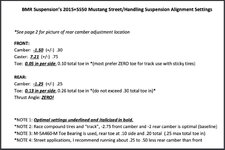
This is BMR specs for a start; others here with lots of experience may suggest a fine tune or two. Looks like BMR suggests a camber track setting at -2.75 front / -2.0 rear initially with zero toe front and 0.13 per side / 0.26 total rear toe in. I'm also playing with alignment settings and will be interested in commentary. I know once you go hardcore the trackrats use a lot more front camber than -2.75.BMR Alignment Settings.jpg
 
This is the setup sheet for a Dark Horse R and the minimal You should start for a real track car though -3.5 camber upfront is exessive you can get away with -3.2 or so.

I dunno. I ran slightly over -4 on my '16 and the tire wear was virtually perfect. Good for a couple of seconds a lap vs -2.5. That was with 305 Nankang AR1s and Vredestein Vorti Rs.

You need to get a bit radical with cutting out the strut tower tops but it's not a big deal to do. There's a jig that makes it very doable.

BTW, my Dark Horse is at -2.5 factory stock. I don't have plates, it was supposed to come with them but it didn't. I am good with -2.5 for what I'm doing now.
 
Last edited:

I dunno. I ran slightly over -4 on my '16 and the tire wear was virtually perfect. Good for a couple of seconds a lap vs -2.5. That was with 305 Nankang AR1s and Vredestein Vorti Rs.

You need to get a bit radical with cutting out the strut tower tops but it's not a big deal to do. There's a jig that makes it very doable.

BTW, my Dark Horse is at -2.5 factory stock. I don't have plates, it was supposed to come with them but it didn't. I am good with -2.5 for what I'm doing now.
I'm happy with -3 to -3.2 on AR1/A052 and lap times are good enough and wear is around the 200 laps mark so can't complain. Though my tracks are small around 3 km.
 
Every tire requires a camber & temperature it likes as I'd guess @blacksheep-1 would agree. (I.E. stiffer sidewalls, wider/narrow contacts, construction, compounds, etc.)
I'd suggest purchasing a pyrometer and learning how to interpret the data based on temperature across the contact patch. This will help you learn what a particular tires likes as well as what works best with your car and the suspension you have.

Enjoy the rabbit hole .. its deep and expensive.
 
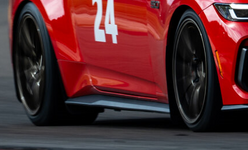
Your track day photos have a surprising amount of information as to what is happening dynamically to your tyres under loaded conditions.
Information you would normally have to figure out from reading the tyre edge.
In this shot your front wheel appears to be still in negative camber compared to the rear which looks to have gone positive in comparison. Would be interested if you feel the car tends towards over steer just from this visual interpretation.
The main point being you can see the amount of deflection, and looking at the tyre edge you can gauge if the tyre would really like more camber to stop it tucking under, losing its shape and therefore grip level.
As @saleen367 mentioned above, every tyre has a setup its happy with, how you keep it happy will be determined by your setup. You can gauge how happy the tyre was by looking at the wear pattern especially on the outside shoulder, the most obvious part. Looking across the tyre you can see if you are destroying the edge of every circumferential groove indicating under steer.
Some smart cookie on this site mentioned using some chalk on the shoulder and side wall to easily show how far over the edge your tyre is being worked.

I just got back from a very fast and flowing circuit, we were looking at the tyres with the workshop manager and discussing that i could possibly run a bit more camber on mine, or ideally more caster to get camber on turning given i am maxed out on camber settings. All the while discussing was it my driving style given it was a new track to me and i was on a mission to beat the boys who had been there a few weeks previously. And yes i beat the fastest Mach 1 boy by 1/2 a second.
@saleen367 it sure is a deep rabbit hole.

1747025593092.png
 
@Bill Pemberton @GJarrett @bnight @JDee @saleen367 @GAR944 Thank you all for the replies and feedback. I do have a Longacre pyrometer, and I will be checking the temperatures between runs when I go to Barber at the end of the month. I'll make what adjustments I can while there, which in reality will probably be limited to front camber adjustment.

With my current alignment settings and running the Continental ExtremeContact Sport 02, I wore out the inside shoulder of both front tires. Where the Sport 02 is a street focused tire, the EC Force, which I'll be running this year is designed for track use, so we'll see how it wears with the current settings.

It seems the rabbit hole never ends. I just spent the weekend tearing out the back seat and trunk area and installing the Watson Racing 4 point roll cage. Let's see what's next...
 
Top