The Mustang Forum for Track & Racing Enthusiasts

Taking your Mustang to an open track/HPDE event for the first time? Do you race competitively? This forum is for you! Log in to remove most ads.

  • Welcome to the Ford Mustang forum built for owners of the Mustang GT350, BOSS 302, GT500, and all other S550, S197, SN95, Fox Body and older Mustangs set up for open track days, road racing, and/or autocross. Join our forum, interact with others, share your build, and help us strengthen this community!
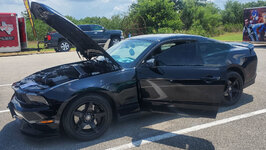
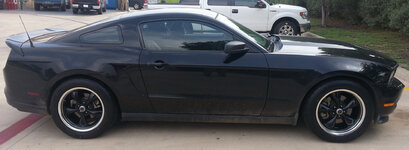
BackInBlack 1.jpg

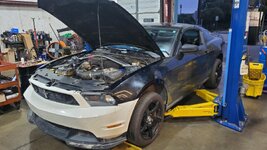
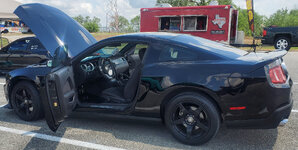
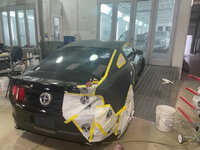
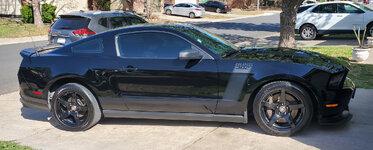
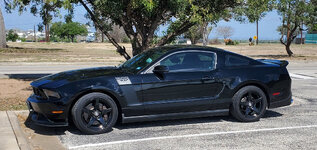
S197 BackInBlack Build Thread Profile - S197 Mustangs

Chassis Swapped Boss 302

This site may earn a commission from merchant affiliate links, including eBay, Amazon, and others.

A few updates: Transmission fluid showed up in the same areas under the car again so I began to worry. I figured I'd see how much fluid I'm losing and top off the transmission. I pulled the fill plug and fluid started gushing out of the fill hole! Someone overfilled it by alot. So I drained it to the proper level, cleaned it up and I've been checking on it to see if more fluid shows up. So far it looks like crisis averted. So that's good.

Gear noise is still there. Nothing to say now except that must just be the AMP gearset. Shifter feels great. The poly transmission bushing didn't seem to be doing anything for my car except transmit noise. Things did feel more precise with the Blowfish bracket, but removing that didn't cause me any shifting problems either. And that thing caused a loud vibration. Update on my panhard bolt hole... Don't know what I thought I saw there but I went to take pictures for the guy I was going to use to weld, and I didn't see any damage at all. I must have seen it from a bad angle or something? Anyway, it looks like I'm good to go on that -- until I figure out that I was looking at the wrong hole or something.

And when I'm all ready to call it quits on my engine investigation and just live with it, I get an unexpected new data point that gives me one last hope of solving it. I'll go over the clues I have so far -- large and small. Been over the entire car multiple times at this point, so anything not mentioned has most likely been ruled out more than once. The transmission stuff appears to have been a red herring.
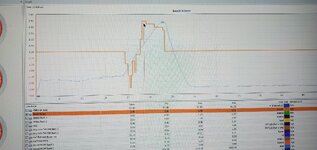
  • Shaun at AED says he can't tune me due to knock during WOT datalog. Datalog shows between 1-3 degrees knock starting at around 5k rpm. Happens at WOT only. Doesn't happen while daily driving. I've also taken the car to a local dyno tuner who also refused to tune the car.
  • 1779123424970.jpeg
  • Long term fuel trims started off at around 19%, but after replacing the cracked intake tube, replacing the injectors, installing new plugs and some other things, I'm down to a high of around 11%, with averages around 8%.
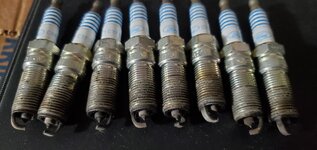
  • New Motorcraft spark plugs were installed at build time, 10K miles ago and when I pulled them out they were pretty dirty. Not ruined but lots of carbon. Replaced with new NGK iridiums.
  • 1779123297965.jpeg
  • After finding the inside of my intake manifold caked with oil, I installed the FRPP oil separator on the passenger side. I've whittled my check intervals down to about once every 2k miles, and in that time I never find more than about 3 oz. of fluid, no matter whether I'm doing road trips, WOT datalogging or just driving around town.
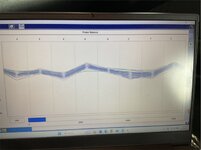
  • Ran a full battery of FDRS tests on the engine. Found cylinder 3 to have a slightly lower power output than the others, but still well within spec. Timing and everything else well within spec. Scoped cylinder 3 and found scoring. Not terrible scoring but does appear that it could impact on how the engine runs.
  • 1779123681308.jpeg1779123215013.png
  • Did compression and leakdown test. Results were very healthy, well within spec.
  • I never see any blue smoke, but at cold start in the morning, the car does chug a little and there is a clear gasoline smell if I have the door open. I even tried setting a camera right next to the exhaust to record a cold start and I don't see anything unusual. After less than a minute, the engine is running normally and the smell is gone. OEM cats are still functional and are on the car, so light blue smoke might be being masked.
  • Tried using some pretty aggressive seal conditioner (AT-205) with no solid results to report.
  • Oil consumption has always been high. It varies anywhere between .2 qt. in 1k miles, to over a quart in 1k miles. Averages around 1/2 quart per 1k miles.
Now, the unexpected new datapoint. So, to get to my transmission builder, I have to drive several hundreds of miles. In preparation, I changed the oil with a fresh fill of Amsoil 5W-50 about a week before I left. I had only driven about 2k miles on the previous fill and while there was some consumption, it was negligible and I didn't need to top off in that time. That 2k miles would have been mostly city driving. After driving to the transmission builder and back, I didn't check the oil right away. But the day after I got back, I started noticing a ticking noise at cold start. Now the transmission builder told me that there was a problem with my QTP side pipe cutouts (and there was) and that's what they thought the noise was. But the noise persisted after I pulled the cutouts off. I said, "uh oh" and checked the oil -- and I was a little over a quart below the full line. Then I realized, the last time I had oil consumption like this I had done a road trip too. This's gotta be a clue! I fed all of this information into an AI, and the AI concluded that there's an issue with my valve seals. It said that if my oil consumption were from the cylinder wall scoring and blowby, that I'd be getting more oil in my catch can. It also said that if it were blowby, the oil consumption would be more tied to RPM. Whereas getting more oil consumption from long distance highway driving had something to do with creating a vacuum in the seals or something (I forget the details). But it sounded like it made sense... What do you guys think?

Now, I did try the valve seal angle previously by using seal conditioner, but that wouldn't help if there was a rip or if something wasn't seated right for another reason. I've read that valve seals can be replaced without removing the cylinder head, but every time I've asked someone about it, I was told that they wouldn't do it and that they'd pull the cylinder head for a rebuild instead if I really wanted to do that. Is that (replacing valve seals without removing the cylinder head) a really risky job? Because, to me, if I'm gonna pull the cylinder head, I might as well do the whole enchilada while we're in there considering the costs, and my car just doesn't need that yet. But if there's a cheaper way just to replace the seals, there might be a way to save this engine... get it in ship shape... and maybe one day even beat on it like it's meant to be beaten on...
 
Last edited:
I've read that valve seals can be replaced without removing the cylinder head, but every time I've asked someone about it, I was told that they wouldn't do it and that they'd pull the cylinder head for a rebuild instead if I really wanted to do that. Is that (replacing valve seals without removing the cylinder head) a really risky job? Because, to me, if I'm gonna pull the cylinder head, I might as well do the whole enchilada while we're in there considering the costs, and my car just doesn't need that yet. But if there's a cheaper way just to replace the seals, there might be a way to save this engine... get it in ship shape... and maybe one day even beat on it like it's meant to be beaten on...

You can do it with the heads on. Just use an air compressor to hold the valves up.

It is a lot easier with the heads off and a clamp type valve spring compressor tool, though.
 
Is it normal for one quart low to cause ticking in the valve train?
I THINK so. My very rudimentary understanding based on what I've read from others on the internet, is that if it's low on oil, it takes longer to build up oil pressure and so you get some piston slap. Feel free to correct me if this is off. I'm an engineer! Not a mechanic Jim!

You can do it with the heads on. Just use an air compressor to hold the valves up.

It is a lot easier with the heads off and a clamp type valve spring compressor tool, though.
That's what I read. But nobody seems to want to do it...
 
I pulled the fill plug and fluid started gushing out of the fill hole! Someone overfilled it by alot. So I drained it to the proper level, cleaned it up and I've been checking on it to see if more fluid shows up. So far it looks like crisis averted. So that's good.
Just curious, how can one fill the transmission beyond the fill plug height?
 
Just curious, how can one fill the transmission beyond the fill plug height?
By filling while on a non-level surface. Since the fill plug is situated at the back, if the car nose is tipped forward you can get more fluid in the case before it dribbles out the fill plug opening. If then opened on a level surface later, the excess fluid will come out.
 
Just curious, how can one fill the transmission beyond the fill plug height?
Well, I've found that if you're using a hand pump, that the thickness of the pump's hose combined with the thickness of the fluid make it such that you can cram a bunch of fluid in there before pressure squishes it out. So it's pretty easy to overfill at least for me. In fact, with the hand pump I use ($5 one from NAPA), it doesn't spill a drop until I pull the hose out.

My guess as to what happened is that they were trying to overfill a little in order to lessen the gear noise. I did notice that when I drained it to the proper level that it got a little louder. It seems that the AMP gearset that's in there combined with the fluid they recommend (Dex3 ATF) make for some noisy gears. It shifts great, but it's noisy enough that it became a suspect for some of my car's issues. That turned out to be a goose chase though.
 
Last edited:
By filling while on a non-level surface. Since the fill plug is situated at the back, if the car nose is tipped forward you can get more fluid in the case before it dribbles out the fill plug opening. If then opened on a level surface later, the excess fluid will come out.
Ok, that'd do it!
I put my car up on quickjacks... didn't even occur to me.
 
Guys. Our old "Truck Axel" fords have a plug in the cover and a plug in the housing, at the front near the input yoke. The one in front, correct me if Im wrong, is the one you use to indicate correct level. Pull both plugs, add fluid through the rear hole and stop when fluid goes out the front hole. Assuming the car is on a level surface.
 
Guys. Our old "Truck Axel" fords have a plug in the cover and a plug in the housing, at the front near the input yoke. The one in front, correct me if Im wrong, is the one you use to indicate correct level. Pull both plugs, add fluid through the rear hole and stop when fluid goes out the front hole. Assuming the car is on a level surface.
The ones I know about are the drain hole at the bottom and the fill hole on the passenger side (about in the middle of the housing). On mine there's also something that LOOKS like a plug on the driver's side, nearer to the top of the transmission, but in my case that has been intentionally sealed with some kind of goop. Not sure what that one's for or if it's even really a plug, but all of the info I have says the fill plug is the one on the passenger side.

If you're talking about the diff -- I guess it depends on the cover you're using. The Boss/GT500 cover technically has 3 plug holes I think. The top one is for the vent, I think the 2 front (front of the cover, facing rearward on the car) ones are for a cooler but some people use the lower one to drain. Doesn't seem like a good idea to me because you won't get all the fluid out. I think the proper way to drain is to remove the cover. And then you have the one in the rear on the axel housing (facing the front of the car) which is the fill plug where you fill until it comes out.
 
Last edited:
Been doing a lot of research on my frankenstein gearbox and on various types of gear oils I could use. My transmission builder recommends conventional Dex3 ATF because the AMP gearset was designed to mimic Tremec gear design and has tighter clearances. Here's a couple of old posts I found from AMP Distributing from back when they were in the design phase:
This one is a bigger clue than I realized -- this post by @67GTA on TMO says that the TR6060 2nd gear is an, "advanced" gear design...
While researching all of this, I’ve learned some interesting facts about the Magnum XL’s, and differences that exist between the 2.97 and 2.66 boxes. Both use an advanced tooth gear and synchro design on 2nd gear, paired with upgraded carbon fiber blocker rings. This is an “upgrade” from the earlier design Magnum’s which used only symmetrical gears and bronze rings. The “upgrade” was intended to improve cold weather 2nd gear shifts, however the advanced tooth is not the best performance option.

Where the two boxes differ is 3rd gear. The 2.66 box uses an advanced tooth design on 3rd, while the 2.97 uses a symmetrical type gear and synchro. Again, the advanced tooth design is a carry-over from the OE TR-6060, where the priority was placed on smooth shifting in all climates, rather than best design for optimum performance. The owner of Modern Driveline, Bruce, mentioned this on a call when I was describing the issues I’m having. He said that the Tremec Elite distributors have been trying to convince Tremec to use only symmetrical gears in the Magnum and Magnum XL’s, as most of the aftermarket sales are for performance oriented vehicles.
So AMP was clearly going for a more precise and more durable street oriented design... I would guess that Calimer's G-Force gears would have more clearance and would rely on the thicker fluid he recommends for drag racing durability.
TX Drivetrain Performance says something different:
One thing that stands out to me in this quote is the part about fluid being under high pressure. To me it sounds like they're talking about GL-5 fluids here, and this makes me think that they just went with conventional ATF because it's safe. Maybe they didn't want to have to worry about customers destroying their transmissions by using the wrong stuff? It could also be a carry over concern from the older paper synchronizer days.

So it seems to me that AMP designed this gearset with a synchromesh in mind, but also with the viscosity of ATF. On the other hand, TDP says don't do it! This led me to look at what Tremec recommends and what Tremec owners do. And while Tremec generally recommends Dex3 ATF, they also specifically say that Mobil 1 ATF (synthetic) is recommended, and that their own Tremec (synthetic) MTF is safe to use as well. And many other Tremec owners have used other things like Redline D4 (synthetic GL-4) ATF and also various types of synthetic synchromesh fluids. To me this says that synthetics can be safe to use, I just have to be more careful about picking the right ones. And a lower viscosity fluid that resembles ATF seems like it'd be best. Luckily enough, Ford seemed to have the same philosophy as Motorcraft XT-11-QDC is even thinner than ATF.

So, I'm thinking a GL-4 synchromesh with the viscosity of ATF. That is a thing. BG SynchroShift II...
 
Last edited:
I just got my 200k mile MT82 rebuilt by Lashbrook and they recommend the stock Ford fill. https://lmr.com/item/LRS-MT82SVC/mustang-motorcraft-transmission-fluid-service-kit-mt82-11-18
So there's still a possibility that my transmission is the cause of my engine knock, but the only possibility left there is false knock from gear noise. I'm looking for something that'll quiet it down a bit, but I'm also a little nervous because my builder says to use only conventional Dex3 ATF.

I thought about trying the OEM stuff -- it has a low viscosity that I think this gearset would like, but it isn't a proper gear oil and it was chosen for a stock MT-82 that has brass synchros so I thought maybe something that mentions compatibility with both brass and carbon synchros would be good... Also, I think I'd prefer to keep the hot viscosity high without exceeding the viscosity of Dex3 ATF (7.5) too much. I also considered Ravenol MTF3, Redline MT-LV, and Redline D4 ATF that some of the Tremec guys use. I think the Ravenol is my #2 pick -- I'll probably try it after the BG if the BG is a little off, and the Redline MT-LV looks to have about the same viscosity as the Motorcraft stuff, but GL4 rated. I might try that one if I have notchiness or lockout problems. And I'll run back to the ATF if I need to. The ATF works well, it's just noisy as hell and it isn't a proper gear oil. I can live with it -- fair tradeoff for an upgrade I guess but if it's causing engine knock then that won't do... Hopefully I'll get closer to verifying the cause of the knock with some more testing...

Let us know what you think of the Lashbrook rebuild after you get a feel for it!
 
You’re going a little deeper than I am, but the Lashbrook rebuild does use the carbon synchros. And still recommending the oem fill. Lashbrook has been exceptional imo btw.
 
Take a look at Motul DCTF. Haven't used it yet, but heard good things.

Switched mine to DCTF and I've had nice results. It cleared up some crunchiness at low RPM for me, and seemed to clean up the gearbox all around.

I will say this - moving to a McLeod RST & an MGW X-Spec has made this thing just an absolute blast to hamfist around. Shifts f***ing amazing at 4000RPM or 7500RPM.
 
New datalog complete! The new springs made the car feel much more stable doing the pull. Unfortunately, no change. 3.6 degrees knock. Next step, datalog with octane booster! If the knock reduces, that's the end of the road. I'll pull 3-4 degrees timing at WOT and call it a day. If there's no improvement, then I'm gonna try a transmission fluid change to quiet down the tranny.
 
Just go put 2-3 gallons of e85 in, you’ll get the octane you’re looking for.
 

Latest posts

Buy TMO Apparel

Buy TMO Apparel
Top