The Mustang Forum for Track & Racing Enthusiasts

Taking your Mustang to an open track/HPDE event for the first time? Do you race competitively? This forum is for you! Log in to remove most ads.

  • Welcome to the Ford Mustang forum built for owners of the Mustang GT350, BOSS 302, GT500, and all other S550, S197, SN95, Fox Body and older Mustangs set up for open track days, road racing, and/or autocross. Join our forum, interact with others, share your build, and help us strengthen this community!

S197 smaller sway bar more better?

This site may earn a commission from merchant affiliate links, including eBay, Amazon, and others.

257
122
Exp. Type
HPDE
Exp. Level
Under 3 Years
Nova Scotia Canada
Been seeing folks talking about running a smaller rear bar or no rear bar is better on the s197 and I’m trying to figure out why that is. From my understanding a larger rear bar would reduce body roll, am I wrong?
 
As someone who has doglegged an S197 during autocross before, too stiff a rear bar lifts up the inside rear wheel and reduces traction. A stiff rear bar also increases oversteer. Most commentary comes from those running a helical differential that requires inner wheel traction to stay present in order for it to function correctly, so they're extra sensitive to make sure the inner rear wheel doesn't become unloaded in a corner.
 
Smaller rear bar has worked great for me as I have progressed. Started on the FRPP 22 mm bar, then went to the convertible 18 mm bar, and now on the Watson 1/2 inch bar. It’s the best so far.

Cortex makes their adjustable rear bar that has the softest setting the same as the Watson 1/2 inch bar according to Filip.

Some run no bar, but I don’t like the feel at turn in. To me the car kind of shifts weight to the outside before gripping. Unnerving for me.
 
Was running a 18mm rear bar awhile ago and the car felt good and was happy for a bit. Later going with out a bar, that took some getting used to, but it is a considerably faster set, Corner exit becomes spectacular. It funny to see a Porsche stuck to you bumper mid corner, only to loose 5 or 6 car lengths at least on exit.
 
Was running a 18mm rear bar awhile ago and the car felt good and was happy for a bit. Later going with out a bar, that took some getting used to, but it is a considerably faster set, Corner exit becomes spectacular. It funny to see a Porsche stuck to you bumper mid corner, only to loose 5 or 6 car lengths at least on exit.
I think I saw that on TV! :)
 
What's the problem you're trying to solve?

Softening the rear roll stiffness (or stiffening the front) will let you get on the throttle sooner on corner exit, at the expense of increasing understeer. You're balancing that increased understeer with throttle-on oversteer on exit, but it's still there on corner entry and steady-state.

For road racers, where there are nice, long staights after many corners, being able to get on the throttle faster / harder nets them a benefit all the way down those straights, and thus the lap in overall. A bit more understeer on corner entry and mid-corner is an acceptable tradeoff, and might even make the car feel more secure in high speed corners.

In contrast, autocrosses seldom have long straights, and they have much tighter turns. A much higher emphasis is placed on transient handling at low(er) speeds. Another way to get on the throttle earlier is to rotate the car earlier in the turn, and having a car that is neutral to loose on entry can be a benefit in autocross, especially in tight turns. You can also dial out understeer on corner entry with things like shock tuning and increased rear brake bias*.

*There are handling tricks that work great at 40mph and will try to kill you at 140mph.
 
What's the problem you're trying to solve?

Softening the rear roll stiffness (or stiffening the front) will let you get on the throttle sooner on corner exit, at the expense of increasing understeer. You're balancing that increased understeer with throttle-on oversteer on exit, but it's still there on corner entry and steady-state.

For road racers, where there are nice, long staights after many corners, being able to get on the throttle faster / harder nets them a benefit all the way down those straights, and thus the lap in overall. A bit more understeer on corner entry and mid-corner is an acceptable tradeoff, and might even make the car feel more secure in high speed corners.

In contrast, autocrosses seldom have long straights, and they have much tighter turns. A much higher emphasis is placed on transient handling at low(er) speeds. Another way to get on the throttle earlier is to rotate the car earlier in the turn, and having a car that is neutral to loose on entry can be a benefit in autocross, especially in tight turns. You can also dial out understeer on corner entry with things like shock tuning and increased rear brake bias*.

*There are handling tricks that work great at 40mph and will try to kill you at 140mph
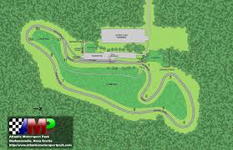
Not really trying to solve a specific problem but I had heard folks talk about it especially when using a Torsen diff which I’ll be installing when I do my gearing change. I mainly use the car for track days and the only the occasional AutoX event. Power down corner exit is pretty critical at my local track as the straights are short and separated by low speed corners

Whole track is 1.6 miles

C8F3EACA-E508-4FDC-8291-906E56A1C30C.png
 
Just guessing, but I'd give the 18mm "convertible" rear sway bar a try. Not sure how easy it might be to find a used one, but I'd give that a shot first (try a WTB post in the forum Marketplace as well as local auto recyclers). If you don't like it, it's popular and you might be able to sell it on.
 
@Mad Hatter those videos of you with the GT4’s never get old, awesome

Adding to other comments, in general if you run a square setup with lots of front camber, you increase front cornering grip so you can back out the rear sway bar without causing too much understeer. Which then really improves power down off the apex. Win win but it’s all a balance of course.

On street I’ve noticed running no rear sway combined with a fair bit of shock rebound damping makes the rear axle a lot more settled on bumpy roads. Consider removing your rear sway completely and cranking up your Konis a bit, it’s easy to do and will give you a good sense of the extremes and then you can adjust to your preference from there.
 
Just guessing, but I'd give the 18mm "convertible" rear sway bar a try. Not sure how easy it might be to find a used one, but I'd give that a shot first (try a WTB post in the forum Marketplace as well as local auto recyclers). If you don't like it, it's popular and you might be able to sell it on.
Found someone locally who has one just have to go and get it and if that falls through I believe dorman sells an 18mm bar
 
Adding to this conversation, the Dorman part number for the 18mm bar is 927-203.

I'm curious, though, what you guys are doing for endlinks with the 18mm bars? I see that MM and a few others offer poly bushing kits for the 18mm bar. Are the stock-style endlinks (Dorman or otherwise) with poly bushings sufficient enough, or is this something that needs to be upgraded? In theory, it looks like you could find an 18mm bushing to fit the Steeda, BMR, or FRPP/Eibach billett rear links, but I don't own any of these to confirm.
 
Top