- Thread starter
- #1,361

Mad Hatter
Gotta go Faster
This is what HAL says.
The 2011–2014 Coyote isn't a fixed-pressure system. It's electronic returnless: the PCM commands a rail pressure target and a Fuel Pump Driver Module varies the pump's duty cycle to hold it. There's no in-tank regulator setting a constant value (AmericanMuscle). ~55 psi is the figure usually quoted as the base target, and I could not verify a factory spec number from a source I'd stand behind, so treat it as approximate rather than a specification.
Why that changes the question. Because pressure is closed-loop, 55 psi is what you get while the pump still has headroom. Once duty saturates at 100%, the commanded pressure stops being achievable and the actual pressure falls — and injector flow falls with the square root of it. That happens at peak rpm and peak load, which is exactly where you don't want it. So the useful number isn't the system's nominal pressure, it's your rail pressure at 7,600 rpm at WOT on E85. That's a measurement, not a spec.
And here's the part I'd take seriously. Converting your own dyno figures to volume at the rail:
E85 costs you about 40% more pump for the same horsepower. A single stock Coyote in-tank pump is generally reckoned good for somewhere around 500–550 crank hp on petrol — which translates to roughly 360–390 hp on E85. You're asking it to support ~606.
So one of two things is true: your pump isn't stock, or it's running with essentially no margin.
If it's the second, note that your dyno pull didn't test it. A pull is fifteen seconds at full load with a cold, full tank. A Codegua lap is two minutes with the tank heat-soaking, the level dropping, and sustained lateral g pushing fuel away from the pickup in long corners. A pump that holds pressure on the rollers can give it up on lap four with a quarter tank in a long right-hander — and on an 12:1 engine on E85 at 7,800 rpm, a lean event there is not a slow failure.
Two channels on the next log settle it: FPDC and fuel rail pressure, both at WOT to the limiter. If FPDC is pegged at 100% or rail pressure sags below target near redline, the pump is the answer before anything else on the list
The 2011–2014 Coyote isn't a fixed-pressure system. It's electronic returnless: the PCM commands a rail pressure target and a Fuel Pump Driver Module varies the pump's duty cycle to hold it. There's no in-tank regulator setting a constant value (AmericanMuscle). ~55 psi is the figure usually quoted as the base target, and I could not verify a factory spec number from a source I'd stand behind, so treat it as approximate rather than a specification.
Why that changes the question. Because pressure is closed-loop, 55 psi is what you get while the pump still has headroom. Once duty saturates at 100%, the commanded pressure stops being achievable and the actual pressure falls — and injector flow falls with the square root of it. That happens at peak rpm and peak load, which is exactly where you don't want it. So the useful number isn't the system's nominal pressure, it's your rail pressure at 7,600 rpm at WOT on E85. That's a measurement, not a spec.
And here's the part I'd take seriously. Converting your own dyno figures to volume at the rail:
| fuel mass | volume at rail | |
|---|---|---|
| E85, 527 rwhp | 388–417 lb/hr | 225–242 L/hr |
| same power on 98 | 265–285 lb/hr | 161–174 L/hr |
E85 costs you about 40% more pump for the same horsepower. A single stock Coyote in-tank pump is generally reckoned good for somewhere around 500–550 crank hp on petrol — which translates to roughly 360–390 hp on E85. You're asking it to support ~606.
So one of two things is true: your pump isn't stock, or it's running with essentially no margin.
If it's the second, note that your dyno pull didn't test it. A pull is fifteen seconds at full load with a cold, full tank. A Codegua lap is two minutes with the tank heat-soaking, the level dropping, and sustained lateral g pushing fuel away from the pickup in long corners. A pump that holds pressure on the rollers can give it up on lap four with a quarter tank in a long right-hander — and on an 12:1 engine on E85 at 7,800 rpm, a lean event there is not a slow failure.
Two channels on the next log settle it: FPDC and fuel rail pressure, both at WOT to the limiter. If FPDC is pegged at 100% or rail pressure sags below target near redline, the pump is the answer before anything else on the list

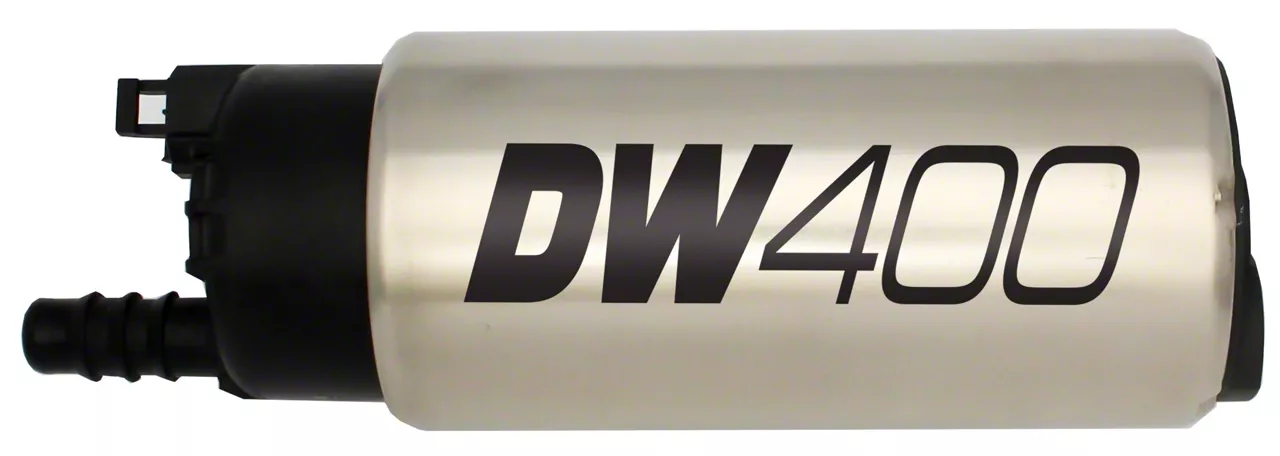


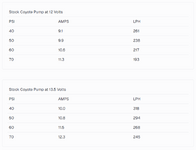
 . You could try to run a 25amp fuse in #13. I know the Boost-a-Pump instructions will just tell you to slap a 30amp fuse in there, so if the micro relay was running into issues I bet they wouldn't advise that (however, once again, the Micro 280 ISO relay is supposedly rated for a much higher momentary capacity which would be okay for the 10 seconds during a drag racing pass - not a continuous endurance racing scenario). I'd still keep a spare relay in the trailer, just in case.
 oops
oops