The Mustang Forum for Track & Racing Enthusiasts

Taking your Mustang to an open track/HPDE event for the first time? Do you race competitively? This forum is for you! Log in to remove most ads.

  • Welcome to the Ford Mustang forum built for owners of the Mustang GT350, BOSS 302, GT500, and all other S550, S197, SN95, Fox Body and older Mustangs set up for open track days, road racing, and/or autocross. Join our forum, interact with others, share your build, and help us strengthen this community!

coil over spring rate help

This site may earn a commission from merchant affiliate links, including eBay, Amazon, and others.

good read. I have some variables on my car that change some of what you are discussing (to a small degree) - 5" min ride height measured inside the pinch weld, track only w2w focus, dot hoosier r7 race tire, and 4 wheel triple adjustable coil-overs (among other things). I am headed out to road Atlanta on Sunday for 7 hrs of track time (prob won't use it all) and an extra test driver or two to help with what im feeling to be similar to what they feel. We always went for more rebound than compression but a very well known engineer has mentioned to have much more compression than rebound so will be trying that to see. Also have the pp2 front lip and wing (its what's legal) but some are thinking the front lip is too much for the tiny rear wing and lack of aero in the back is not helping. im starting with a 800 front spring and a 950 rear (was going to try a 1100 to start but ill have them with me to try if needed as the rears are a simple swap). I do have 700 fronts if needed but when used in the past had too much roll over - and the struts are a pain to swap springs. I will update findings on Monday ;)
 
It's taken me a week to write this brain dump. I hope it's worthwhile.

This is going to get long winded, but I’ll explain how I approach Spring and ARB selection.

TL;DR: Springs primarily control pitch and heave motion. Bars primarily control overall roll angle and roll-couple distribution. Clearly define the problem before choosing the tool to do it.


I feel like I need to preface this a little bit. Without getting into particulars, this is something I do _a lot_ and I’ve spent about 30 years figuring out a method. This is not “THE” method, because there’s no such thing as a single way to choose springs and bars for a car. Everyone has their own approach; this is a Cliff’s Notes version of mine.

There are three main car motions we’re concerned: Heave, Pitch and Roll. Heave for our cars is confined to the crests and compressions of the track. If you start to add some aero into the mix, then you’ll need to support that as well. Pitch is the motion which has the biggest influence on the handling of the car. Generally speaking, as you lower front ride and/or raise rear ride height (known as increasing chassis ‘rake’.) you will make the tend towards oversteer, particularly early in the corner. As the rear squats (reducing rake) the car will tend to understeer. Controlling rake angle is very important. Roll is the motion we get to play with the most and it’s the one that will ultimately determine our roll-stiffness distribution front to rear. Springs determine base roll couple, but the bars produce anywhere from 10-50+% of the total roll stiffness and can allow you to heavily influence the handling balance. These are our 3 primary modes of chassis motion.

Springs give a vertical stiffness to each corner. They will deflect and resist the car chassis motion as the inertial loads of the car shift due to driving. Springs are active in all chassis modes. Anti-Roll bars are springs which are only active in the roll mode. Bonded anti-roll bar bushings are a trick OEM’s use to produce low friction motion. The spring rate of bonded bushings can be added to the spring on that corner for it’s influence. It’s not ‘binding’. They’re intentionally using it to stiffen ride.

When I’m taking a first cut at springs, My initial goal is to choose a front spring which will support the front end adequately during heavy braking. If the car has a lot of travel on the front while braking, that limits how quickly the driver can ramp up brake pressure and, in general, reduces the driver’s confidence by allowing excess brake dive (positive chassis rake) which can cause rear instability. (With stock spring rates of 170#/in, I had a lot of brake dive and had to catch the rear of the car all the way to the apexes and it was tough to get the car to act consistently.)

The rear spring is chosen to allow as much vertical travel as possible, which will improve our traction and corner exits) without the driver complaining of excess chassis motion (squat or reduced rake) on throttle or a general lack of responsiveness in direction change even with appropriate rear roll stiffness. The rear will end up moving about 15-30%% more than the front even though the G-load in braking is 50% or higher than our G-load in acceleration. Cars are always more sensitive to ride height on the front than they are the rear. Allowing the rear a bit of extra compliance help with traction almost always pays off.

Once I’ve selected springs, I use the anti-roll bars to set my overall roll stiffness and roll-couple distribution. The springs will have their roll stiffness contribution and the anti-roll bars will have theirs. If you calculate the roll stiffness of the front and the roll stiffness of the rear, you can come up with a Mechanical Balance ratio of the front roll stiffness to the total. The slang is ‘Mech Bal’. If we’re running a 60% Mech Bal, then 60% of our total roll stiffness is taken on the front axle. This number will vary somewhat due to the track and conditions, but if you hold the mech bal consistent, you can do a global stiffen or soften and not change the mid-corner balance of the car all that much. It’s a cool party trick.

Here’s something that’s a little less intuitive. If we were going to put our car in some sort of simulation program to optimize lap time using all the variables that can change on the car, it wouldn’t give us one setup. It would give us a bunch of setups that all run the same basic lap time within a fractions of a tenth. The spread in mech bal would probably be at least 15% from setup with the lowest to the one with the highest mech bal. It’s not like there’s a single specific value to shoot for. There are any number of tuning variables we can use to tune the balance of a car. They all have compromises. If the car is doing what I want it to do in terms of heave and pitch motion, then I’ll try to leave the springs alone and tune the balance in a different way. If you’re racing, a lot of times you’re in the position where either you can’t change the springs due to time, you don’t have the spring you really want, you’re not allowed to change the springs or whatever. Regardless, you still have to figure out how to make the car turn.

If someone is making the argument that a stiffer rear spring will reduce understeer, I’ll completely agree. Having said that, it’s often not the most efficient way to do it. By that, I mean the compromise of increasing spring rate (decreased compliance) can be a greater negative than the compromises we might have by achieving that same balance with a different choice.

Some ideas to reduce understeer other than increasing rear spring:

Lower front ride height

Higher rear ride height

Softer FARB

Stiffer RARB

Softer front compression damping

Stiffer front rebound damping

Stiffer rear compression damping

Softer rear rebound damping

Reduce rear camber

Reduce rear toe-in

Optimize front camber (It’s not always a gain to increase)

Optimize front toe (In or Out is equally valid. It varies by car and tire.)

Increase caster

Increase rear weight distribution

Optimize tire pressures


I know that a fair number of people calculate their ride frequencies and talk about their suspension stiffness in those terms, which is perfectly fine. I’d have to get sprung and unsprung weights to do the calculations personally. I’ve promised myself I wouldn’t, but that might change. It’s a good way to compare the suspension stiffness of dis-similar cars. Where people get into trouble is when they start using those ride frequency calculations to apply Flat-Ride criteria to a performance car. That’s a bad idea. In very general terms, I find my best cars end up with having the rear ride frequency about 85-90% of the front. There’s nothing magic about this value. It doesn’t influence car motion in any specific way. It’s just a pattern I’ve found over the years. Once I’ve got the rear ride freq up to 93% or so of the front, I know I’m getting to the point of diminishing returns. I need to look to other variables to influence balance. If I can be at 83% and still have a positive front end without carrying a ton of RARB (which will eventually hurt traction), I’m stoked. Generally speaking, though, you have to carry a little more rear spring and/or bar than you’d want to get a balance everyone is happy with.

It's also important to discuss the target balance. That will depend what you’re running. If you’re doing an AutoX, then you need a ton of front end and you just have to deal with the tail wagging around. Having said that, traction will be important, too, so it can’t be a complete sacrifice. If you’re on a smaller racetrack with 2-3 gear corners, then you’re going to be challenging the rear of the car with traction, especially if the track is bumpy, and you’ll soften the car to dial in a little more understeer. If a track gets really fast, especially if there’s a lot of rubber down and banking, then you might have to increase the rear spring and free the car up a little, again, because you don’t have to deal with traction issues as much.

Another thing to consider is how long you want to drive the car in any one go. If you’re doing TT stuff, you can use the rear tires pretty hard, because they only need to live one lap at a time. If you’re doing a 20 minute session, then you can’t use them as hard. If you’re running a double race stint, you have to genuinely protect them by starting the car with an intentional understeer knowing the balance shift will favor the front as the tires deg.

I have found that more experienced drivers will almost always prefer a car which has *more* understeer than a novice will want. The reason is fairly simple, the novice does pretty much everything wrong and can’t load the front of the car correctly at the entry of the corner, so they either under-shoot or over-shoot the corner and induce a fair bit of the understeer they experience. A better driver will brake later, load the front-end better on the corner entry and still not over-drive the turn-in point. He’ll be able to carry more rake in the chassis all the way to the apex with the brake and have the greater share of the turning done in the corner at the apex. He won’t induce the understeer the novice does, so he’ll *want* more rear grip. To a guy like this, more rear grip means he can load the front harder. At some point, the driver will reach the point where he can’t load the front any more. That’s where we find the limit of adding rear grip. The goal is always driving straight off the corner. You don’t want to be balancing the car on the throttle all the way to the exit curb.

____________________________________________________________


S550 specific info:


Some of the numbers I throw out are a little polluted for everyone, because I have an Eco. I will just naturally have less mass to control on the front and less understeer overall. Regardless, these are numbers I’m certain that anyone could put on their car and have a hell of a good day a the track running.

I’m presently running a 500# front spring. I think that’s a reasonable spot for an AutoX/Street car. 400 #/in would be my ‘Street-only’ choice. If I were going to the track with 200tw tires, I might bump it up to 600’s. If I were running slicks, I’d definitely bump it up. I can see running in the range of a 750# front spring, easily. I don’t see any need to go softer than 400 #/in if you have Magneride. If you’re on some sort of stock-ish damper, you might have to go a little softer, but that’s more a damper issue than anything.

I never thought the stock rear spring felt all that bad in terms of stiffness, I just thought it felt too high of a ride height. Regardless, I followed what everyone was saying (at least to some extent) and put a stiffer (950 #/in) rear spring in than the stock (720 #/in) one. I was told to go to 1100. I could lower the rear ride now but now I was feeling the rear skate on bumps and it felt like the rear of the car was bouncing a lot on the tire. Traction was not very good on rough pavement and on smoother pavement, I was getting a lot of drifting on throttle. After that, I got a 20mm rear anti-roll bar (my car came with a 24mm rear bar). It improved mid-corner balance, but it still wasn’t good on bumps. I’ve dropped rates to 850, then 750. Both felt better than the last. At that point, I thought, well, how far *can* I drop? I’m presently on 500 #/in rear springs with a 20mm rear anti-roll bar. I’m not going to lie, this combo is pushy, even for me. Having said that, it rides great and traction is ridiculously good, even on bad pavement. I haven’t driven this in AutoX or on a track, and I don’t necessarily recommend anyone else to run it, but this proves we can. I think somewhere in the 700-900 #/in range is a good track rear spring rate. I have a friend with a 700+ HP S550 who loves the 700 rear spring, because he can finally get a little traction. I can definitely see going stiffer depending on the track, tires, driver, etc. My recommendations are what someone can try as a good starting point, not what will magically put them on pole of the next race.

A stiffer front bar will increase the load on the front tires in roll, which will increase understeer steady state. Stiffening the front bar will also increase turn-in responsiveness, so there are aspect of it that help the front. By taking more cornering load, increasing the front bar stiffness can help traction (if it doesn’t induce understeer). On a front-engine GT car, I intentionally try to run a bit of front bar, because carrying around a V8 between the front tires really sucks for getting the damned thing to change direction. If you can balance it, increasing front roll stiffness can really help in point-and-squirt type corners. Having said all this, in long-duration corners, specifically if they’re banked, having a stiffer front bar will create excessive understeer. There’s just no way around it. Front bar stiffness is very track specific. Run as much as you can, but no more than you need.

My approach to rear anti-roll bar stiffness is very salt-to-taste. I’m happy to run it disconnected if traction is really a problem. The rear does roll around a lot if you do that, though. I was surprised at how little time I actually lost in an AutoX by disconnecting the rear bar. It was only a few tenths quicker hooked up. Directional response with it unhooked is crap, but you can get filthy with the throttle and the rear will still stick. I’ll stiffen the rear bar without much hesitation as well, until it starts to cause problems, which is usually wheelspin/traction. Sometimes people are a little scared by the rear bar. My advice would be to don’t hesitate to make fairly large tuning changes. You’ll likely be able to move the balance a bit one way or the other, but don’t expect huge chunks of lap time. I have 2 bars, 20 & 24mm. I’ll run either depending on conditions. Sam Strano makes an adjustable bar that covers a really good working range.

In terms of overall roll stiffness, particularly with an extended splitter, it’s easy to get in the situation of bottoming the splitter edge when combining braking and cornering, especially if there’s a compression in the track. If you want to reduce the overall roll in the car without influencing balance, then you have to figure out how to go up on both evenly. Remember while their primary influence will be with respect to the end of the car the anti-roll bar is located on, it’s a total roll stiffness we’re working with. Increasing the front bar will slightly reduce rear roll and increasing rear bar will slightly reduce roll in the front, both as a secondary effect. Going a set up all the way around on bar stiffness is a good way to improve response and driver feedback. If you go too far, the car will start to feel 'skatey' and 'on top of the road.' The tire will be loaded too quickly and breaks free early in the corner before the car has reached peak lateral load.

It's a completely valid approach to run no bars at all, but we don’t have the conditions with this car that would suggest doing it as standard practice. If I were going for a rain session, I would disconnect bars front and rear.

Potential S550 Mustang 200TW/square fitting tire starting setup

500 #/in front spring (450 #/in if you’re using AJ Hartman’s Magneride kit)
750 #/in rear spring
Front Bar BMR 35mm 2/3 adjustment both sides.
Sam Stano’s rear bar, mid setting
We can discuss dampers. Basically, you get what you pay for.
-3.0* front camber / 0.5mm (at the wheel) front toe-in
-1.7* rear camber / 2mm (at the wheel) rear toe-in
~15mm lower front ride height than stock
~35mm lower rear ride height than stock

There are entirely too many variables on any car to list them all, but if you put that combination on the car and take it to the track, it won’t suck.

I won’t argue that I’m coming up with any of this in the correct manner, I’m just sharing how I do it. If anyone makes it this far, thanks for reading.
I love when someone can put a technical subject into plain English and make it straight forward to read and understand. Especially when you describe the feel of the car that correspond to how i feel it through the seat of pants experience.
Big thanks for that write up. I'll be re reading it a few times.
 
good read. I have some variables on my car that change some of what you are discussing (to a small degree) - 5" min ride height measured inside the pinch weld, track only w2w focus, dot hoosier r7 race tire, and 4 wheel triple adjustable coil-overs (among other things). I am headed out to road Atlanta on Sunday for 7 hrs of track time (prob won't use it all) and an extra test driver or two to help with what im feeling to be similar to what they feel. We always went for more rebound than compression but a very well known engineer has mentioned to have much more compression than rebound so will be trying that to see. Also have the pp2 front lip and wing (its what's legal) but some are thinking the front lip is too much for the tiny rear wing and lack of aero in the back is not helping. im starting with a 800 front spring and a 950 rear (was going to try a 1100 to start but ill have them with me to try if needed as the rears are a simple swap). I do have 700 fronts if needed but when used in the past had too much roll over - and the struts are a pain to swap springs. I will update findings on Monday ;)
This is one follow-up im really looking forward to hearing about, good luck with the day, hope it goes smoothly.
 
good read. I have some variables on my car that change some of what you are discussing (to a small degree) - 5" min ride height measured inside the pinch weld, track only w2w focus, dot hoosier r7 race tire, and 4 wheel triple adjustable coil-overs (among other things). I am headed out to road Atlanta on Sunday for 7 hrs of track time (prob won't use it all) and an extra test driver or two to help with what im feeling to be similar to what they feel. We always went for more rebound than compression but a very well known engineer has mentioned to have much more compression than rebound so will be trying that to see. Also have the pp2 front lip and wing (its what's legal) but some are thinking the front lip is too much for the tiny rear wing and lack of aero in the back is not helping. im starting with a 800 front spring and a 950 rear (was going to try a 1100 to start but ill have them with me to try if needed as the rears are a simple swap). I do have 700 fronts if needed but when used in the past had too much roll over - and the struts are a pain to swap springs. I will update findings on Monday ;)
I tend to run more compression damping than rebound, but it depends on the situation. If you're doing testing, make sure you put in compression and remove rebound in roughly the same percentages. Reducing rebound has advantages in terms of the tire contact patch load variation, so it's usually an advantage if you can keep rebound low. If you're running very heavy compression damping, then you're probably attempting to keep the springs as soft as possible. Having said that, you have to control the body of the car as well. At Road Atlanta, the T3 curb will define how much rear rebound you'll be able to remove. You should use as much of the curb as possible. We'll want to jack the compression up to limit the amount of energy that goes into the spring, but the car will bounce as it comes off the curb no matter what. As you reduce rebound, it will cycle more. You need it to settle quickly enough that the body motion caused by the curb isn't hurting traction. Front rebound will have a big influence coming on to the back straight and in the transition from 10a to b.

When you're making damper changes, figure them out prior and then make them over the entire car. Picking at it 1 click here and 1 click there will never get you there.
 
Potential S550 Mustang 200TW/square fitting tire starting setup

500 #/in front spring (450 #/in if you’re using AJ Hartman’s Magneride kit)
750 #/in rear spring
Front Bar BMR 35mm 2/3 adjustment both sides.
Sam Stano’s rear bar, mid setting
We can discuss dampers. Basically, you get what you pay for.
-3.0* front camber / 0.5mm (at the wheel) front toe-in
-1.7* rear camber / 2mm (at the wheel) rear toe-in
~15mm lower front ride height than stock
~35mm lower rear ride height than stock

There are entirely too many variables on any car to list them all, but if you put that combination on the car and take it to the track, it won’t suck.

I won’t argue that I’m coming up with any of this in the correct manner, I’m just sharing how I do it. If anyone makes it this far, thanks for reading.
Here is my setup based on this and a few comments:

Hristofor's S550 Mustang 295/35/19 A052 TW200 setup

515 #/in front spring (I feel that going with something like 650# might be better a lot of roll)
800 #/in rear spring (divorced rear also feel this is too soft)
Front Bar Steeda 35mm 2nd hole (580#/in) .
OEM PP1 rear bar (123 #/in).
Ohlins R&T (6 clicks from full stiff front and rear).
-3.3* front camber / 3.3 mm front toe-out total. (I plan to go back to 2.4 mm toe-out front)
-1.5* rear camber / 3.0 mm rear toe-in total. (I plan to go back to 2.4 mm toe-in rear)
~25mm lower front ride height than stock
~25mm lower rear ride height than stock

I'm exactly 1" lower from stock and don't run any rake on the car since I have wing delete and normal aero. If you run aggressive aero a little rake to make the splitter work is needed.

So here are my notes thoughs on that setup:

Overall I strive to have a almost perfect neutral balance. However with so much rebound the car is a bit on the Understeer side. For me this is mostly because the rear has too much grip been so much softer than the front if we apply the 0.49 MR on the rear that 800 lbs spring comes up to something like 390 lbs at the wheel compared to 504 lbs at the front 0.98 MR.
At the same time the rear rolls a lot in corners with the relatively soft bar but adding more bar will result in adding even more understeer in slow corners. Removing rebound from the rear might help a bit with it being more playful or adding more front rebound but I'm yet to play with that.
What I'm trying to say is that 625 / 914 lbs springs might be better for a 200TW tire and I plan to try it eventually. But I don't think I will ever be going back to sub 800 lbs rear springs.

Regarding alignment Ford configure the DHR cars with at least 1.2 mm of toe out per tire which is why I think 2.4 mm total toe-out works good and in fact I know it does as this is a setting I was running prior to my last alignment. But overall for track driving you need the toe-out to help with the car initial turn-in into corners.

This is my understanding though and what is working or not working for me so far.
 
Potential S550 Mustang 200TW/square fitting tire starting setup

500 #/in front spring (450 #/in if you’re using AJ Hartman’s Magneride kit)
750 #/in rear spring
Front Bar BMR 35mm 2/3 adjustment both sides.
Sam Stano’s rear bar, mid setting
We can discuss dampers. Basically, you get what you pay for.
-3.0* front camber / 0.5mm (at the wheel) front toe-in
-1.7* rear camber / 2mm (at the wheel) rear toe-in
~15mm lower front ride height than stock
~35mm lower rear ride height than stock

There are entirely too many variables on any car to list them all, but if you put that combination on the car and take it to the track, it won’t suck.
For the record I am assuming you are talking divorced spring rates for the rear as you had mentioned the AJ configuration previously.
 
First, I don’t want to come across as saying that stiffening the car is automatically bad. It’s not. Sometimes that’s the exact thing you need to do. My overarching statement is to use the correct tool to address the specific problem you’re having. Springs are relatively easy for a driver to feel, so they often want to go there first. If pitch control (in this case, too much squat on throttle) is a problem that you struggle with, then increasing rear spring is exactly what you need to do. I am curious why you’d raising the front rate at the same time? What you’ve proposed would increase the front roll stiffness distribution which could potentially increase understeer. Are you attempting to get the car lower as well?

Let’s address the math just a little bit before going on. If we’re looking at wheel travel vs. spring travel on the spring, then our motion ratio tells us that with 1 unit of rear wheel travel will give us 0.49 units of spring movement (choose the units you wish). However, if we’re looking at force or spring rate, then we need to square the motion ratio to get the correct result.

Front spring 515 #/in = (0.98)^2 * 515 = 495 #/in at the wheel

Rear spring 800 #/in = (0.49)^2 * 800 = 192 #/in at the wheel (does that sound a little more familiar S197 guys?)

You said that you feel the rear rolls quite a bit, but you can’t increase bar stiffness, because that would increase understeer. I think you’re saying that you can’t reduce roll by increasing *front* roll stiffness because of the added understeer. I completely agree. If you’ve reached the limit on the front bar setting, then you have to go to the other end. Stiffening the rear bar would be a logical next step as it will reduce rear roll and understeer all in one shot.

I’m not trying to sound dismissive, but if you feel that the rear is rolling too much then I would try to address that problem as directly as possible, especially since an adjustable rear bar is a relatively inexpensive and simple thing to do. As I said, I have a 20mm and 24mm RARB and don’t think twice about putting on the one I need that day. The 20 came off of a V6 convertible and my car was delivered with the 24. I *think* this is the GT350 bar as well? Sam Strano said his bar basically covers the range I have, so it would be on the soft side of the aftermarket choices. Maybe the Pedders or Eibach rear bar might be a better match for you?

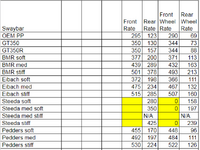
Here are a variety of available options:
1757286503811.png

I got booted from M6G for telling a guy not to run 45 psi in his tires at Daytona, so I don’t frequent it often, but this is a good chart I nabbed from over there. I have no idea how accurate it is. It suggests a front ARB motion ratio of 0.98 (i.e. strut linked) and rear ARB motion ratio of 0.316. Even if it isn't 100% accurate, at the very least, it should give us an idea of what is available. A stiffer rear bar may not solve all your problems, but it would be good to experience how much of an effect a bar can have on a car you are already super familiar driving.

I’ve watched some of your in-car previously, BNight. You spend quite a bit of time on a relatively small track, right? I can definitely understand wanting more rotation in the car on that type of track.

Things like toe are a tuning tool. I can promise you that Multimatic will have spent no time to optimize it. They might have spent a couple days doing performance tuning on the car, but most of their running would have been on the systems and durability end. It was likely arrived at by the initial setup being 1.5mm both sides (just because it ‘sounds’ reasonable). At the end of the test when they set it down, they measured 1.0m on one side and 1.5mm on the other. When they had to come up with a final recommendation, the averaged what they finished with and divided by 2. When they wrote it down, they truncated 1.25mm per side to 1.2 and there you go. I’m not saying I know that’s what has happened, but, having been involved in these types of things in the past, it wouldn’t surprise me. Regardless, this setting is for a Michelin slick, so that number is really only applicable to that tire. There’s nothing wrong with either of your two settings, but there’s nothing magic about them, either. It just matters whether that setting matches the rest of your total package, most importantly, tires.

Toe in and out are equally valid on the front axle. It’s completely car/track/tire dependent. Toe-out is more common, but it shouldn’t be seen as an absolute. If you're lost, go to 2mm out per side as a starting point on any car/tire combo on the planet.

Rear toe on a rear drive car will almost universally be ‘in’ statically. Front drivers will often go to rear toe-out just to get the thing to turn, but if you have to go toe-out to make a rear-drive GT car turn, then something is broken…like the chassis. Bnight, do you have aftermarket rear toe links? It’s tough to do with the stock ones, but if you have toe links with a threaded adjuster, then test reducing rear toe-in by 1 flat per side. If that’s good, go another. Rear toe is a very powerful tool to adjust balance. If you're lost, go to 2mm in per side as your general-purpose starting point.

By all means, change the springs. I’ve learned every time I’ve done it. You have good dampers, so you’ll likely be able to control more spring than someone on a stock-type damper setup. I’d recommend doing them one end at a time. Neither are such a huge departure that you’re going to get lost, but, if you do them at the same time, it will be impossible to know which change produced what result.

I applaud your balance goal. I’ve had perfectly neutral cars twice in the last 30 years. Both times it only lasted for 1 single lap. Both times that was all I needed.

Lastly, what are the dimensions of your springs? I might be able to locate some for you which you don’t have to get through Ohlins.
 
Last edited:
So back from the depths of what is known as Road Atlanta! I have well over 10,000 laps there as it's my home track and where I learned to w2w race back in the mid 90's. From the dip, to shaving the hill, to its current config, Ive driven them all. That being said its why I use that track for 99% of my testing as its a constant variable that doesn't change. Now on with the show!

I ran 800 fronts with 950 rears on an MCS triple adjustable remote reservoir shocks on all corners. sway bars were same I have been using. shock adjustments were made by a shock and chassis engineer I have help. fresh heat cycled dot hoosier r7's (all my tires get their first heat cycle in blankets on the wheels - keeps everything controlled and constant). 1st two hour session was done in 7-10 lap increments with any changes made in between. Car felt much better out of the gate than with the 800 rear springs. some slight bouncing coming out of 10b up the hill and in 1 or 2 other places. still some corner exit oversteer but substantially less than before. 75 deg ambient temp so a real nice morning. .2 tenths faster than my best at 7/10ths (not race pace). Looks good so far. Pull in and relay the info to my engineer. Makes some tire pressure changes and some shock adjustments and back out for another 7-10 laps. Feels better so going right direction. Bounce is gone but still a touch of oversteer. Another tenth faster while in traffic. Pull in and discuss the realize on 20 min left in session before quiet time so call it to make some bigger changes. Next session is 5 hrs long but surely won't need it all. My friend shows up and hops in the car and heads out with same setup. Comes back in after 7-10 laps and we compare notes with the engineer. Add some nitro to the shock cans, couple clicks here and there and he goes back out. Temps have climbed to mid 80s. He comes back in and is a little more comfortable. He hops out and I hop in. Car feels even better even as the track is decaying as the heat is making everything a tad slick. 7-10 laps in car feels as good as it ever has so call the day - have a big race at the end of the month so don't need to waste it all.

Tomorrow will unload and get it back on the lift. need to write down all the final settings and make some other changes. Going to try to rewire the car with a pdm and 10" screen to replace the existing gauges I have been using. Drop another 25# if possible, pack up and head to the race. I appreciate all the insite and help from this thread (and others on this site). I still have more to go but im headed in the right direction now. and for those who have asked clipping the low 1:36's to high 1:35's - im sure I can find more in it soon.
 
First, I don’t want to come across as saying that stiffening the car is automatically bad. It’s not. Sometimes that’s the exact thing you need to do. My overarching statement is to use the correct tool to address the specific problem you’re having. Springs are relatively easy for a driver to feel, so they often want to go there first. If pitch control (in this case, too much squat on throttle) is a problem that you struggle with, then increasing rear spring is exactly what you need to do. I am curious why you’d raising the front rate at the same time? What you’ve proposed would increase the front roll stiffness distribution which could potentially increase understeer. Are you attempting to get the car lower as well?

Let’s address the math just a little bit before going on. If we’re looking at wheel travel vs. spring travel on the spring, then our motion ratio tells us that with 1 unit of rear wheel travel will give us 0.49 units of spring movement (choose the units you wish). However, if we’re looking at force or spring rate, then we need to square the motion ratio to get the correct result.

Front spring 515 #/in = (0.98)^2 * 515 = 495 #/in at the wheel

Rear spring 800 #/in = (0.49)^2 * 800 = 192 #/in at the wheel (does that sound a little more familiar S197 guys?
Ok so my math might be off but my point is that this springs have a big front bias and sure that help with initial turn-in but in slow corners (hairpins the car wash out on exits) while in fast corners (aka sweepers) the rear steps out.

So the result is that the car is not good in any possible corner. That stepping out in fast corners and understeer in slow corners is what tells me that the rear is not controlled enough by the springs or shocks. Which is why I think a higher rear spring is need the only option for that from Ohlins is 914 #/in (GT350 rear spring rate).
You said that you feel the rear rolls quite a bit, but you can’t increase bar stiffness, because that would increase understeer. I think you’re saying that you can’t reduce roll by increasing *front* roll stiffness because of the added understeer. I completely agree. If you’ve reached the limit on the front bar setting, then you have to go to the other end. Stiffening the rear bar would be a logical next step as it will reduce rear roll and understeer all in one shot.

I’m not trying to sound dismissive, but if you feel that the rear is rolling too much then I would try to address that problem as directly as possible, especially since an adjustable rear bar is a relatively inexpensive and simple thing to do. As I said, I have a 20mm and 24mm RARB and don’t think twice about putting on the one I need that day. The 20 came off of a V6 convertible and my car was delivered with the 24. I *think* this is the GT350 bar as well? Sam Strano said his bar basically covers the range I have, so it would be on the soft side of the aftermarket choices. Maybe the Pedders or Eibach rear bar might be a better match for you?

Here are a variety of available options:
View attachment 105716

I got booted from M6G for telling a guy not to run 45 psi in his tires at Daytona, so I don’t frequent it often, but this is a good chart I nabbed from over there. I have no idea how accurate it is. It suggests a front ARB motion ratio of 0.98 (i.e. strut linked) and rear ARB motion ratio of 0.316. Even if it isn't 100% accurate, at the very least, it should give us an idea of what is available. A stiffer rear bar may not solve all your problems, but it would be good to experience how much of an effect a bar can have on a car you are already super familiar driving.
Regarding RARB there is a reason why Steeda developed a competition rear swaybar which is actually softer than the OEM PP1 rear bar. Though Steeda loves to run much stiffer rear springs (the Dual Rates springs are 1200#/in in the Divorced location on the firm rate). What I'm trying to say is that I'm really happy with my rear PP1 ARB and I feel that the issue I have will be better controlled with stiffer springs in the rear.
I’ve watched some of your in-car previously, BNight. You spend quite a bit of time on a relatively small track, right? I can definitely understand wanting more rotation in the car on that type of track.

My local track actually changed layout and now has faster sections: Fast S transition that people are essentially driving flat out at 99 mph or more depends on car is the first 2 corners. Fallowed by a left hand turn similar to Parabolica (Monza) where you accelerate in the curve from 55 mph to 96 mph (this is where the rear is stepping out because of the consistent radius) leading to the longest straight top speed 126 mph. Then you enter a slow section of 3 left 90 degrees turns fallowed by a right 90 degrees exiting to another straight 105 mph top speed and stopping in a kink to a hairpin 34 mph. Another short straight and an slow S turn 51 mph apex. Fallowed by another straight and final hard braking to 31 mph for a left hairpin like corner exiting the start/finish straight. This makes that track very hard to optimise for as the key corners are ether very fast: Front straight S corners and Parabolica. Or very slow the 2 left/right slow S corners and the 2 hairpins.
Serres the other track I run has a similar layout with key fast corners but 2 hairpins as well. Both tracks have an avg speed of around 74 mph.

Things like toe are a tuning tool. I can promise you that Multimatic will have spent no time to optimize it. They might have spent a couple days doing performance tuning on the car, but most of their running would have been on the systems and durability end. It was likely arrived at by the initial setup being 1.5mm both sides (just because it ‘sounds’ reasonable). At the end of the test when they set it down, they measured 1.0m on one side and 1.5mm on the other. When they had to come up with a final recommendation, the averaged what they finished with and divided by 2. When they wrote it down, they truncated 1.25mm per side to 1.2 and there you go. I’m not saying I know that’s what has happened, but, having been involved in these types of things in the past, it wouldn’t surprise me. Regardless, this setting is for a Michelin slick, so that number is really only applicable to that tire. There’s nothing wrong with either of your two settings, but there’s nothing magic about them, either. It just matters whether that setting matches the rest of your total package, most importantly, tires.
Maybe but that was also what late Kenny Brown give me as numbers for alignment on an S550 so there must be something to it he was also preaching that 800 #/in front springs is what you need for slicks. Sure the toe-out is not universal and I know people here prefer to run with 0 toe on the front. But I use that alignment for like 6 seasons now and I'm happy with how the car performs with it. My last alignment went a bit too much to the toe-out (3.3 mm) side so I will be getting that back a bit (2.4 mm) next week when I fit the new tires. I need less toe to make the car more stable in the fast sections and under braking.
By all means, change the springs. I’ve learned every time I’ve done it. You have good dampers, so you’ll likely be able to control more spring than someone on a stock-type damper setup. I’d recommend doing them one end at a time. Neither are such a huge departure that you’re going to get lost, but, if you do them at the same time, it will be impossible to know which change produced what result.

I applaud your balance goal. I’ve had perfectly neutral cars twice in the last 30 years. Both times it only lasted for 1 single lap. Both times that was all I needed.
I used to have balance more but always changing the car leads to you know less than ideal setups.
Lastly, what are the dimensions of your springs? I might be able to locate some for you which you don’t have to get through Ohlins.
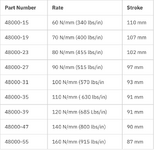
The Ohlins springs are metric: 180 mm in length with 65 mm of ID:
Screenshot 2025-09-08 at 9.02.34.png

Swift also makes springs for the Ohlins though they are 178 mm instead of 180 mm and they happen to have higher rates up to 1600#/in.

The options I'm interested in:
From Ohlins: 630/915 #/in (this the rear spring on the GT350)
From Swift: 685/1200 #/in

I only chimed in because my setup is close to your suggested ideal setup but as usual devil is in the details.
 
First, I don’t want to come across as saying that stiffening the car is automatically bad. It’s not. Sometimes that’s the exact thing you need to do. My overarching statement is to use the correct tool to address the specific problem you’re having. Springs are relatively easy for a driver to feel, so they often want to go there first. If pitch control (in this case, too much squat on throttle) is a problem that you struggle with, then increasing rear spring is exactly what you need to do. I am curious why you’d raising the front rate at the same time? What you’ve proposed would increase the front roll stiffness distribution which could potentially increase understeer. Are you attempting to get the car lower as well?

Let’s address the math just a little bit before going on. If we’re looking at wheel travel vs. spring travel on the spring, then our motion ratio tells us that with 1 unit of rear wheel travel will give us 0.49 units of spring movement (choose the units you wish). However, if we’re looking at force or spring rate, then we need to square the motion ratio to get the correct result.

Front spring 515 #/in = (0.98)^2 * 515 = 495 #/in at the wheel

Rear spring 800 #/in = (0.49)^2 * 800 = 192 #/in at the wheel (does that sound a little more familiar S197 guys?)

You said that you feel the rear rolls quite a bit, but you can’t increase bar stiffness, because that would increase understeer. I think you’re saying that you can’t reduce roll by increasing *front* roll stiffness because of the added understeer. I completely agree. If you’ve reached the limit on the front bar setting, then you have to go to the other end. Stiffening the rear bar would be a logical next step as it will reduce rear roll and understeer all in one shot.

I’m not trying to sound dismissive, but if you feel that the rear is rolling too much then I would try to address that problem as directly as possible, especially since an adjustable rear bar is a relatively inexpensive and simple thing to do. As I said, I have a 20mm and 24mm RARB and don’t think twice about putting on the one I need that day. The 20 came off of a V6 convertible and my car was delivered with the 24. I *think* this is the GT350 bar as well? Sam Strano said his bar basically covers the range I have, so it would be on the soft side of the aftermarket choices. Maybe the Pedders or Eibach rear bar might be a better match for you?

Here are a variety of available options:
View attachment 105716

I got booted from M6G for telling a guy not to run 45 psi in his tires at Daytona, so I don’t frequent it often, but this is a good chart I nabbed from over there. I have no idea how accurate it is. It suggests a front ARB motion ratio of 0.98 (i.e. strut linked) and rear ARB motion ratio of 0.316. Even if it isn't 100% accurate, at the very least, it should give us an idea of what is available. A stiffer rear bar may not solve all your problems, but it would be good to experience how much of an effect a bar can have on a car you are already super familiar driving.

I’ve watched some of your in-car previously, BNight. You spend quite a bit of time on a relatively small track, right? I can definitely understand wanting more rotation in the car on that type of track.

Things like toe are a tuning tool. I can promise you that Multimatic will have spent no time to optimize it. They might have spent a couple days doing performance tuning on the car, but most of their running would have been on the systems and durability end. It was likely arrived at by the initial setup being 1.5mm both sides (just because it ‘sounds’ reasonable). At the end of the test when they set it down, they measured 1.0m on one side and 1.5mm on the other. When they had to come up with a final recommendation, the averaged what they finished with and divided by 2. When they wrote it down, they truncated 1.25mm per side to 1.2 and there you go. I’m not saying I know that’s what has happened, but, having been involved in these types of things in the past, it wouldn’t surprise me. Regardless, this setting is for a Michelin slick, so that number is really only applicable to that tire. There’s nothing wrong with either of your two settings, but there’s nothing magic about them, either. It just matters whether that setting matches the rest of your total package, most importantly, tires.

Toe in and out are equally valid on the front axle. It’s completely car/track/tire dependent. Toe-out is more common, but it shouldn’t be seen as an absolute. If you're lost, go to 2mm out per side as a starting point on any car/tire combo on the planet.

Rear toe on a rear drive car will almost universally be ‘in’ statically. Front drivers will often go to rear toe-out just to get the thing to turn, but if you have to go toe-out to make a rear-drive GT car turn, then something is broken…like the chassis. Bnight, do you have aftermarket rear toe links? It’s tough to do with the stock ones, but if you have toe links with a threaded adjuster, then test reducing rear toe-in by 1 flat per side. If that’s good, go another. Rear toe is a very powerful tool to adjust balance. If you're lost, go to 2mm in per side as your general-purpose starting point.

By all means, change the springs. I’ve learned every time I’ve done it. You have good dampers, so you’ll likely be able to control more spring than someone on a stock-type damper setup. I’d recommend doing them one end at a time. Neither are such a huge departure that you’re going to get lost, but, if you do them at the same time, it will be impossible to know which change produced what result.

I applaud your balance goal. I’ve had perfectly neutral cars twice in the last 30 years. Both times it only lasted for 1 single lap. Both times that was all I needed.

Lastly, what are the dimensions of your springs? I might be able to locate some for you which you don’t have to get through Ohlins.
TeeLew, I am so glad to see you on here. Your advice is some of the most solid thought through, and I listen to you as much as I listen to 1OldRacer, Honeybadger, Alessandro, and Mavisky. Truly good information that I will be rereading at once I go coil-overs and more aero than just louvers and diffuser.

As my job entails, tire psi is extremely important, so once I go slicks, that is also something that I will be watching for information on.

I need to send you a dm on fender louvers. Please check!
 
The Ohlins springs are metric: 180 mm in length with 65 mm of ID:


Swift also makes springs for the Ohlins though they are 178 mm instead of 180 mm and they happen to have higher rates up to 1600#/in.

I'd measure those spring perch diameters. A 2.5" I.D. spring is 63.5mm and 180mm is 7.08" long. My guess is with either no work or very little work you could have any rate your heart desires. You *might* have to turn 1mm off the radius of your spring perches, but then you should be good.

Who knows, it might already be 2.5" and Ohlins just listed funky spring dimensions to make sure people bought through them?
 
I only chimed in because my setup is close to your suggested ideal setup but as usual devil is in the details.

I wouldn't use the word 'ideal.' Let's call it a 'suggested starting setup.' I know there are a lot of people that really just don't know where to start and, IMO, the canned spring combos are much more cosmetic than functional. I feel like I can help nudge them in the right direction, but it has to be something I've actually driven and it needs to be something that isn't going to get anyone in trouble. I'm confident you can put those numbers on the car and have a really good day at a track or AutoX.

You've driven this same basic package for a long time and want to tailor it more to you, which is understandable. I'm offering these settings to the guy that wants to take something to the track that is significantly better than what Ford provides, but isn't going to be too bad on the drive to and from the track. This isn't meant to be something that gets you on the pole to the next race, just something that gets you to the start line of the next HPDE.
 
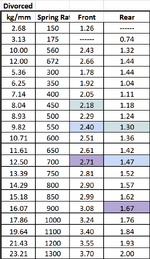
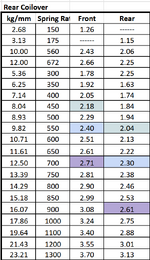
This has been a pretty good thread so thought I'd add screen snip of part of my spring rate / weight spread sheet showing natural frequency front and rear. This is based off my 3750lb car, so something with weight reduction will shift things a bit.

Im running MCS, so coilover specifically, and right now on 550/700. That gives a NF of 2.4f/2.3r. In my case, the rear is pretty loose. Doesnt want to put power down with the rear bar connected. Going to order a 600 lb/in spring to drop the rear which would be 2.40f/2.13r. Relatively soft rear based on "normal convention" of rear frequency 0.2hz higher but my style wants more stability.

The above mentioned 515/800 (divorced) from bnight would be 2.33f/1.57r. That seems to be super soft in the rear. The equivalent divorced spring rate to 600 lb/in in coilover would be about 1450 lb/in divorced.

1757567743186.png

1757567777361.png
 
Im running MCS, so coilover specifically, and right now on 550/700. That gives a NF of 2.4f/2.3r. In my case, the rear is pretty loose. Doesnt want to put power down with the rear bar connected. Going to order a 600 lb/in spring to drop the rear which would be 2.40f/2.13r. Relatively soft rear based on "normal convention" of rear frequency 0.2hz higher but my style wants more stability.

The above mentioned 515/800 (divorced) from bnight would be 2.33f/1.57r. That seems to be super soft in the rear. The equivalent divorced spring rate to 600 lb/in in coilover would be about 1450 lb/in divorced.

Honestly, everything you've written makes complete sense. I don't know how I'd make a Mustang work with that much rear spring, but, for sure, that would be seriously on the nose.

There is no 'normal convention of rear 0.2 higher' by anyone who does this who does not work for an OEM. There was a mantra in the 90's about flat-ride spring selection in every vehicle dynamics class that all of us bright-eyed, budding engineers took before going to industry. The professors loved the idea, because it was mathy. It was literally indoctrination. I ran down a whole rabbit hole a long time ago to pound that square peg in the round hole. I don't learn very fast. It took probably 4-5 years before I didn't have the stiffer rear ride as some sort of 'perfection' in my head.

OEM guys might change springs 5 times on a test platform before they get it right and go to production. While I try not to be 'that guy,' I'm sure I've had single days where I've changed that many springs. I've been able to investigate this tiny little corner of insignificance in ways that very few people get the opportunity to do.

I'm going to go against every OEM chassis engineer on the planet and tell you they're *all* wrong, at least for racetrack performance. I can see good reasons for doing flat-ride on busses and cargo haulers. Beyond that, it's of absolutely no use to us. This is a hill I'm perfectly comfortable dying on. It makes me a heretic. Lord knows I have been burned on plenty of forum stakes for stating it.

Changing your springs are easy as can be. Spend the $100 and put a 350 in the back. Don't do it because it will magically cure all the problems in your car. It won't. Do it just to feel the difference. Don't worry about the number on the side of the spring. That number doesn't matter. What matters is you get the rear of the car under you. A 350 might be way too big of a step, but that's good information to know. Now you know you want to be between 700 & 350. If you try to go 650-600-550-500 it takes too long to get there.

Make a big step, get the ride height back to where it was, make sure you don't have bump rubbers in there causing inconsistencies and give it a try. What's the worst case scenario of too soft of a rear spring? You're pushy for a day...That's it. I guarantee there will be aspects of the softer rear spring you will like even if you decide that it's not what you want overall. Then it's a game of keeping the aspects you like and fixing the aspects you don't. If you never try soft, though, then you don't know what it does and you can't make an informed opinion on what you really need.

All of these aftermarket companies jump through hoops to reduce understeer. I never felt my car had a genuine understeer, even when stock. Yes, it would understeer mid-corner due to a lack of front camber, but even in that state, it was never just pure push and the rear was always threatening to step out. Some of that might have been the horrible Pirelli tires, but that's how they delievered it. In my head, the entire handling envelope of the car needs to be compressed. The understeer needs to be less and the oversteer needs to be less. Paradoxially, we can get some of the former by improving the latter.

Are you game to try it? If you've got video, PM me a good run. I'll try to give you some ideas.
 
This has been a pretty good thread so thought I'd add screen snip of part of my spring rate / weight spread sheet showing natural frequency front and rear. This is based off my 3750lb car, so something with weight reduction will shift things a bit.

What masses are you using for sprung/unsprung. What about tire rates? I haven't done the homework to do these calcs.
 
There is no 'normal convention of rear 0.2 higher' by anyone who does this who does not work for an OEM. There was a mantra in the 90's about flat-ride spring selection in every vehicle dynamics class that all of us bright-eyed, budding engineers took before going to industry. The professors loved the idea, because it was mathy. It was literally indoctrination. I ran down a whole rabbit hole a long time ago to pound that square peg in the round hole. I don't learn very fast. It took probably 4-5 years before I didn't have the stiffer rear ride as some sort of 'perfection' in my head.

OEM guys might change springs 5 times on a test platform before they get it right and go to production. While I try not to be 'that guy,' I'm sure I've had single days where I've changed that many springs. I've been able to investigate this tiny little corner of insignificance in ways that very few people get the opportunity to do.

I'm going to go against every OEM chassis engineer on the planet and tell you they're *all* wrong, at least for racetrack performance. I can see good reasons for doing flat-ride on busses and cargo haulers. Beyond that, it's of absolutely no use to us. This is a hill I'm perfectly comfortable dying on. It makes me a heretic. Lord knows I have been burned on plenty of forum stakes for stating it.
Very good point here. The NF is good to be able to compare one vehicle to another, but its very much a starting off point and shift need to occur depending on the needs of the vehicle dynamics.

An example. My Evo runs 3hz front and 4hz rear (roughly). The rear seems crazy high but when you consider the car must tri-pod to turn because reasons I wont get into, the rear of the car is then held up by 1 spring. So that 4hz quickly drops to 2.5hz.

And now Ive tried the, we'll call it, OEM convention of .2hz greater rear on the mustang, and even .2hz less, and its been very much not great. While Im still learning RWD and muscle cars, I have been at this >20years and not slow to adjust to hoping into other cars.

Changing your springs are easy as can be. Spend the $100 and put a 350 in the back. Don't do it because it will magically cure all the problems in your car. It won't. Do it just to feel the difference. Don't worry about the number on the side of the spring. That number doesn't matter. What matters is you get the rear of the car under you. A 350 might be way too big of a step, but that's good information to know. Now you know you want to be between 700 & 350. If you try to go 650-600-550-500 it takes too long to get there.

Make a big step, get the ride height back to where it was, make sure you don't have bump rubbers in there causing inconsistencies and give it a try. What's the worst case scenario of too soft of a rear spring? You're pushy for a day...That's it. I guarantee there will be aspects of the softer rear spring you will like even if you decide that it's not what you want overall. Then it's a game of keeping the aspects you like and fixing the aspects you don't. If you never try soft, though, then you don't know what it does and you can't make an informed opinion on what you really need.
I like this idea. I always say never make small changes hoping for a big effect. I happen to have my 450lb/in springs from trying 450/550 so I could swap the 700 for the 450. Not quite half, but that drops me from currently 2.4/2.3hz to 2.4/1.85hz. I have an event in a couple days, I think I can swap the springs quick enough to try.

What masses are you using for sprung/unsprung. What about tire rates? I haven't done the homework to do these calcs.

I have 1025front and 850rear for corner weight, and 130lb/120lb for unsprung. Its probably wrong now with the lighter wheels and coilovers, I need to go back to my weights list and update that.

The numbers above are ignoring tire rates though I do have a table for added tire effects. With a guess of 2000lb/in for tires (probably too high for A052, but was a number I had found years ago for A7s), that would change my 2.4/1.85hz calc to 2.16/1.73hz. Dropping that estimate to 1500lb/in changes it to 2.09/1.70hz.

This of course assumes linear rate which a tire certainly is not. But none of these numbers are meant as gospel anyways. Just a first line method of comparison :thumbsup:
 
Good stuff! I've never played with an AWD car, so I'd be at square one. Does the Evo have some aero on it as well? It sounds like a 3rd spring setup.

A 450 that you already have on the shelf is perfect. I genuinely feel it will go in the right direction for you. If it doesn't work, I swear I'll say, "I'm sorry."

I'm going to steal your numbers until I get better ones for calcs. I think you're in the right range for tire stiffness and those numbers work out about how I'd expect. Even if you're not bang on the exact number, it's a good reality check. I'll dig around and see what I can find on tires. I should be able to come up with something.

When I was looking at your spreadsheet numbers I thought they were probably without the tire. Once you put the tire in, it all looks pretty standard. If we say the tire is 2000 #/in, then you'll be right in the range that I like with the 450. Interestingly, this is going to put you at the same basic ride rates that BNight is considering. This experiment might be something that helps you both.

Honestly, seeing these numbers makes me wonder why I'm liking even bigger splits that this? I'm just spit-balling, but is this for a square tire setup? I run square so I can rotate tires, but to get more in my 'normal' range of F/R ride freq ratio, I'd have to split tire widths to get a little more rear tire relative to the front (10 or 20 mm). I think I've only worked on one car with square tire widths and I didn't hardly do anything on it. Rear tires are always wider than the front. They are on the Camaro as well. This very well may be muddying the water for all of us...Or maybe I'm just a Pu55y. It's something like that.
 
I like this idea. I always say never make small changes hoping for a big effect. I happen to have my 450lb/in springs from trying 450/550 so I could swap the 700 for the 450. Not quite half, but that drops me from currently 2.4/2.3hz to 2.4/1.85hz. I have an event in a couple days, I think I can swap the springs quick enough to try.

The numbers above are ignoring tire rates though I do have a table for added tire effects. With a guess of 2000lb/in for tires (probably too high for A052, but was a number I had found years ago for A7s), that would change my 2.4/1.85hz calc to 2.16/1.73hz. Dropping that estimate to 1500lb/in changes it to 2.09/1.70hz.

This of course assumes linear rate which a tire certainly is not. But none of these numbers are meant as gospel anyways. Just a first line method of comparison :thumbsup:
The reason I don't like NF is because it's weight dependant so the same spring will have different NF on a 2000 lbs car and on a 3700 lbs car. Which makes it very hard to know what is good or bad (Gran Turismo 7 uses NF instead of spring rates for springs and it's super stupid way to tune suspension).

However your rear springs are way higher than the front so I'm guessing your car is oversteering a lot. For rear coilover springs your front and rear springs have almost the same MR or very close to one another with probably rears been little higher.

Vorshlag actually have spring packages that they tested and developed for MCS:

  • Vorshlag's GT Spring Package is 450 #/in (2.18 hz) Front / 550 #/in (2.04 hz) Rear - This I guess is a package for a street / weekend car on street tires (PS4s, Cup 2)
  • Vorshlag's GTS Spring Package is 600 #/in (2.51 hz) Front / 750 #/in (2.38 hz) Rear - This should be the experienced driver 200TW tire package so I guess this will be your best bet.
  • Vorshlag's GTR Spring Package is 800 #/in (2.90 hz) Front / 1100 #/in (2.88 hz) Rear - This is the straight out slick tire Sunday racer package I find the rear a bit too high for my liking aka DHR cars don't run rear springs that high.
This packages as a concept are what late Kenny Brown was teaching in his Speed Therapy Academy so the rates should get you there. And If I were in your shoes I would have probably go to the GTS package.

The Divorced spring location just doesn't have enough MR to get to a rear that firm which is why I think the Ohlins are just a street coilovers and not a great track coilovers though I don't want to go through the hassle of going with true coilover on the rear and they work great for a dual purpose car.

Hope this helps.
 
Good stuff! I've never played with an AWD car, so I'd be at square one. Does the Evo have some aero on it as well? It sounds like a 3rd spring setup.
We have standard SM/XA aero, pretty similar to what you see at the top of CAM also.
Still more work to do on it but the focus is on the mustang for now.

Honestly, seeing these numbers makes me wonder why I'm liking even bigger splits that this? I'm just spit-balling, but is this for a square tire setup? I run square so I can rotate tires, but to get more in my 'normal' range of F/R ride freq ratio, I'd have to split tire widths to get a little more rear tire relative to the front (10 or 20 mm). I think I've only worked on one car with square tire widths and I didn't hardly do anything on it. Rear tires are always wider than the front. They are on the Camaro as well. This very well may be muddying the water for all of us...Or maybe I'm just a Pu55y. It's something like that.

I'm square, 315 A052s on 18x11.5s. Id love to run a bigger rear tire since there's lots of room. But only thing available is the vitour and I did NOT like them at all.
 

Buy TMO Apparel

Buy TMO Apparel
Top