The Mustang Forum for Track & Racing Enthusiasts

Taking your Mustang to an open track/HPDE event for the first time? Do you race competitively? This forum is for you! Log in to remove most ads.

  • Welcome to the Ford Mustang forum built for owners of the Mustang GT350, BOSS 302, GT500, and all other S550, S197, SN95, Fox Body and older Mustangs set up for open track days, road racing, and/or autocross. Join our forum, interact with others, share your build, and help us strengthen this community!

Excessive tire wear on outside shoulder on track, 305/30/19, normal?

This site may earn a commission from merchant affiliate links, including eBay, Amazon, and others.

Frankly I think the one option you do not want to do is also the one that could reduce some of the wear - going to a squared system. Over the years tracking Vipers and Mustangs I saw many folks chasing this problem and many spent a bunch of money playing with suspensions, etc. before just going to a squared system or a much bigger tire up front. I am not saying it will cure the problem, but it sure seems to lessen it alot. Part of it is being able to rotate all around and the other is it reduces the amount of push Ford ( or Dodge ) want dialed into the front of their cars for their so called safety factor.

Also what tires are you using , and normally cranking the pressures way up to 40 lbs. with the more competitive tires will see them go away at that high of temp. in my experience.
 
I have had 4 Mustangs for track use, ranging from a '16 PP1 to the Mach 1 and now the Dark Horse. Suspensions ranged from stock as delivered to the full Ford Racing track suite. In no instance did any of my cars oversteer, they all tended to understeer. It is the nature of front engine cars to do that due to the bulk of the weight being on the front tires. Manufacturers know that it is also safer for the average driver to have a bit of understeer near the limit.

If you run a stickier tire or a wider tire on the rear it's just going to understeer even worse.
If you stiffen up the front sway bar you are going to get more understeer.
Your front pressures are too high. I go out at 28 cold and come in at 34-36. That varies with individual tires, they all have different characteristics.

You need all the front camber you can get, I was able to get slightly over -4 with Vorshlag plates and that was the best setup I found. It did not wear the inner edges of the fronts excessively, wear was remarkably even across the tire. Lastly, and most importantly, the driver needs to keep the tires hooked up and not sliding.

I run in Open group, so my cars are plenty fast. And also, what Bill said.
 
Frankly I think the one option you do not want to do is also the one that could reduce some of the wear - going to a squared system. Over the years tracking Vipers and Mustangs I saw many folks chasing this problem and many spent a bunch of money playing with suspensions, etc. before just going to a squared system or a much bigger tire up front. I am not saying it will cure the problem, but it sure seems to lessen it alot. Part of it is being able to rotate all around and the other is it reduces the amount of push Ford ( or Dodge ) want dialed into the front of their cars for their so called safety factor.

Also what tires are you using , and normally cranking the pressures way up to 40 lbs. with the more competitive tires will see them go away at that high of temp. in my experience.
Thanks for the reply and input.

I've experimented with 100tw (SC3R) and 200tw (CRSv2). Next season, i will have a set of endurance 200's such as RS4 for the abrasive tracks, and another set of super 100 or endurance 100 such as the SC3R or NT01 for smooth tracks. The SC3R's are outstanding, and never stop gripping until corded. They wear out fast but are the cheapest of the bunch in my sizes. The CRSv2 are a little greasy as they get hot and reach 40PSI towards the end of a session.

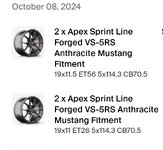
I have bought a set of forged Apex lightweight VS-5RS wheels, in staggered format still, but both 1/2" wider than stock. This will make it possible to go 325's in the front and rear, so squared tires on staggered wheels if you will.

Screenshot_20241022_085815_Shop.jpg
 
Last edited:
I have had 4 Mustangs for track use, ranging from a '16 PP1 to the Mach 1 and now the Dark Horse. Suspensions ranged from stock as delivered to the full Ford Racing track suite. In no instance did any of my cars oversteer, they all tended to understeer. It is the nature of front engine cars to do that due to the bulk of the weight being on the front tires. Manufacturers know that it is also safer for the average driver to have a bit of understeer near the limit.

If you run a stickier tire or a wider tire on the rear it's just going to understeer even worse.
If you stiffen up the front sway bar you are going to get more understeer.
Your front pressures are too high. I go out at 28 cold and come in at 34-36. That varies with individual tires, they all have different characteristics.

You need all the front camber you can get, I was able to get slightly over -4 with Vorshlag plates and that was the best setup I found. It did not wear the inner edges of the fronts excessively, wear was remarkably even across the tire. Lastly, and most importantly, the driver needs to keep the tires hooked up and not sliding.

I run in Open group, so my cars are plenty fast. And also, what Bill said.
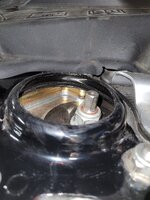
Thanks for your input. Did you notice any braking reduction impact with that much front camber? Next seqson , I will bump up my camber from 3.2 to 3.5 or higher, if my plates and drilled towers allow it.

17296023823402970445343023764568.jpg
 
I've fought this issue as you can see from this thread. All good suggestions here. In hindsight I was focusing too much on the wear on the outside edge of the front tires and not enough on whether the front and rear tires were wearing evenly. Mine were not. When I fixed the front rear balance, it also fixed the outside front edge wear problem. The reason your rear tires look so good is because the fronts are carrying too much of the cornering loads. So I would start by increasing your rear sway bar rate until the front and rear tires are wearing evenly and see if that takes care of your outside edge wear problem on the fronts. It did for me.
 
I've fought this issue as you can see from this thread. All good suggestions here. In hindsight I was focusing too much on the wear on the outside edge of the front tires and not enough on whether the front and rear tires were wearing evenly. Mine were not. When I fixed the front rear balance, it also fixed the outside front edge wear problem. The reason your rear tires look so good is because the fronts are carrying too much of the cornering loads. So I would start by increasing your rear sway bar rate until the front and rear tires are wearing evenly and see if that takes care of your outside edge wear problem on the fronts. It did for me.
It was only recently, ie, after and during the front edge issue, that I softened the rear roll rate, as the stiffer Dual rate springs had induced a tad too much oversteer.

You still have a valid point though, regarding my changes possibly causing the problem to transfer from the rear to the front. The car is very neutral now. I would hate to kill that balance, but might need to. Will see if making the fronts as wide as the rears (325 square), adding a bit of camber, keeping the Hot pressures a bit higher, all contribute to reducing some front outside wear.
 
Last edited:
Sorry to revive an old thread, but this has so much great input that I decided to add my experiences and seek guidance as well.

I am a big fan of trail braking, but still getting excessive outside front tire wear, even with -3.2* camber and zero toe, on my 2022 Mach1 HP. This occurs on both 100 and 200 treadwear staggerred 305/30R19 and 325/30R19 tires. I intend to stay staggerred and not deal with extended studs and spacers imposed by squared setup.

I've gradually addressed bushings and suspension components this year with most of the Steeda catalogue, and it has transformed the handing dynamics. The most notable are IRS ultimate kit, Dual rate springs, Comp adjustable Swaybars, adjustable rear camber arms, DSC Magnaride controller, lowering engine mounts.

Sway bars are set to full soft rear, 2nd softest front, with two more notches to go. Handling and balance are spot on. Tons of grip in the front, and rear grip and wear are just perfect with -2.3* camber and .15 toe in.

Car sees dual duty of spirited drives, driving to the tracks, and road track HPDE days in running in advanced rungroups.

Through the above modification cycles, the car always got professional alignment done by the same trusted pro shop. I still go through 2-3 sets of fronts, for one set of rears. Depending on track surface and layout, I rotate my staggerred tires from side to side, mid day. Hot pressures are 36 to 40PSI.

Track Day Season is over in Quebec and Ontario (Canada), but last three options to reduce excessive outside front tire wear next season will be:
#1 - Maintain front pressures in higher range (38-44 PSI).
#2 - Stiffen up front sway bar by one notch.
#3 - Add a touch more front camber perhaps from -3.2* to -3.4*, as to not affect threshold braking performance.
#4 - Try an endurance 200 to 300 treadwear pair of tires in the front, with a stickier set in the rear.
View attachment 99269

Using different front rear or new/ old tires is a big no no. It's purely a crutch, not a solution. The tires have a specific performance envelope, that is where the tires need to be running. The odd front/ rear compound/ construction is a huge headache. This year's Gt4 required a front tire that used the same compound, but a different construction. We chased this setup all year, just trying to get the tires to last a stint without coming apart. We chased many of the same problems that you are right now.
I'm pretty sure that next year's Gt4 will have a new front tire ( wink wink, nod, nod).
The conversation we could have on this would last for hours, so just take my word for it, same compound ( preferably same size) is the way to go. Even small incremental changes in psi from front to rear should be avoided if you can. All 4 tires, at their performance envelope is the goal.
 
Sage words from the Guru of Gummy Tires, and though many of us try to convince many of you that you should only run the same brand tires front and rear, they should also be the same model. You heard the Sermon from the Mount ( Mounting of tires that is ) so follow what the Blacksheep Guru has spoken and ye shall go faster !
 
Last edited:
I am not sure how relevant the threshold braking issue is on a car with ABS. At least on my S197, which is autocross only (but thats a lot more violent braking) there was no braking change between -3 and -4 camber.

In reality, you are probably trail braking a little anyway...e.g. the outside tire is loaded more than the inside, so body roll and suspension angles are in play and it doesn't have -4 at that point.

DaveW
 
the stiffer Dual rate springs had induced a tad too much oversteer.
Was that oversteer on turn-in, mid-corner, exit, or some combination? Personally, I like a car that's "pointy" or "on the nose" which entails a hint of oversteer on corner entry. This lets me rotate the car earlier in the cornering phase, so I can get onto the gas sooner mid-corner to exit. The weight shift on throttle helps to plant the rear, and shock tuning plays a part. The key to this is for the car to be predictable with a smooth breakaway, instead of being "snappy" evil tail-happy. Driving style may need to be changed for this to work - the more the car wants to oversteer on entry, the less (trail-)braking you can do after turn-in and the more you need to do in a straight line. And the more sensitive you need to be to the dynamic changes in balance so you can correct for them quickly. Slow hands for input, fast hands for correction.
 
Thanks for your input. Did you notice any braking reduction impact with that much front camber? Next seqson , I will bump up my camber from 3.2 to 3.5 or higher, if my plates and drilled towers allow it.
Absolutely no impact on braking at all.
 
... When I fixed the front rear balance, it also fixed the outside front edge wear problem. The reason your rear tires look so good is because the fronts are carrying too much of the cornering loads. So I would start by increasing your rear sway bar rate until the front and rear tires are wearing evenly and see if that takes care of your outside edge wear problem on the fronts. It did for me.
Thanks for this input! It is true that although I made the car's handling neutral and predictable, I may be asking the front end to do too much. Next season, I will try returning the rear sway bar to the middle position, even though it made the rear oversteer a little, mid to late corner, so I could not apply as much throttle as early, as I can now with the softest setting.
 
Last edited:
Was that oversteer on turn-in, mid-corner, exit, or some combination? Personally, I like a car that's "pointy" or "on the nose" which entails a hint of oversteer on corner entry. This lets me rotate the car earlier in the cornering phase, so I can get onto the gas sooner mid-corner to exit. The weight shift on throttle helps to plant the rear, and shock tuning plays a part. The key to this is for the car to be predictable with a smooth breakaway, instead of being "snappy" evil tail-happy. Driving style may need to be changed for this to work - the more the car wants to oversteer on entry, the less (trail-)braking you can do after turn-in and the more you need to do in a straight line. And the more sensitive you need to be to the dynamic changes in balance so you can correct for them quickly. Slow hands for input, fast hands for correction.
Great question and input. Thanks for this!

The issue I solved with the rear sway bar set at it's softest setting is to reduce "snappy" oversteer mid to later corner. I may still spend more seat time and revisit this setting next season. There is so much at play here, and variables I tinkered with last season, ie: tire compound (100tw and 200tw), tire pressure, tire temperature, rear camber settings, track surface (cement versus asphalt, bumpy versus smooth).
 
... there was no braking change between -3 and -4 camber.

In reality, you are probably trail braking a little anyway...e.g. the outside tire is loaded more than the inside, so body roll and suspension angles are in play and it doesn't have -4 at that point.

DaveW
Thanks for your input.

I am very big on trail braking, and use it pretty much on all corner entries. I also coach HPDE participants to try this technique of weight transfer to the front until they reach the apex, then ease on to the throttle so as to not unsettle the car.

This is likely not helping the outside edge wear, on the outside tire. It is the way I am most comfortable, and can carry more speed through a corner...
 
Last edited:
The issue I solved with the rear sway bar set at it's softest setting is to reduce "snappy" oversteer mid to later corner.
Did this happen mostly on higher-G corners? One thing I'd look at is if you were getting into the rear bumpstops, and the sudden increase in overall stiffness was causing the snap. You say the car is riding pretty high, but also that you're using 200# rear springs and sometimes running with no sway bar. Maybe go stiffer on both sway bars.

As far as trail-braking, I definitely want to use some brake to keep some weight on the nose as I turn down to the apex, but not so much that I'm scrubbing the front tires. So I brake hard in a straight line, then release most of the brake effort as I turn in, keep light braking to the apex, then onto the throttle as I unwind the wheel. How much brake pressure to release as you turn in can be a fine line, and setup and overall driving style plays into it.
 
Great question and input. Thanks for this!

The issue I solved with the rear sway bar set at it's softest setting is to reduce "snappy" oversteer mid to later corner. I may still spend more seat time and revisit this setting next season. There is so much at play here, and variables I tinkered with last season, ie: tire compound (100tw and 200tw), tire pressure, tire temperature, rear camber settings, track surface (cement versus asphalt, bumpy versus smooth).
Winnah!.. sort of.
The fast guys with S197s are running 18mm or no bar in the rear, FP lower trailing arms and stock or Gt500 center link. The front gets the FP " blue" bar.along with cut out towers to get 3 to 3.5 degrees of camber, and all the caster they can get. Since you don't have a stripped out race car ( although, the cage got them back up to 3300plus pounds) it was arranged differently.
If you run coil overs, try about 400 rear, 600 front, and spend at least $5K on them, if not, just run some FP " kit" springs.
I'm not going to publish the spring rates and the shocks were $10K proprietary Penskes that folks spent a lot of time developing, so you're on your own there. But you now have enough to work with.
 
Last edited:
Did this happen mostly on higher-G corners? One thing I'd look at is if you were getting into the rear bumpstops, and the sudden increase in overall stiffness was causing the snap. You say the car is riding pretty high, but also that you're using 200# rear springs and sometimes running with no sway bar. Maybe go stiffer on both sway bars.

As far as trail-braking, I definitely want to use some brake to keep some weight on the nose as I turn down to the apex, but not so much that I'm scrubbing the front tires. So I brake hard in a straight line, then release most of the brake effort as I turn in, keep light braking to the apex, then onto the throttle as I unwind the wheel. How much brake pressure to release as you turn in can be a fine line, and setup and overall driving style plays into it.
I do majority of the hard braking in a straight line and ease off as I turn in with either little or no brake pedal pressure left as I reach the Apex. Our cars are nose heavy and dont have even 50/50 weigh distribution. Trail-braking is probably not helping by shifting even more weight to the front. I dont notice any understeer but I am probably scrubbing or rolling the outside front tire, outside edge...

As mentioned, I solved the oversteer with one notch of softer setting on the rear swaybar. This was most apparent while exiting slow speed corners.

I am usig Steeda Magnaride Controller and Dual rate springs which have the following rates. The 1st/2nd are front street and track rates when leaned into. The 3rd/4th are the rears. Im definitely not hitting the bumpstops.
Screenshot_20241025_030739_Drive.jpg
 
Last edited:
Winnah!.. sort of.
The fast guys with S197s are running 18mm or no bar in the rear, FP lower trailing arms and stock or Gt500 center link. The front gets the FP " blue" bar.along with cut out towers to get 3 to 3.5 degrees of camber, and all the caster they can get. Since you don't have a stripped out race car ( although, the cage got them back up to 3300plus pounds) it was arranged differently.
If you run coil overs, try about 400 rear, 600 front, and spend at least $5K on them, if not, just run some FP " kit" springs.
I'm not going to publish the spring rates and the shocks were $10K proprietary Penskes that folks spent a lot of time developing, so you're on your own there. But you now have enough to work with.
Steeda Dual rate springs, Steeda Adjustable front and rear swaybars, Steeda DSC Magnaride Controller, are designed to work together. They have transformed the car, handling and removed the plunging effect when braking hard and reduced car rolling in corners. The revised controller reacts much faster to absorb bumps.

I like the versatility of this setup and not planning to replace the stock Magnaride dampers in the near future. I realize there is much better out there at higher costs and compromises. I want to keep the car reasonably friendly aa I still drive on my power to road tracks that are up to 6 hours away from home. I have no immediate plans to transform the Mach1 into a trailer queen either.

Below are the Steeda Dual Spring rates front and rear...Screenshot_20241025_030739_Drive.jpg
 
Last edited:
Lots of great technical data here, yet do remember the simple stuff, because sometimes it is simple the race course you are running. I have seen guys chase set-ups till they were blue in the face when the simple fix was to rotate their tires from side to side often at a particular track. When numerous folks with differently modified cars are having the same issue, set up may be only a snippet of the problem, it can be primarily track related. The other common issue is finding folks with scrubbed outside edges on certain brands of tires. Problems often can have simple answers, yet they are the most often overlooked, so simply stay aware of what others are experiencing.
I do reiterate that a staggered set up is still one of those simple causes, lots of weight up front on a tinier tire.
 
Lots of great technical data here, yet do remember the simple stuff, because sometimes it is simple the race course you are running. I have seen guys chase set-ups till they were blue in the face when the simple fix was to rotate their tires from side to side often at a particular track. When numerous folks with differently modified cars are having the same issue, set up may be only a snippet of the problem, it can be primarily track related. The other common issue is finding folks with scrubbed outside edges on certain brands of tires. Problems often can have simple answers, yet they are the most often overlooked, so simply stay aware of what others are experiencing.
I do reiterate that a staggered set up is still one of those simple causes, lots of weight up front on a tinier tire.
Thanks Bill. Square tire setup is first item on the list for next season.
 
Top