The Mustang Forum for Track & Racing Enthusiasts

Taking your Mustang to an open track/HPDE event for the first time? Do you race competitively? This forum is for you! Log in to remove most ads.

  • Welcome to the Ford Mustang forum built for owners of the Mustang GT350, BOSS 302, GT500, and all other S550, S197, SN95, Fox Body and older Mustangs set up for open track days, road racing, and/or autocross. Join our forum, interact with others, share your build, and help us strengthen this community!

I Crashed Today at Roebling

This site may earn a commission from merchant affiliate links, including eBay, Amazon, and others.

Here’s a video of my best lap from 8/29/29 on the 200TW tires. Around 1:06 of this video is about the same position on the track as where the crash video started.
You really have to get the car down to apex. Watch the video and look at where the rubber lines are and where you are driving. Get someone in the right seat with you coaching, it will really help.
 
You really have to get the car down to apex. Watch the video and look at where the rubber lines are and where you are driving. Get someone in the right seat with you coaching, it will really help.
Can you be more specific of where I’m missing the apex? I’ve watched the video, and I’m driving the line pretty close to how I was coached. I could have gotten a little tighter on the apex at 1 and 7, but most everywhere else seems like I’m driving as I was taught. I’d like to learn, so I appreciate any help.
 
Can you be more specific of where I’m missing the apex? I’ve watched the video, and I’m driving the line pretty close to how I was coached. I could have gotten a little tighter on the apex at 1 and 7, but most everywhere else seems like I’m driving as I was taught. I’d like to learn, so I appreciate any help.
As I recall, turn 1 is actually 1A, 1B and maybe 1C, the way I eventually learned that corner was to ignore the inside radius and judge my line by the distance form the outside edge. That turn is one of the most bizarre corners in motor racing and people don't even know it exists.
 
This is a gross exageration in order to get my point across - in a number of corners you're doing a NASCAR-style high-line "rim-riding" on corner entry, then diving into the apex too late. I've seen this in rookies, where they're "driving off the hood of the car" and/or fixating on reference points until the car is even with them. In your case, you could also just be taking the phrase "late apex" too far.

One tell-tale is that I often hear tire squeal at turn-in, but almost never at or after the apex. That tells me you're over-driving the entry.

Look ahead. No, futher ahead.

Before you make any inputs for corner entry (braking and/or turning the wheel) you have to know where the corner exit is, so you know the radius of the corner and how much to brake and turn. You may not be able to actually see it, but you have to at least imagine where it is, accurately. Turn-by-turn, lap after lap.

This may be a wierd personal thing, so I'll defer to those more experienced in track driving, but I almost never drive where I'm looking at in that instant - I'm looking ahead to plan for the next corner / set of inputs, while my peripheral vision is adjusting the current inputs for where the car is. It's an extension of the "look where you want to go" mantra. I'm always trying to look (and plan) at least 2-3 seconds ahead of where the car is. The car has inertia, and that means you can't change where the car will be in a very short time frame (tenths of a second) - it's inertia means it's headed there no matter what you do. You may be able to make small corrections, but not big changes. Mass increases inertia linearly, but speed increases inertia exponentially - the faster you go, the further in the distance you need to look to be able to control the car with your inputs.

I'm primarily an autocross guy, but I've done a few track days. In autocross, it's usually easy to see the "important" guiding cones you selected during your course walk. Sometimes you need to look out the side windows or over your shoulder, but they're in view 99.9% of the time. On track, it's harder to see things like "rubber grooves" and curbs in the distance, especially if there's elevation changes or things blocking your view. I'll use flag stations, trees, tire walls, and other fixed objects to give myself reference points on the track. These aren't necessarily right at corner entry/apex/exit points on track, but they help me point the car in the direction needed throughout the lap. I've built a mental map during the first couple laps (and preferably watching track videos the previous night) of where they are in relation to the track (e.g., flag station is 20' inside edge of track and 10' before apex, last tree in line is 40' outside track and 15' after exit). I'll look as far ahead as possible for those reference points, often glancing between them. The sooner I can spot a reference mark, the more I'm able to plan ahead.

Before corner entry, I should already be looking at the corner's exit reference. As I turn down to the apex, I'm trying to spot a reference for the next corner's entry (unless there's a long straight). Before I get to that corner entry, I've picked up the exit reference. It's a constant visual leap-frog of sighting these references, using them to help me plan where the track is going through the lap. I'm using them to plan for both position and direction (technically, the vector of inertia - where the weight of the car wants to go) of the car on the track.

After watching your full lap video 3-4 times, I was able to pick some references for each corner. Sometimes they weren't in shot when I'd be looking for them.

I'm really interested in what others think of the following breakdown, so let's have other folks' opinions - agree, disagree, call me crazy, it's all helping the community learn. Like I said, I've done a lot of autocross but not many track events, so I'll defer to the input of those with more track experience.

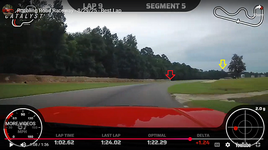
Starting on the exit of the corner before the one you crashed in, I'm using the end of the outside berm (red arrow) as my exit reference, and when I'm there I want the car generally pointed at the taller tree in the distance (yellow arrow). I'm more looking at the yellow arrow and using my peripheral vision (both horizontal and vertical) for the red arrow and closer. Yellow arrow is long-term planning, red arrow and closer is short-term adjustments. The general arc of the corner was established at turn-in. That taller tree / yellow arrow is also a reference for the next corner entry - it's just behind the berm, which is 40' from the track (note that I'm terrible at estimating actual distance in feet so I could be off, but I think you get the idea).
1757197688531.png

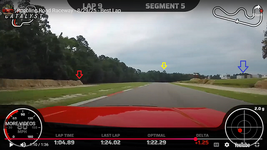
Before I'm even with the end of the berm / exit point, I'm looking for the "mound" of taller trees on the right (blue arrow). They're about halfway between apex and exit of that corner, about even with the start of the pit wall, and will be in line with the flag station when it becomes visible. I'm mostly glancing between the blue arrow and the end of the track under the yellow arrow, calculating my braking point for the turn coming up now that I've got a good feel for exit speed from this one, and using peripheral vision for the red arrow and track closer in.
1757198400141.png

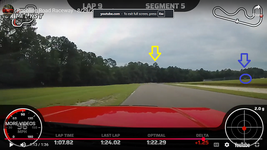
And here the roof of the flag station just popped up (blue circle). The flag station is pretty even with corner apex. I'm starting to look for the timing tower further to the right. I also now have a reference for the corner start (straight towards me from the yellow arrow tree some n feet - I also might be able to make out the outside edge of the track there) and corner apex, and I know it's constant-radius, so I'm already "seeing in my head" where the track is going for the entire turn and planning my braking and turn-in points and steering amount accordingly.
1757198756997.png

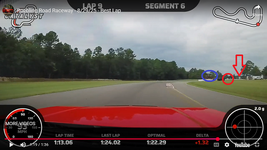
I'm past turn-in, headed towards apex, and I've started to see the timing tower (red arrow). Just between the flag station (blue circle) and timing tower is a white structure just peeking over the pit wall (red circle). When I'm even with the flag station, I want the car pointed at that structure - that verifies the line I want for corner exit that's been in my head. I'm far enough away from apex that I can make some minor corrections get the apex "clipping point" and exit point I want if my line isn't perfect, but time for those corrections is almost up.
1757200382929.png

I'm almost even with the flag station (blue circle) and I can fully see the white structure now (red circle). The red paint on the curb just in front of me is my "clipping point" and I want the car pointed at the white structure when I'm there (pretty happy with the line). But I'm not focused on that curb, it's in my vertical peripheral vision as I'm looking further up the track. I'm also scouting the tree line in the distance (yellow arrow) to give me a ballpark reference for the next turn after this long straight. Keeping my focus further up the track and to the right also gives me a better chance of catching any last-minute flag from the station as I pass it.
1757200980173.png

I've exited the turn onto the straight, and I've found my next reference - the white wall (yellow circle) in front of the flag stand that's at the next corner. I spotted it a bit before this, but it blends with the end of the pit wall so I rolled the video a little more until it separated. I'm also looking for cars moving down the pit lane that might enter the track.
1757201684106.png

Okay, so hopefully all that made some sense. You can see how far in the distance I'm looking to plan inputs, and my vision is bouncing around between these reference points, the flag stands, the mirrors, and occasional checks of the gauges and the track for debris and marble build up. I never really focus on one thing for more than a half a second or so, and I'm using peripheral vision a lot - I'm trying to take in as big a picture as possible to build a "mental model" of everything around me so I can plan my inputs as far ahead as I can. Situational awareness is key and tunnel vision is the enemy.

How does this compare to where you were looking?
 
This is a gross exageration in order to get my point across - in a number of corners you're doing a NASCAR-style high-line "rim-riding" on corner entry, then diving into the apex too late. I've seen this in rookies, where they're "driving off the hood of the car" and/or fixating on reference points until the car is even with them. In your case, you could also just be taking the phrase "late apex" too far.

One tell-tale is that I often hear tire squeal at turn-in, but almost never at or after the apex. That tells me you're over-driving the entry.

Look ahead. No, futher ahead.
This is a great brakedown Dave but looking at objects around the track instead of close to the track is very hard for novice drivers. It's even hard for experienced drivers for example I just started doing what you are describing in that post and it's really hard for me to do. I imagine for someone in his first few seasons will be impossible to do. Novice drivers drive off the hood of the car just because they still don't have the mental capacity to process what is going on around them in that much detail. Imagine like what you were doing in the car when you were about to pass your drivers test and how now you can eat, drink and talk to someone when you are driving. So that's the difference between a really experienced driver like you and a novice.
 
I think that frequently new drivers overthink the whole process. If you have to actively think your way through a corner that suggests to me you're not a natural driver. Some people are naturals, some people aren't. I have no idea why it is that way but after 50 years of doing this, that's my observation.
Some people can read a track instantly and get it, and others can't. I don't coach anymore, but it's been my experience that you can tell if a person is a natural driver in about 3 corners. No idea why that is, other than we're all individuals with different skill sets and different abilities to manage the high performance driving task.
 
This is a great brakedown Dave but looking at objects around the track instead of close to the track is very hard for novice drivers. It's even hard for experienced drivers for example I just started doing what you are describing in that post and it's really hard for me to do. I imagine for someone in his first few seasons will be impossible to do. Novice drivers drive off the hood of the car just because they still don't have the mental capacity to process what is going on around them in that much detail. Imagine like what you were doing in the car when you were about to pass your drivers test and how now you can eat, drink and talk to someone when you are driving. So that's the difference between a really experienced driver like you and a novice.
When I was first learning to ride a motorcycle fast, that concept was described as having a dollar of change in your pocket. When you first learn to drive a manual, 95 cents of your wealth is spent just learning how to release the clutch smoothly without killing the engine or launching into an obstacle. You've only got 5 cents left for everything else - checking mirrors, looking at road signs, etc. As you learn how to shift, and you have 50 cents left for everything else, there's still just another 50 cents left to help you safely manage other driving responsibilities. After time, managing your clutch becomes 5 cents, and that's when you can work on other skills with your 95+ cents left over, but not before then. When shifting becomes 1 cent and you have 99 cents change left to spend is when you realize you are now spending that change by eating, drinking, and talking safely and not even thinking about it.

You remain safe by not ever using credit: you've only got that dollar's worth of attention. If you try to spend more than that dollar of attention, that's when you crash. My first few days and tracks as a novice I spent all my dollar of change trying to stay on the line and go as fast as I could on the line. I didn't have any change left over to do stuff like scan the corner stations for flags. My instructor made me slow down enough that I could spend some change concentrating on other things like scanning the corner stations.

Following that analogy, I work on track skills recognizing that while I am concentrating on one, I won't be competent going to others until I get the one I am working on now, so I have to back off other stuff. For example, heel-toe brake shifting used to use up my 95 cents, so I had to back off speed and other considerations since I didn't have enough change left over to do that too. I'm probably only using about 25 cents on heel-toe now and can go use more of my leftover change for corner station scan, etc.
 
Last edited:
This is a gross exageration in order to get my point across - in a number of corners you're doing a NASCAR-style high-line "rim-riding" on corner entry, then diving into the apex too late. I've seen this in rookies, where they're "driving off the hood of the car" and/or fixating on reference points until the car is even with them. In your case, you could also just be taking the phrase "late apex" too far.

One tell-tale is that I often hear tire squeal at turn-in, but almost never at or after the apex. That tells me you're over-driving the entry.

Look ahead. No, futher ahead.

Before you make any inputs for corner entry (braking and/or turning the wheel) you have to know where the corner exit is, so you know the radius of the corner and how much to brake and turn. You may not be able to actually see it, but you have to at least imagine where it is, accurately. Turn-by-turn, lap after lap.

This may be a wierd personal thing, so I'll defer to those more experienced in track driving, but I almost never drive where I'm looking at in that instant - I'm looking ahead to plan for the next corner / set of inputs, while my peripheral vision is adjusting the current inputs for where the car is. It's an extension of the "look where you want to go" mantra. I'm always trying to look (and plan) at least 2-3 seconds ahead of where the car is. The car has inertia, and that means you can't change where the car will be in a very short time frame (tenths of a second) - it's inertia means it's headed there no matter what you do. You may be able to make small corrections, but not big changes. Mass increases inertia linearly, but speed increases inertia exponentially - the faster you go, the further in the distance you need to look to be able to control the car with your inputs.

I'm primarily an autocross guy, but I've done a few track days. In autocross, it's usually easy to see the "important" guiding cones you selected during your course walk. Sometimes you need to look out the side windows or over your shoulder, but they're in view 99.9% of the time. On track, it's harder to see things like "rubber grooves" and curbs in the distance, especially if there's elevation changes or things blocking your view. I'll use flag stations, trees, tire walls, and other fixed objects to give myself reference points on the track. These aren't necessarily right at corner entry/apex/exit points on track, but they help me point the car in the direction needed throughout the lap. I've built a mental map during the first couple laps (and preferably watching track videos the previous night) of where they are in relation to the track (e.g., flag station is 20' inside edge of track and 10' before apex, last tree in line is 40' outside track and 15' after exit). I'll look as far ahead as possible for those reference points, often glancing between them. The sooner I can spot a reference mark, the more I'm able to plan ahead.

Before corner entry, I should already be looking at the corner's exit reference. As I turn down to the apex, I'm trying to spot a reference for the next corner's entry (unless there's a long straight). Before I get to that corner entry, I've picked up the exit reference. It's a constant visual leap-frog of sighting these references, using them to help me plan where the track is going through the lap. I'm using them to plan for both position and direction (technically, the vector of inertia - where the weight of the car wants to go) of the car on the track.

After watching your full lap video 3-4 times, I was able to pick some references for each corner. Sometimes they weren't in shot when I'd be looking for them.

I'm really interested in what others think of the following breakdown, so let's have other folks' opinions - agree, disagree, call me crazy, it's all helping the community learn. Like I said, I've done a lot of autocross but not many track events, so I'll defer to the input of those with more track experience.

Starting on the exit of the corner before the one you crashed in, I'm using the end of the outside berm (red arrow) as my exit reference, and when I'm there I want the car generally pointed at the taller tree in the distance (yellow arrow). I'm more looking at the yellow arrow and using my peripheral vision (both horizontal and vertical) for the red arrow and closer. Yellow arrow is long-term planning, red arrow and closer is short-term adjustments. The general arc of the corner was established at turn-in. That taller tree / yellow arrow is also a reference for the next corner entry - it's just behind the berm, which is 40' from the track (note that I'm terrible at estimating actual distance in feet so I could be off, but I think you get the idea).
View attachment 105676

Before I'm even with the end of the berm / exit point, I'm looking for the "mound" of taller trees on the right (blue arrow). They're about halfway between apex and exit of that corner, about even with the start of the pit wall, and will be in line with the flag station when it becomes visible. I'm mostly glancing between the blue arrow and the end of the track under the yellow arrow, calculating my braking point for the turn coming up now that I've got a good feel for exit speed from this one, and using peripheral vision for the red arrow and track closer in.
View attachment 105677

And here the roof of the flag station just popped up (blue circle). The flag station is pretty even with corner apex. I'm starting to look for the timing tower further to the right. I also now have a reference for the corner start (straight towards me from the yellow arrow tree some n feet - I also might be able to make out the outside edge of the track there) and corner apex, and I know it's constant-radius, so I'm already "seeing in my head" where the track is going for the entire turn and planning my braking and turn-in points and steering amount accordingly.
View attachment 105678

I'm past turn-in, headed towards apex, and I've started to see the timing tower (red arrow). Just between the flag station (blue circle) and timing tower is a white structure just peeking over the pit wall (red circle). When I'm even with the flag station, I want the car pointed at that structure - that verifies the line I want for corner exit that's been in my head. I'm far enough away from apex that I can make some minor corrections get the apex "clipping point" and exit point I want if my line isn't perfect, but time for those corrections is almost up.
View attachment 105680

I'm almost even with the flag station (blue circle) and I can fully see the white structure now (red circle). The red paint on the curb just in front of me is my "clipping point" and I want the car pointed at the white structure when I'm there (pretty happy with the line). But I'm not focused on that curb, it's in my vertical peripheral vision as I'm looking further up the track. I'm also scouting the tree line in the distance (yellow arrow) to give me a ballpark reference for the next turn after this long straight. Keeping my focus further up the track and to the right also gives me a better chance of catching any last-minute flag from the station as I pass it.
View attachment 105682

I've exited the turn onto the straight, and I've found my next reference - the white wall (yellow circle) in front of the flag stand that's at the next corner. I spotted it a bit before this, but it blends with the end of the pit wall so I rolled the video a little more until it separated. I'm also looking for cars moving down the pit lane that might enter the track.
View attachment 105683

Okay, so hopefully all that made some sense. You can see how far in the distance I'm looking to plan inputs, and my vision is bouncing around between these reference points, the flag stands, the mirrors, and occasional checks of the gauges and the track for debris and marble build up. I never really focus on one thing for more than a half a second or so, and I'm using peripheral vision a lot - I'm trying to take in as big a picture as possible to build a "mental model" of everything around me so I can plan my inputs as far ahead as I can. Situational awareness is key and tunnel vision is the enemy.

How does this compare to where you were looking?
As I said in my previous post in this thread, where I talked about f/r balance and grip, another thing the pro instructors made us do was drills they called "look at nothing and see everything". Basic message was that your brain can manage the car if you don't distract it by fixing your gaze on something. So, keep your eyes moving and scan the track side to side through to the exit of the corner and onto the upcoming straight as you're braking. As you scan back and forth with your eyes, note the location of the apex (or the location on the track where you'll switch from turn-in to turn-out - sometimes that spot isn't at the inside edge of the track) and continue scanning through to the exit. Keep your eyes up and moving and you'll be surprised at how the world slows down and you proceed smoothly and quickly through the corner.
 
Last edited:
As I said in my previous post in this thread, where I talked about f/r balance and grip, another thing the pro instructors made us do was drills they called "look at nothing and see everything". Basic message was that your brain can manage the car if you don't distract it by fixing your gaze on something. So, keep your eyes moving and scan the track side to side through to the exit of the corner and onto the upcoming straight as you're braking. As you scan back and forth with your eyes, note the location of the apex (or the location on the track where you'll switch from turn-in to turn-out - sometimes that spot isn't at the inside edge of the track) and continue scanning through to the exit. Keep your eyes up and moving and you'll be surprised at how the world slows down and you proceed smoothly and quickly through the corner.
Or, as AJ Foyt once said, look way down the track, not the nose of the car or the car in front of you, if anything happens in between, it will get your attention.
 
The problem is this is not taught for day to day driving at all! You should be looking hundreds to thousands of feet down the road when driving on/in the freeway/city too. Your 'lizard brain' is really good about dealing with all of the things close to you and setting the trajectory of the car so you can use your cognitive brain to path plan and stay out of trouble. You go where you look! I had to teach a bunch of software engineers how to drive fast for a lemons team ages ago (or at least enough to not get any flags), the best thing is to put a line of tape on the windshield just below your eye level and never look below the tape unless your parking! (Hills on the track not withstanding...)

Edit - You can and should practice this everyday when driving, it takes a lot of work to get used to it.

I put an old video of me crashing at Buttonwillow up, everyone makes mistakes! Just learn from them.
 
Last edited:
For the inexperienced who have come across this thread and may be having second thoughts about this hobby or want to know whats the best way to avoid the situation we have all been discussing.
A summary approach to learning safely in one very long essay, by the way it isn't foolproof.

For those new to driving at speed, and i mean those with only a few years of track events because it really is probably less than 50 hours of track time, you never get to experience what happens when traction is lost dramatically at speed. When it does your reactions need to be instinctive rather than processed in real time, its too late by then. So how do we achieve that.
I think that frequently new drivers overthink the whole process. If you have to actively think your way through a corner that suggests to me you're not a natural driver. Some people are naturals, some people aren't. I have no idea why it is that way but after 50 years of doing this, that's my observation.
Some people can read a track instantly and get it, and others can't. I don't coach anymore, but it's been my experience that you can tell if a person is a natural driver in about 3 corners. No idea why that is, other than we're all individuals with different skill sets and different abilities to manage the high performance driving task.
I always love reading @JDee comments because to me they come across as very direct but there is always a message contained within. It appeals to my brutally honest approach because there is a lot at stake here, both financially and physically. Understand what is at stake.
New drivers do overthink the whole process, they have nothing to base their actions on other than what they see at the time and what they have been told. There in lies part of the problem, getting good instruction from the right people.
The second is getting that seat time to build experience which i'm really happy to say is pushed by everyone i've seen on this forum. Seat time before mods is always the message. Find out what you think you need rather than here is the list of must do mods before you get in the car. Part of the experience component is building muscle memory and brain links to what happens when i do X. Honestly, learning in a modern Mustang probably isn't the greatest idea, they are to heavy and fast, read that as when i bite its probably going to hurt big. The caveat to that is if you are willing to approach this slowly and cautiously then go for it but we know that's not actually going to happen. Even i have to talk to myself, its wet and i have nothing to prove, just stick behind the Cayman because he obviously has more self control than me but i can get past the car he just passed as well. I've been doing this for 38 years and still have to actively tell myself to pull my head in.

Best place to learn in my opinion, start with Autocross, also mentioned extensively by everyone and for good reason. Much lower speeds, but you will actively experience under and over steer way more often and to higher levels than you should be experiencing on track, this isn't a drift forum. What you probably won't realise is you are also being forced to work out lines between points just like any race track, just in miniature. A lot of places will probably run multiple courses in a day so you are actually learning way more than lapping the same old racetrack and following the rubber without actually understanding why this is the line.
I was taught to dissect each corner backwards. The exit determines what happens before it, where do i need to be pointing towards the next segment, we then trace the largest arc back to touch the inside of the corner and the entrance to the corner where it intersects with our incoming straight, this becomes our turn in point. Next we determine where we would have to brake to get to a speed at that turn in point that would allow the car to follow that arc with no steering change mid corner. This becomes our basic theoretical line through the corner.
Drive into the corner, set the steering wheel on our arc and we should end up pointing down track towards the next corner with no corrections required.
Yes it is for a single stage corner but new folk have to start somewhere and having a method to come up with a basic line with an understanding of what should be possible to drive is the starting point. We are trying to learn without involving tyre slip angles and under & over steer to start with.
My observation is new drivers turn in too early in general and end up having to crank more lock mid corner after hitting an early apex when they realise they are going to run off track not facing the direction to the next corner. Learn the track before you get on the track. Get a picture of its layout and work out where the theoretical lines are before hand. As we mention earlier in this thread, wizzing past the turn in point at speed isn't going to be pretty.
Even the elder statesman agrees which means it must be right.
Not sure I agree with either of you as I always studied the track in my head or during a classroom , then drove at a reasonable speed, initially, to focus on the correct apex for each corner.

Also mentioned, but possibly get you arrested, the local big carpark, probably after dark when its empty, which is just going to make you look more suss. Did that one afternoon on a rooftop carpark, practice for our nationals autocross, had the area coned off and ended up with a few spectators, found out one was an off duty police officer, appears we had done enough to make him think we weren't total idiots. If you can find a spot, do exaggerated inputs of brake throttle and steering and see what happens. It's how you learn. Just not in the middle of an intersection in town. Its frowned upon and Mustangs get a bad name.

Next stage would be a technical low speed circuit if you can find one near by. The young friend i am coaching into the sport has set himself track day targets, won't do a particularly unforgiving circuit until he has completed 10 track days elsewhere on safer circuits. I like that level of self awareness. Having been 4 wheels in the dirt with him, smart man.
Driver coaching with someone other than your mate, like a professional, someone with actual runs on the board with circuit racing. Yes i did send him out first with instructors. I value my life also. They will slap any obvious bad habits out of you quick smart, they don't like being scared by the people they are coaching. The shortest coaching session i know of was out pit lane into turn 1 straight into the kitty litter. My friend told him to straighten the wheel and drive it straight in as he had overcooked the entry so badly on the first corner he didn't want to come off the track sideways at speed. Thankfully the guy listened. We all started somewhere.

Hopefully by this stage you have gained enough car control experience that high speed circuits shouldn't be a daunting experience. Just remember, drive at a pace you are comfortable with, leave the egos at home and take it as a learning experience still.
Every circuit will need time for you to work out the lines, braking points, turn in marks, bumps, curbs to avoid etc. This isn't a drive to the local shops. Learn the track, not just the left, right, left bit. Talk to people, where are the tricky bits, where are the hidden traps. Every circuit will have curbs to stay off, they may be higher, may drop off on the back side, maybe a different texture. Where is the bump mid corner when the suspension is fully loaded, the hump just as you want to hit the brakes requiring an earlier application with a slight lift before getting back onto them. When was the track resurfaced, last time you were there it was old asphalt, now its new, it makes a difference.
I mention all of these because this is the level of thought that you need to bring with you to the track. Its the bare minimum, those guys that actually race take it to a level way beyond this. Motorsport at any level is a thinking game.

The last part of the basic equation i see is, what happens inside the car. What is the norm. Thankfully technology has brought us cameras with far more pixels than i started with so we can sit and watch other do their stuff and dissect their every move.
I have had the pleasure of scaring the crap out of people over the years who have asked what i do that makes me faster than them. Come for a ride you say. This is where reality really starts to bite for those that haven't grown up around motorsport and the level of physicality involved wrestling a car around a track. A fast open road drive is the most they have experienced and being a passenger in a competent track car is an interesting awakening. Most of us have had passengers looking for the non-existent brake pedal on the passengers side.
If you can, watch videos of your local tracks with known people driving, see how they react, the level of inputs required to maintain a line through a corner. Our theoretical line i mentioned previous was just that, a low speed line, at speed we dance over and under that line finding a balance to keep momentum and turn all in balance. Once again we are trying to educate you to the level of interaction that is required in this hobby/sport. What you once believed was overdriving might just be what is actually required to get those times that everyone was talking about. While we are here, just because someone else can do such and such a time doesn't mean you can. Every car and person is different, learn to drive it competently first before we play that game. It might look like your car on top but underneath you don't know what has been done, first rule of motorsport, underplay everything to keep the other guessing how does he do it.

Now to some examples given our access to video.
The incident on this thread has been dissected enough as to why it happened but @mavisky makes a great point on what needs to be done when it happens. This doesn't necessarily concern this incident in particular as this thread has become a good discussion about the "hope it never happens" side of this hobby.
Once you were out wide I totally understand the natural instinct to want to keep the car on the pavement, even though the safest avenue of escape is probably pushing wide into the grass and gradually bringing it back to the pavement. You're on treaded tires so not like you'll skate like you're on slicks. Then you either consciously or subconsciously got out of the gas which is what started the rear moving. Once that happened the inputs were too slow on the wheel. Your thinking of "pointing the wheels down the straight" were mostly correct, but you have to counteract the rotation first and that can take a quick "over reaction" input on the wheel to get that started before you can then point the car the right way.

Might as well start with his example, his video shows Autocross at its best with the amount of steering input and speed of input needed to keep the car under control when its actively trying to get away from him. Way more involved than you are ever likely to encounter on the road.

I'm going to use my off track excursion to quantify the inputs shown in his video.
Starting at 71Deg of right hand lock with definite under steer and realizing I'm about to visit the bumpy slippery stuff. 1/2 a second later I'm committed to leaving the track as i know i cant make it stick and am back to 55Deg. Another 1/2 second and i'm at 25Deg left hand lock. Wheels off track another 1/10 second later we have hit 49Deg Left hand lock. 3/10 second later back to straight ahead. So from 55Deg right to neutral we did 153 degree of left then right turn in just under a second to make sure i left the track with the car balanced and not wanting to dig a front tyre into the softer surface. I have always made it a practice to actively turn the car off track rather than let it slide sideways off track. No i don't do this often.
vlcsnap-2025-09-09-20h54m21s454.pngvlcsnap-2025-09-09-20h55m20s845.pngvlcsnap-2025-09-09-20h55m55s632.pngvlcsnap-2025-09-09-20h56m12s528.pngvlcsnap-2025-09-09-20h56m33s658.png
Next lesson is, this isn't over yet. We have left the track "safely" but still have to bring it under control and avoid everything off track as well.
Yep, thats a cone right in front of me. i like my new AJ canards so time to avoid that one and the other 2 hidden behind my logger. Another flick to the left with a correction catch again to keep everything stable.
Again about a second to make a decision and act on it before impact.
vlcsnap-2025-09-09-20h57m21s763.pngvlcsnap-2025-09-09-20h58m04s338.pngvlcsnap-2025-09-09-20h58m46s084.pngvlcsnap-2025-09-09-20h59m14s009.png
And why did all this happen, didn't take my own advice and park my ego. Finally had a chance to get past 2 BMW's and tried to get away from them way too fast and paid the price.

Like i mentioned at the start, it isn't foolproof as we all do something foolish every now and again. Its how we prepared that determines the outcome.

I 'd like to say thanks to all the members that take the time to give advice on here for all sorts of topics. You guys are a really great resource especially for those of us not surrounded by like minded people with the level of knowledge, contacts and experience.

The fact that a lot of people have owned up to their own mishaps and shared their learning say a lot about everyone. Especially @krisk for starting this thread rather than quietly sweeping it away, these are the really good learning threads that help a lot of people.
 
Incidents like this is why I think a driving sim is the best investment one can make if you want to do this hobby remotely seriously. Virtually unlimited track time, 99% of it is applicable to the real world, and you get to drive a ton of different cars and tracks. When I was building my car, I spent hours on the sim driving GT3 cars with TC turned off and I built a bit of a natural "instinct" on how to respond to the car losing traction. It's really helped my driving - you can see a few examples of where this "instinct" comes into play on my shakedown laps at road america this year.


Sometimes you reduce throttle 10% and steer into it, sometimes you hit the brakes and steer into it, and sometimes you spin and pray you can keep it off the wall by getting the tires to spin at the right time (I'll hunt for one of those videos). SIM is the best way to learn all that safely.
 
When I was first learning to ride a motorcycle fast, that concept was described as having a dollar of change in your pocket.
I loved that analogy about having a dollar of change in your pocket to spend when and how you need it most, when that time arises.That same principle can be applied to life itself. The most important thing is never using credit!!!!!!......That change you have in your pocket has helped you so far by setting limits so as not to "over extend" your progress and abilities.
 
Ahh - found the spin and uploaded it to youtube. This was way back with the second ever event with the new build and I hadnt quite adjusted to it yet. I got on power too early and it wasn't forgiving - and I corrected poorly.

Once I start to spin, watch the brake pressure bar. I slam on them (~1250 psi) and once the rotation is slowed, I steer back straight and let back off the brakes to stop my momentum going towards the wall. Then back on the brakes to kill speed again until I come to a stop.


All instinct in that clip from my iRacing experience. Def a lot I could've done better - but the sim racing experience is what kept me out of the wall.
 
Last edited:

Latest posts

Buy TMO Apparel

Buy TMO Apparel
Top