I love that they use “Mu” for brake pad friction we use it in aviation for runway friction on landing. I never understood what it actually meant but i know it’s directly proportional to friction lol

This site may earn a commission from merchant affiliate links, including eBay, Amazon, and others.
Only because the factory "street" ABS is dog sh*t. The S650 and the new Dark Horse SC have much better and modern ABS. It took me a while to figure out what was going on with the ABS thanks to Terry from Vorshlag to actually posting it in a way that clicked with me. The aggressive GLoc pads were never working because the ABS was fighting them in every brake zone to a point where the Ice Mode kicked in. Now with the lower Mu pads it's much easier to control the car in the brake zone and to stay on them for long.You don't need much mu on the front of the car and significantly less on the rear. A higher friction level doesn't increase braking performance, it just makes the ABS come in sooner.
Modulation is a much bigger deal than ultimate friction level.

That chart is what I used when I selected the OEM PP1 pads for rear (DS2500) and DSUno (Red) for front.
Yep, and they really fight rear locking. ABS can only do so much, especially since they all run the torsen, which screws you for braking. There just isn't enough diff lock to keep things happy.
In general, any sort of front-engine GT-ish car wants very little braking on the rear. I haven't tried it, but I suspect the EBC blue (orignal) would be too much for the rear. The DS2500 really drops over about 350*. That's going to be about the temperature on brake application. 1/2 way through the brake zone, they'll be 550-ish. That's kinda the idea of a digressive rear pad. Good initial friction, then have the friction level drop through the zone so you don't have to fight locking on corner entry. A friction coeff. of about 0.30-0.35 is what you're looking for on the rear coupled with something in the 0.45 range on the front. Any of the big friction pads on the front will be a like a light switch, on/off.
You don't need much mu on the front of the car and significantly less on the rear. A higher friction level doesn't increase braking performance, it just makes the ABS come in sooner.
Modulation is a much bigger deal than ultimate friction level.
My last track day was on really brake intensive track. And I was mighty impressed with how that brakes package performed as people were struggling with brakes. The DSUno is very easy to modulate but also aggressive and with great stopping power. I was sharing the box with a friend of mine who has a G80 M3 with over 600 WHP and while his lap times were faster we were actually posting similar 180-120 km/h braking times. He got his rear pads on fire (Pagid RSL29) while my DS2500 was performing great. So overall I'm happy with that package and for example compared to Gloc R16/R12 combo I was running previously and Serres the car was actually over slowing for T1 by 0.5 seconds because this was the first time I was driving the DSUno/DS2500 combo. In other words that combo is very aggressive and very good and I don't think my car ever braked better. After my last event I replaced the Brakes Booster and there is a difference in the boost to the brakes so I guess I will be stopping even better.This is going to be my setup as well - how do you like it? Any other advice or feedback to share?

I wish I had saved the link, but I read somewhere that the Dark Horse with handling package was able to decelerate at 1.4G without the ABS overriding. This (and the tires Ford chose) is why it had the shortest stopping distance of any production car in the history of Motor Trend.Only because the factory "street" ABS is dog sh*t. The S650 and the new Dark Horse SC have much better and modern ABS. It took me a while to figure out what was going on with the ABS thanks to Terry from Vorshlag to actually posting it in a way that clicked with me. The aggressive GLoc pads were never working because the ABS was fighting them in every brake zone to a point where the Ice Mode kicked in. Now with the lower Mu pads it's much easier to control the car in the brake zone and to stay on them for long.
 www.wheelcircuit.com
So this S550 quirk appears to have been addressed, at least on the S650 Dark Horse with handling package.Was constantly fighting the ABS Ice mode (OEM ABS module intervene once you are past 1.2G of braking)
Please do not forget to take some photos of the back of the original pads, so we can figure out what Ford installs at the factory.The stock pads should be pretty good then. When mine go ill try the glocs and see what happens
Fronts almost zero modulation constant ABS activation on street tires so 16 are too aggressive for street tires. Rears also too aggressive but I was having ABS issues even with R10/R8 then I switched to R12/R8(same rears) and the ABS issues become even more and with 16/12 was insane.So what was wrong with the Gloc 16/12? That was recommended to me by Tim at OP mustang for my Dark Horse. Over braking the rear?


This is going to be my setup as well - how do you like it? Any other advice or feedback to share?
I agree, and prefer more smooth modulation rather than on/off switch. Not sure why anybody would want the on/off switch other than a misconception of better/stronger braking. Reminds me of those throttle booster gimmicks lol
How hot is too hot for the DS2500? I run them front and rear as of now, and I can definitely feel performance degradation near the end of the 20 minute session if I’m not managing temps with cooldown laps.
Do you guys smell brake burning after sessions? I do!
Fronts almost zero modulation constant ABS activation on street tires so 16 are too aggressive for street tires. Rears also too aggressive but I was having ABS issues even with R10/R8 then I switched to R12/R8(same rears) and the ABS issues become even more and with 16/12 was insane.
Dracon with different setups 180-100 km/h times:
View attachment 109736
On Serres since turn 1 is over 100 km/h I measured 180-120 km/h:
View attachment 109737
All of this data is collected with Racebox from GPS. As you can see the DSUno/DS2500 combo is much faster to brake compared with Gloc R16/R12 and is really clear how going up in Front compounds actually net worse results. I spend tons of money on brakes the past 3 seasons and I really hope I found a solution as it was a nightmare.
Thanks I don't left foot brake but stopping 1800 kg ( 3968 lbs) car from 200 km/h (124 mph) takes a lot of toll especially when your brake pads are triggering ABS and spending so much more time on the brakes. My tracks are very short 1.86 miles and they have a lot of brake zones: Dracon has 5 stops and the longest straight is a 1/4 mile. So the brakes just don't have time to cooldown in a lap. Which is why after struggling for a few seasons and SRF showing signs of boiling I decided to check the data to quantify what exactly was going on. What prompted that research was Terry changing the ABS on Trigger. So I found some brake zones and run through my best laps over the years to figure out what was going on. Dracon got changed in 2024 which changed the data. And so was Serres but the R16/R12 vs DSUno/DS2500 happen on exactly the same car in the span of 2 months in September/November 2025 on a brand new A052 tires. In fact my Serres 1:27.86 lap time actually was loosing 0.5 seconds in the brake zone on Turn 1 just because braking from the R16/R12 marker over slowed the car.First, this is some really cool testing you've done here. Second, boiling SRF is impressive. Time to increase the ducting. I don't know if you left foot brake, but be careful of crossing pedals if you do (both at the same time as you transition between the two). That puts a lot of unnecessary heat into the brakes.
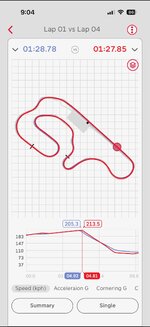
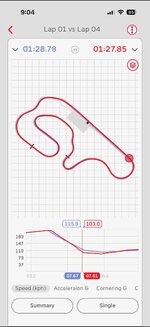
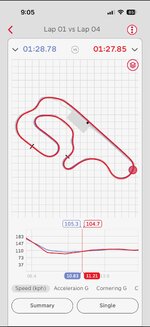
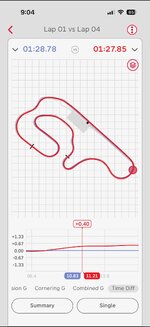
Do you drive with these pads on the street, too, or only on the track?That chart is what I used when I selected the OEM PP1 pads for rear (DS2500) and DSUno (Red) for front.
I drive with them on the street as well but drive is very strong word it's mostly from/to the track or from/to Dealer of my tires shop. At that point of the life of the car I very rarely use it on the street. But yeah they are streetable pads and they don't make a lot of noises like Gloc so for a change my car doesn't sound like a train when it stops.Do you drive with these pads on the street, too, or only on the track?
If so, could you tell us a little more about them?
 The DS2500 is the only Ferodo pad that does not have that warning.