The Mustang Forum for Track & Racing Enthusiasts

Taking your Mustang to an open track/HPDE event for the first time? Do you race competitively? This forum is for you! Log in to remove most ads.

  • Welcome to the Ford Mustang forum built for owners of the Mustang GT350, BOSS 302, GT500, and all other S550, S197, SN95, Fox Body and older Mustangs set up for open track days, road racing, and/or autocross. Join our forum, interact with others, share your build, and help us strengthen this community!

HPDE tires

This site may earn a commission from merchant affiliate links, including eBay, Amazon, and others.

More than a tire with the 26 offset? No way.

All we are doing is moving the wheel out to match the same position as the stock 26 offset, so we can use the 52 offset from the rear wheel ( so we can rotate).

I think the leverage would be exactly the same, since the wheel and tire are moved into the exact same position as the 26 offset with no hub.

It only increases leverage if you are moving the wheel and tire further outboard. In this case, the wheel and tire are in the exact same position.
Any time you move the face of the wheel out from the hub you will increase leverage. A spacer will do just that. Tell me how it won’t? Is it a factor? depends. The fact you have to lengthen your studs should tell you that right off the bat The shear weight of the vehicle has moved outboard of the hub. Pretty basic geometry. Dealt with this in offroad vehicles. Big difference here is a sandwich spacer for increased strength with the lengthened studs. Some spacers bolt on to standard length studs and have new studs to bolt wheel on. Same result far less strong
 
Any time you move the face of the wheel out from the hub you will increase leverage. A spacer will do just that. Tell me how it won’t?

Because the outside rim of the face of the wheel does not move out at all.

The front backspace is 26. The rear wheels are 52. The spacer moves the outside rim of face of the rear backspacing wheel to the same location as the regular front backspace wheel.

Does my explanation make any sense?

Is it a factor? depends. The fact you have to lengthen your studs should tell you that right off the bat The shear weight of the vehicle has moved outboard of the hub. Pretty basic geometry. Dealt with this in offroad vehicles. Big difference here is a sandwich spacer for increased strength with the lengthened studs. Some spacers bolt on to standard length studs and have new studs to bolt wheel on. Same result far less strong
No. The studs having to be lengthened does not change where the outside rim of the face of the wheel is. The lug nuts are further out on a 52 backspace wheel plus spacer - true. But the leverage is being applied from the tread back into the hub. Leverage is like a big lever. One end is the tread, and the other end is the hub. The tread is in the exact same spot relative to the car as the 26 backspace wheel would be without a spacer, so the leverage force acting on the hub is the same when you compare a 26 backspace 11" front wheel and a 52 backspace rear wheel installed on the front with a spacer to put the tread in the same location.


There is only more leverage on the hub if the wheel and tire are pushed further outboard.

That is not happening in this case.

The spacer is to put the wheel in the exact same position and not further outboard or inboard.
 
"Anything that places the tire further outboard, whether it’s a spacer or a wheel with reduced offset, will put more angular load on your wheel bearings. The farther the tire gets pushed outboard, the greater that angular load.

This definitely can lead to accelerated bearing wear. It’s just a matter of whether the bearings can handle it indefinitely, or at least for an acceptable length of time."


This appears to be true to me.

The spacer pushed the wheel further outboard.

The wheel with reduced offset (26 instead of 52) also pushes the wheel further outboard.

Both put the same increased leverage, "angular load," on the hub and bearings.

One has a spacer, and the other does not, but the end result is the same.


This is distinct from simply taking the same wheel and using a spacer to move the wheel and tire further outboard for looks or whatever. That does indeed increase the angular load (or leverage) on the hub and bearing.


Hopefully I have communicated my position clearly. First, tell me you understand everything I wrote (if you don't, then point it out so I can clarify that part) and then, once we are communicating clearly, tell me where I am wrong.
 
Last edited:
From the same link:

"This exactly. People like to b*tch and moan about how bad spacers are, but effective offset is effective offset. The car sees zero difference whether it’s built into the wheel or it’s done with spacers."
 
AI response (probably false information to try to kill us and speed up AI taking over the world and eliminating humans, though):

The Comparison
To answer your question exactly, it all depends on the total distance from the hub to the center of the tire:
  • Scenario A (More offset + spacer): The wheel sits further outboard.
  • Scenario B (Less offset, no spacer): The wheel sits further inboard.
The setup with the larger total outboard distance (typically the More Offset + Spacer combination) puts more leverage on the hub. If both setups push the wheel outward to the exact same track width, the leverage placed on the hub and suspension will be practically the same
 
I think you missing the basic point here. The shear load of the weight of the vehicle is moved farther away from the face of the hub with a spacer. Offset and rim width have nothing to do with the wheel face to hub mating surface. I’d you move the wheel face farther out from the hub there will be a larger horizontal distance ie more leverage on the hub. How can this not be? Totally separate from width and off set. But obviously if the setup is reasonable this could be minimal but obviously if you have a ridiculous (wrong offset or rim width etc) setup it could be a factor. In any case sandwiched spacers of reasonable width obviously work. If you put a 12” spacer on probably not. That would be a lot of upward leverage on the hub
 
There's a lot of quoting of general cases, but we're dealing with a specific case here. If you use a spacer, and the same wheel, the centerline of the wheel & tire moves away from the hub, and leverage (and bearing wear) on the hub increases.

However, in our case, we're comparing a wheel that is 18" (or 19") x 11" with a 26mm offset mounted directly to the wheel hub, to an 18"/19"x11" wheel with a 52mm offset, plus a 26mm spacer, mounted to the hub.

In our case, the centerline of the wheel/tire does not change in relation to the hub (and its bearings).

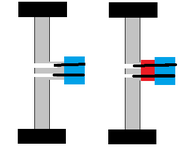
Forgive my terrible (or complete lack of) artistic abilities. Not to scale. Pic on left is a 26mm offset wheel (grey) mounted to hub (teal). Note that because the wheel has a deep center "pad" the lug nut pockets can be deep. The pic on the right is a 52mm offset wheel, with a 26mm spacer (orange). Because the "pad" of the wheel is not as deep, the bottom of the lug nut pockets move away from the hub face, so extended lug studs are needed.

1780034921606.png
There is no difference in the length of the "lever arm" from wheel/tire centerline (or outside edge for those in a turn without enough camber) to the hub bearings.

There is additional stress on the lug studs. But using a high-quality lug stud, using spacers with hubcentric pilot rings machined in if they're thick enough to negate the usefulness of the hub's pilot ring, ensuring the mating faces are flush*, and maintaining proper torque solves that problem.

* Watch the video posted in this thread. https://trackmustangsonline.com/thr...ls-falling-off-at-the-track.17931/post-267795
 
I’ll test them out when i get them assuming OP’s spacers are good. Yeah if you have it set up right specifically engineered for your application all should be good. I’m not worried i’m going to do it. Plenty of people do it wrong in various applications but this is a very specific time tested setup and still wheels fly off apparently. Anytime you run a spacer you introduce potential problems. Don’t buy off amazon lol
 
All things being equal the leverage will be greater In this particular instance with carefully selected backspacing components problem
is mitigated with good extended studs and spacers. The hubs on a s550/650 are pretty beefy as well. Yet wheels still fly off had some on track recently. I torque after every session amazed how they loosen up
 
brandmodel295305priceUTQG
BridgestonePotenza RE-71RS30 sq2000200
BridgestonePotenza RE-71RZ30 sq2140200
ContenintalExtremeContact Force30 sq1700200
FalkenAzenis RT660+35 sq30 sq1800200
GoodyearEagle F1 Supercar 330302100220
MichelinPilot Sport Cup 230302300240
NankangSportnex CR-S30301700200
VitourTempesta P1 P-01R30301900200
GoodyearEagle F1 Supercar 3R30 sq1800100
NittoNT0130 sq2340100
PirelliP Zero Trofeo R3030250060
PirelliTrofeo Track30248540
ToyoProxy R30sq30140040

We need to make a better and more updated chart
 
This car weighs almost what our cars weigh and has a lot of power, so this longevity review on the new Hoosier Track Attack Pro (not the R8, a 40 tw tire. This is a 200 tw tire and significantly cheaper) might be useful. It is 305R30/19

 
After they've had a good amount of time to cool though, right? I know it often goes without saying around these parts, but if a cold torque rating is applied to a hot stud after a lapping session the nut may feel looser than normal for different reasons...
Always right before i go out. Not when i come in so usually that’s at least an hour. Or two. Is there a hot and cold torque rating? I know the coated studs at op use less torque all around
 
Is there a hot and cold torque rating?
The general guideline is not to touch them at all when hot, as trying to torque them down to the cold number can stretch the stud, deform the threads, or outright snap the stud due to them now being over-torqued when they return to their cold state. An hour should be fine. Just wanted to double check, since a wheel unexpectedly coming off can be a "significant emotional event" hah.
 
Top