The Mustang Forum for Track & Racing Enthusiasts

Taking your Mustang to an open track/HPDE event for the first time? Do you race competitively? This forum is for you! Log in to remove most ads.

  • Welcome to the Ford Mustang forum built for owners of the Mustang GT350, BOSS 302, GT500, and all other S550, S197, SN95, Fox Body and older Mustangs set up for open track days, road racing, and/or autocross. Join our forum, interact with others, share your build, and help us strengthen this community!

Advice on camber setting for track

This site may earn a commission from merchant affiliate links, including eBay, Amazon, and others.

6
7
Exp. Type
HPDE
Exp. Level
Under 3 Years
California
Hi, as I'm entering my 10th HPDE event I start to see some limitations my car has. I have a base GT with some add ons.
One of the issues is that the outer part of the tires is getting eaten more aggressively as my tack skills are improved. I would like to add some camber. I have the Steeda plates and rear kit that can be adjusted, but I have absolutely no idea what numbers to aim for. The car is also a daily. Ideally, (I know though, it's not ideal) I would like to drive the car with that camber in the street while having "minimum" wear. Changing camber back and forth and having to do an alignment every time is not an option at the moment.

My car has the FP track springs , 18x10 apex wheels with 275/40 Continental ECS2

Thanks
 
How many HPDE sessions d the Continental ECS2 tires last? That will help others provide an answer. And you say your 10th HPDE, but how often do you go?

If you are doing a lot of tracking, then you can use more negative camber up front, because you will be wearing the tires before you wear out the insides driving sedately on the street. If, on the other hand you might go 4-6 months without a trip to the track, and aggressive camber setting is going to wear the inside shoulder/tread.
 
Changing camber back and forth and having to do an alignment every time is not an option at the moment.
With that in mind, whatever setting you choose will be a compromise, and you need to accept that.

Let's start with the assumption your current tires have been on the car for a while and have seen your typical mix of everyday and track driving. If the tires are being worn more heavily on the outer shoulders from track driving with too little camber, and the inside shoulders don't look too worn from street driving with too much camber (or toe out), then you can stand to dial in more negative camber.

How much more camber should you use? Somewhere more than what you have currently and probably less than all you can get. I know, you want us to give you a number, but the ideal compromise number is specific to your driving style and aggression, your mix of street / track, the particular track(s) you drive, etc.

It would help if you gave us your current alignment numbers, and maybe pics or front & rear tire wear, and a rough estimate of the miles on the tires from street vs track.

Just spit-balling without knowing the above, I'd throw another -0.5 on the front and -0.2 on the rear. Check wear periodically and adjust.
 
... I would like to add some camber. I have the Steeda plates and rear kit that can be adjusted, but I have absolutely no idea what numbers to aim for. The car is also a daily. Ideally, (I know though, it's not ideal) I would like to drive the car with that camber in the street while having "minimum" wear. Changing camber back and forth and having to do an alignment every time is not an option at the moment.
...

I wrote several DIY alignment articles over at 6g. They can be found at my build log, which contains many links to other tech tips.

Here is my technique to easily and accurately switch between street and track settings:

These days I put on my track brake pads and track wheels, and change the front alignment for track. Then I drive 200 miles to the track and back this way. My logic is that the wear on track tires rolling down the freeway is nothing compared to screaming around the track, and those tires won't last more than 4 weekends anyway.

How much camber? The answer is always "As much as you can get!"
I ran -3.7 up front last weekend, and I plan to try my max setting of -4.2 next. This for 200tw tires, not 300tw.

I also designed a camber gauge for Steeda plates.
DIY Camber gauge for Steeda plates
1783896440355.png
 
I think IMSA only allows us to run 3.5, and we'd like to get more if we could, you'll need plates and maybe cutting the shock tower. The 275 tire is way too small for these cars, try to get some 305s on it if you can
 
In lieu of giving you the 'right' answer, I'll give you the 'right enough' answer. Go to maximum on both front and rear cambers. With plates, you'll be about -3.0* on the front (maybe a tick over). You'll be -2.0* or a little less on the rear. Set front toe to slightly toe-in at 1/2mm per side measured at the rim. Set the rear to 1.5mm toe-in per side measured at the rim.

Hot pressure targets of 30 psi front and 28 psi rear. Start them at 23/21 and bleed down to targets when they're hot.

Don't make it a bigger deal than it is.
 
Set front toe to slightly toe-in at 1/2mm per side measured at the rim. Set the rear to 1.5mm toe-in per side measured at the rim.
I see you recommended toe in for both front and rear. Did you mean toe out for the front, or toe in for both front and rear?

If you meant toe-in, could you explain why?

By the way, I am not looking to debate - I have never played with the toe setting. I just see everybody recommending 0° toe on the front or slightly toe out, with rear being slightly toe in, and this is the first time I have seen a recommendation for front toe in, so I thought I would I ask your reasoning (and you are normally pretty good about supplying explanations). Thanks in advance.
 
I will share my settings that are working for my car as I love sharing them:

F: -3.2 Camber (this actually wear tires on the inside because of Highway driving), -2.5 mm Total Toe-Out (-1.2 or so per side)
R: -1.5 Camber (on one side I have -2.0 didn't bother to fix it on both), +2.5 mm Total Toe-In (+1.2 or so per side)

This actually works great for me in terms of tire wear and times but my car has 295/35/19 A052 tires and Ohlins Coilovers with 500 lbs front and 800 lbs rear springs.
 
I see you recommended toe in for both front and rear. Did you mean toe out for the front, or toe in for both front and rear?

If you meant toe-in, could you explain why?

By the way, I am not looking to debate - I have never played with the toe setting. I just see everybody recommending 0° toe on the front or slightly toe out, with rear being slightly toe in, and this is the first time I have seen a recommendation for front toe in, so I thought I would I ask your reasoning (and you are normally pretty good about supplying explanations). Thanks in advance.

Toe is a 'salt-to-taste' setting which will vary based on tire & driver. I think a little toe-in gives a little better mid-corner front grip (on B'stones). Other people go for toe-out, which will tend to give a touch more initial response. Anything I give out is a starting suggestion, not a final answer.

It appears you have all stock bushings, right? As the bushings deflect, they will tend to push things in the toe-out direction, especially under braking. To have a small amount of toe-out dynamically, you'll need to set it a little toe-in statically.

By all means, try a couple different adjustments and see what it does *for you*.
 
Toe is a 'salt-to-taste' setting which will vary based on tire & driver. I think a little toe-in gives a little better mid-corner front grip (on B'stones). Other people go for toe-out, which will tend to give a touch more initial response. Anything I give out is a starting suggestion, not a final answer.

It appears you have all stock bushings, right? As the bushings deflect, they will tend to push things in the toe-out direction, especially under braking. To have a small amount of toe-out dynamically, you'll need to set it a little toe-in statically.

By all means, try a couple different adjustments and see what it does *for you*.
While you are here, can you give a quick explanation on toe measurement when i t comes to mm as opposed to degrees. Where is it measured at? Noticed you specifically mention "at the rim" above. My brain is saying that is affected by what size rim you are running. My alignments have always been done by someone else and i just never asked.
 
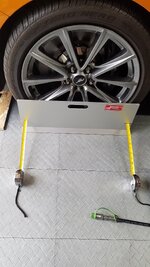
At the rim applies to a string measurement setup -- at the 3:00 and 9:00 points on the rim. I do one good string dial-in, and then I switch to toe plates (Longacre or equivalent). These plates butt up against the tire, and have two slots for two tape measures. Take the delta between the two left-wheel/right-wheel spans: toe [inches] = rearward @rim - forward @rim.
The angle is then tan-1(delta/21"). (21" is the spacing between the slots for my plates.)

This is a handy website calculator to convert the delta to degrees.

1784067405931.jpeg
 
Last edited:
While you are here, can you give a quick explanation on toe measurement when it comes to mm as opposed to degrees. Where is it measured at? Noticed you specifically mention "at the rim" above. My brain is saying that is affected by what size rim you are running. My alignments have always been done by someone else and i just never asked.
Your brain is right. If I'm talking about a car on a road course, then assume an 18" wheel. On a 19" wheel, add 10% to the measurement.

This is a really good kit for measuring toe. It's much better than plates, because you're keeping a consistent centerline for both axles. No dogtracking. https://calipergarage.com/

Her's a site to play with the angle/measure coversion. https://usa.wisefab.com/toe-converter?___store=en&___from_store=en2

It's a little bit of trig. Arcsin( (toe setting) / (rim radius) ) = toe angle
 
*Also, when I say 'at the rim', it's to differentiate it from 'at the tire center.' If you're really in a pinch, that's how you have to measure it.

If you use the angle measurement, then rim size doesn't matter, but you'll sound more 'in the know' if you talk about toe in terms of the linear measurement as opposed to the angle.
 
*Also, when I say 'at the rim', it's to differentiate it from 'at the tire center.' If you're really in a pinch, that's how you have to measure it.

If you use the angle measurement, then rim size doesn't matter, but you'll sound more 'in the know' if you talk about toe in terms of the linear measurement as opposed to the angle.
BUT then everyone gives a measurement but doesn't give the reference frame.
That is the stupid part.
Thanks for the links.
 
At the rim applies to a string measurement setup -- at the 3:00 and 9:00 points on the rim. I do one good string dial-in, and then I switch to toe plates (Longacre or equivalent). These plates butt up against the tire, and have two slots for two tape measures. Take the delta between the two left-wheel/right-wheel spans: toe [inches] = rearward @rim - forward @rim.
The angle is then tan-1(delta/21"). (21" is the spacing between the slots for my plates.)

This is a handy website calculator to convert the delta to degrees.

View attachment 111011

And this was the part no one seems to talk about when they give you information.

1784077174353.png
 
Not sure if your point.
Do you mean that they don't explain the process so that it makes sense?
If i say i run 1.2mm toe out, which is a common statement, no one really knows the true value without the other pieces of the puzzle. Where was that 1.2mm measured from. Where if we give and angle, it gives all the information in one package. Its just that measurements don't require people to pull out a calculator when we don't have fancy alignment machines.
Your brain is right. If I'm talking about a car on a road course, then assume an 18" wheel. On a 19" wheel, add 10% to the measurement.
Point in case, "assume" an 18' wheel, which i wouldn't caus i don't use them.

The snip from your link gave me the full picture. Here is all the information required to know we are talking about the same measurement.
Assumptions, the mother of all F'ups.
 
If i say i run 1.2mm toe out, which is a common statement, no one really knows the true value without the other pieces of the puzzle. Where was that 1.2mm measured from. Where if we give and angle, it gives all the information in one package. Its just that measurements don't require people to pull out a calculator when we don't have fancy alignment machines.

Point in case, "assume" an 18' wheel, which i wouldn't caus i don't use them.

The snip from your link gave me the full picture. Here is all the information required to know we are talking about the same measurement.
Assumptions, the mother of all F'ups.
overall you shouldn't overthink your alignment. For me -1.2 mm is almost the same as -0.12 toe. So What metric you use is not that important. Regarding rims sure they do play a role which is why most motorsport alignment is done with rims off with all this fancy motorsport equipment for alignment in the paddock.
 

Latest posts

Buy TMO Apparel

Buy TMO Apparel
Top