The Mustang Forum for Track & Racing Enthusiasts

Taking your Mustang to an open track/HPDE event for the first time? Do you race competitively? This forum is for you! Log in to remove most ads.

  • Welcome to the Ford Mustang forum built for owners of the Mustang GT350, BOSS 302, GT500, and all other S550, S197, SN95, Fox Body and older Mustangs set up for open track days, road racing, and/or autocross. Join our forum, interact with others, share your build, and help us strengthen this community!

What is a good "beginner" lap time at Road Atlanta?

This site may earn a commission from merchant affiliate links, including eBay, Amazon, and others.

That Sam Paley kid really knows how to wheel :D

@Junkyard Dog - the reality is your brain wont be able to process enough info at once to focus on building fundamentals plus lap time. And Road Atlanta is one of the last tracks you want to run out of mental bandwidth. For the time being, just focus on the basics, listen to your instructor, and keep it greasy side down. At this point, its all about building the addiction.

I will say, I don't recommend riding with anyone until you need a kick in the pants. There's usually a moment with newer drivers where they thinking they're reaching the limit and it's causing them to be too conservative or push for lap time in weird areas. A ride with a faster driver can help move the ceiling up for you and let you know where you're wasting energy trying to be fast.

It can also have the opposite effect. I had to stop giving rides to my students until end of the event because they'd try to replicate the braking and aero stability my car has in the turns.

TLDR: get out there and turn as many laps as you can and have fun. focus on momentum and car control. speed comes naturally with that.
 
Several folks have mentioned something like "focus on momentum" in this thread.

Can you elaborate a little? I am not sure what that is meant to communicated to me as a newbie.

Thanks in advance, and apologies if I am a pain in the butt with such a question, but if it is repeated more than once, it must be important, so I want to understand what is being communicated.
 
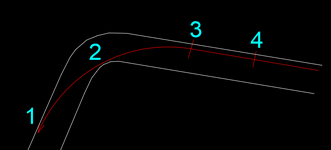
How i was taught to break down a corner for the theoretical line as a starting point. Other variables come in to play but from a beginner plain jane keep it simple to get you "safely" through a corner basics this works.
Point 1. Follow the numbers as we start at the exit of the corner. Where do we want to end up and what direction is the car facing. Parallel to the track edge point down track.
Point 2. Clipping the apex on the inside of the corner.
Point 3. Turn in point.
You are looking for the largest arc that picks up these 3 points that allows you to turn the steering wheel and hold it at a set angle and follow this line. When you have determined this line you can then move onto the next step.
At Point 3 there will be a speed at which you and the car can maintain this line with the grip available. You want to arrive at point 3 at this speed.
Point 4. Braking point, the point on track at which you need to start braking that gets the car down to your corner speed by Point 3.

1771989312844.png
I still use this pattern when mapping out a new track for my preliminary work on learning a new circuit. Get a copy of the layout and start linking corners together to see what looks right. Its a starting point that wont have me half way through a corner and be still looking at the outside wall. Never pretty at speed.
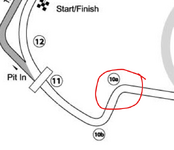
Now the pic above was a snap shot of one standalone corner. It actually happens to be this one. I used your track.
1771991041894.png
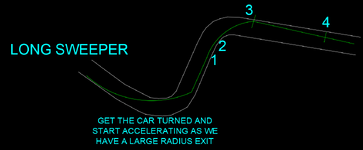
When we add the combination of corners together and what comes after 10b we can see there is nothing to be gained by flying through 10a onto the wrong side of the track and ending up with a really tight 10b that would require us to loose all our momentum just before we turn onto a long "straight" well sweeper but its a bloody big radius one. If we turn in later at 10a, apex later and stay close on exit we open up the more important corner that will allow us to turn in and start accelerating as our speed for that radius will be higher than what we managed to hold between the 2 close corners. We have effectively lengthened the "straight" by getting our point we can start accelerating earlier. Had we followed our single corner line, 10b would be slow all the way round till we were well into the segment to 11 before the turn radius allowed you to get on the accelerator proper. The same process was used, we just changed Point 1, where do we want to finish up and the rest shuffles accordingly.
1771990951951.png
Maintaining momentum is finding that line that allows you to flow through the corners with the least amounts of all inputs required. Every time you brake too early, brake too late, too quick with a steering input there is a penalty and correction required that kills your momentum. This is where the saying "smooth is slow, slow is fast" comes about. Careful, considered inputs allow you to maintain an overall faster pace. Bonus being less likely to come unstuck in a bad way. Find the lines and smoothness first without trying to be fast and suddenly you will be.
There is as much work to be done off the track learning as on track. Do this for years and photos become guess the curb at the track in the picture, that's how well you get to know where you are driving on track
 
Just in case we haven't given you enough to think about while you're on track, remember to keep an eye on the flag stands. Flaggers are your friends. They're your early warning system for things happening on track that you can't see yet.
 
I looked in the lap times at Road Atlanta, and they stretch from 1:51 down to 1:23. Some folks are new, and some are highly experienced (and all kinds of different cars, including some that look like gutted race cars).

I went to the track a grand total of once. 😆 And it was a one day HPDE event, so I have a grand total of five (20-30 minute) sessions under my belt, and that day was in June of 2025. I did not think to time my laps. It was all I could do to drive and listen carefully to the instructor, and hope I did not wreck the most expensive car I had ever purchased in my life.
I intend to procure a Garmin Catalyst, and so I will probably record a lap time this year, 2026. It is has been so long that it will probably be like being almost new again, especially in the first morning session. Assuming it is sunny and warm, and I have some grippy tires, 200 tw tires, or a set of the Pirelli Trofeo RS (180 tw) that Ford thought should be OE tires on my car (LOL, brilliance dreamed up in their marketing department, I think), what should I expect out of a newbie driver like myself in an A10 Dark Horse with the optional handling package that is stock, as Ford Designed it?

More importantly, how much improvement should I be looking for in subsequent track days? How was progression for you ? By the way, you do not have to have twenty years experience and a background career as factory race car driver to answer this question. If you have a few HPDE days under your belt, and you can give me some idea of how much you managed to reduce your lap times with experience, that would be helpful.

I have delusions of grandeur, as most new HPDE drivers do, LOL. I'd like to get some more realistic idea of what to expect.

And I know it varies based on the driver, but if you share your experience, it will help, and if 20-30 of you share your experience, it will really help get some idea of how things should reasonably go, as there will probably be a varied talent pool and a range, but probably somewhat similar improvements over time.

Thank you in advance.

If it is a year later, and you are seeing this, do not be afraid to chime in. More information is always better than less.
You mention getting a Catalyst. I like mine, but I use a setting on it where it turns the display off during the laps. That way I am not distracted and stay more "in the moment"...just driving.
 
my .02
I see your responses to basic terminology.
Lap time is not something you want to shoot for early if technique is not second nature and concise execution. If you don't have seat time or really understand. 1st all should acquire driving books and read absorb. Then use the concepts in small ways on the street but NOT AT SPEED . autocross to know how to hang the car out and appreciate what it feels like at safe environment. You can not attached internet comments to a speed event. Way to much disconnect. Go to a school . Fastest guys trailbrake, use throttle off oversteer to set turn, throttle on to set etc....
However if you are running weekend events in a street car like HPDE you definitely don't worry about lap times ( qualifying race times) of hotshoe drivers with tons of laps in prepared car. Track lap times can be found posted by sanction events in past.
I was an instructor, I raced in SCCA ,PCA and other events. I just received my national license "again" after being out of a standard, race car at speed for 25 years. Amazing how much speed you can pick when running with the track record holder. As mentioned before.
Pay for an instructor to just go with you around the track, let them drive your car.
Also, look for "your car, your SET UP" with a known winner , instructor or accomplished racer on youtube and watch their videos in car. Watch where they put the car, rpms. Watch it over and over and over.( national guys usually don't post video)
Be careful because many guys put in car videos on youtube in HPDE and don't have a clue.
I have been fortunate to have raced 24 hour events , national events. To get back on track in a safe setting and new rules, it still takes mind adjustment to be at speed. It came back to me fast but I recall how it felt to be a newb at TWS in 96.
Also I do know how it feels to off at 12 on the old track( long straight away) side by side and almost hit the wall....
Enjoy the ride!
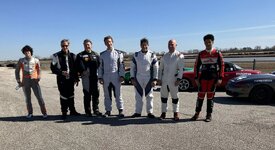
2 weeks ago:MSR SCHOOLsmall.JPG
 
First off, congrats on getting on track with your new hooptie. As others have said, focus on driving, not lap times.

FWIW, NASA SoCal does not time the HPDE1 & HPDE2 run group at all. We want drivers to focus on safety, flagging and learning the proper way around a race track.

That said, my one and only to RoadATL was March 2007 in my little 1985 CMC Mustang. My fastest lap time came during the Sunday qual session - 1:45.043.

~3200lbs, 230hp/300tq, 16" Toyo RA1s, 12" front brakes w/2 piston Cobra calipers. Mr Jeff Burch in his 3rd Gen Camaro was about 1.5s faster than me that weekend.

From the start of the weekend during the Saturday warmup to the Sunday afternoon race, I managed to knock 8+ seconds off my lap times - 1:53.456>1:45.043.

Seat time. There is simply no substitute for it. Keep going to the track.
 
How i was taught to break down a corner for the theoretical line as a starting point. Other variables come in to play but from a beginner plain jane keep it simple to get you "safely" through a corner basics this works.
Point 1. Follow the numbers as we start at the exit of the corner. Where do we want to end up and what direction is the car facing. Parallel to the track edge point down track.
Point 2. Clipping the apex on the inside of the corner.
Point 3. Turn in point.
You are looking for the largest arc that picks up these 3 points that allows you to turn the steering wheel and hold it at a set angle and follow this line. When you have determined this line you can then move onto the next step.
At Point 3 there will be a speed at which you and the car can maintain this line with the grip available. You want to arrive at point 3 at this speed.
Point 4. Braking point, the point on track at which you need to start braking that gets the car down to your corner speed by Point 3.

View attachment 108982
I still use this pattern when mapping out a new track for my preliminary work on learning a new circuit. Get a copy of the layout and start linking corners together to see what looks right. Its a starting point that wont have me half way through a corner and be still looking at the outside wall. Never pretty at speed.
Now the pic above was a snap shot of one standalone corner. It actually happens to be this one. I used your track.
View attachment 108984
When we add the combination of corners together and what comes after 10b we can see there is nothing to be gained by flying through 10a onto the wrong side of the track and ending up with a really tight 10b that would require us to loose all our momentum just before we turn onto a long "straight" well sweeper but its a bloody big radius one. If we turn in later at 10a, apex later and stay close on exit we open up the more important corner that will allow us to turn in and start accelerating as our speed for that radius will be higher than what we managed to hold between the 2 close corners. We have effectively lengthened the "straight" by getting our point we can start accelerating earlier. Had we followed our single corner line, 10b would be slow all the way round till we were well into the segment to 11 before the turn radius allowed you to get on the accelerator proper. The same process was used, we just changed Point 1, where do we want to finish up and the rest shuffles accordingly.
View attachment 108983
Maintaining momentum is finding that line that allows you to flow through the corners with the least amounts of all inputs required. Every time you brake too early, brake too late, too quick with a steering input there is a penalty and correction required that kills your momentum. This is where the saying "smooth is slow, slow is fast" comes about. Careful, considered inputs allow you to maintain an overall faster pace. Bonus being less likely to come unstuck in a bad way. Find the lines and smoothness first without trying to be fast and suddenly you will be.
There is as much work to be done off the track learning as on track. Do this for years and photos become guess the curb at the track in the picture, that's how well you get to know where you are driving on track


That was a lot of work, GAR944. Thank you.

When I read the description of the first line and saw you were applying it to 10A, I was thinking, "Wait, he must not know you can't go to the outside because there is another turn to the right immediately . . . ah, it is because he is in Australia . . . " LOL, then I saw your second description where you said exactly that and showed me how to modify the line to set up for 10B.

Not immediately apparent on a map (but you can see it on the videos steveespo posted) is that 10A is at the end of an almost one mile long full throttle sprint, and 10A is at the bottom of a hill. So just about any Mustang can be approaching or over 140 mph there (my Dark Horse can be over 140 mph coming down that hill). In addition, the track is wide, very wide, for a mile, and then suddenly narrows down at that turn. It is a very hard braking area coming downhill and getting ready to take that turn. Thankfully there is no wall there, but there is a huge gravel runoff (I recently posted an old article with a photograph of the Vorshlag S197 Mustang plowing through the gravel when its brakes failed at 10A which you might have seen to give you an idea of the runoff area).

Thank you for your advice and taking so much time to help out a fellow forum member on the other side of the world. I really do appreciate it.
 
From the start of the weekend during the Saturday warmup to the Sunday afternoon race, I managed to knock 8+ seconds off my lap times - 1:53.456>1:45.043.

Seat time. There is simply no substitute for it. Keep going to the track.

Wow. That's huge!

Well, I had to let all the Miatas pass me on the first session in the morning, LOL.

By the end of the day I was passing all of the cars in my large Novice group (both the instructed and the more experienced solo drivers) except the C7 Corvette Z06. My instructor had decades of experience and in the afternoon actually encouraged me to get up on the other cars in the turns and get a point by and go, so I assume that he felt comfortable enough for me to push harder. In the morning he was much more cautious with me, on the first lap even asking that I not exceed 120 mph on the straight.
 
Last edited:
Just in case we haven't given you enough to think about while you're on track, remember to keep an eye on the flag stands. Flaggers are your friends. They're your early warning system for things happening on track that you can't see yet.
I have to work on everything, I know, but you point out the one thing that I need to work on the most.

I need a constant reminder to watch for the flag stands.

Thank you for the reminder.
 
I need a constant reminder to watch for the flag stands.
Take a piece of masking / painters tape, use a Sharpie to write "FLAGS" on it, and stick it on the inside of the windshield so it's in line with the front of the hood when you're driving. It's not blocking your view of the track, but it's always in your peripheral vision.
 
I have to work on everything, I know, but you point out the one thing that I need to work on the most.

I need a constant reminder to watch for the flag stands.

Thank you for the reminder.
That was one of my instructor's primary focus items the second weekend I spent at a HPDE event. He noticed that I was concentrating so much on driving the lines etc that I was not looking at many of the flag stations. He coordinated with the track and had one of the stations (on the Oaktree turn at VIR) black flag me to see if I noticed. Yep, guilty - I didn't notice the first lap they did it, but then did notice the next time around.
 
I have to work on everything, I know, but you point out the one thing that I need to work on the most.

I need a constant reminder to watch for the flag stands.

Thank you for the reminder.
A non-related but helpful tip for newer drivers: A few weeks ago at Barber, my buddy of mine was getting really frustrated with his instructor. I asked the instructor to run with me to see what his beef was. I noticed that he was using a bunch of terms and phrases that I wasn't familiar with. For instance, he'd tell me to "turn up" at the next turn. Later he said "for this one, turn down". After a couple times I said "I don't know what you are telling me". He appreciated the feedback. Be sure to ask questions of and challenge your instructors when things aren't clear. It helps them too.
 
Never think a question is too dumb to ask. An instructor's job (not just HPDE, any kind of teaching) is to impart knowledge to the student. If the student doesn't understand, the instructor isn't doing their job. But they need to know that the student doesn't understand, so they can adjust how they're communicating.
 
That was one of my instructor's primary focus items the second weekend I spent at a HPDE event. He noticed that I was concentrating so much on driving the lines etc that I was not looking at many of the flag stations. He coordinated with the track and had one of the stations (on the Oaktree turn at VIR) black flag me to see if I noticed. Yep, guilty - I didn't notice the first lap they did it, but then did notice the next time around.
So did you have to return to the pits?
 
Yes I did. I remember noticing the flag and commenting to my instructor "why is he black flagging me?" then finished the rest of the lap and went into the pits. That's when they explained why they flagged me, told me I had missed the first flag, and impressed upon me the need to starting noticing them from now on. It worked, and I spent the rest of the day's sessions making sure I looked at all of the flag stations. Being a novice, the result is that my lap times went down because concentration I was spending on going fast had to be transferred to concentration on looking for flag stations (being a safe driver). As my experience (seat time) gained, scanning for stations became instinct, didn't take up my concentration, and I continued on to learning the next thing to be a better driver.

I learned a cool analogy long ago when I learned how to ride a motorcycle fast. Imagine you have a dollars worth of nickels in your pocket, and they represent all the focus and concentration you have available. At the beginning, you will need to spend about 95 cents on learning how to operate the clutch and shift gears without killing the engine, lurching, or falling over. You've only got 5 cents left over to focus on other stuff, certainly not enough to go fast, lean into the apex, etc. As time goes on, you'll need to spend less and less of your dollars worth of nickels on clutch/shifting gears, so now you can spend more on managing balance, acceleration, etc. After awhile you'll spend none of your nickels focusing on your clutch, it becomes instinctive. In the above example I had to spend a lot of nickels looking for flag stations so I didn't have as many nickels left over to go as fast as I was going before. After that became instinctive I got my nickels back to work on the next thing.

You have a multitude of skills to spend your learning nickels on first before you have enough nickels to start spending on lap times. Trying to spend nickels you don't have is when you go into debt... and on track, debt means breaking something expensive or painful. IMPORTANT: don't go into debt! Don't spend nickels you don't have, spend them on what you need to spend them on first, and when what you spent them on becomes instinctive, you get them back to spend on the next thing you need to focus on.
 
Last edited:
Yes I did. I remember noticing the flag and commenting to my instructor "why is he black flagging me?" then finished the rest of the lap and went into the pits. That's when they explained why they flagged me, told me I had missed the first flag, and impressed upon me the need to starting noticing them from now on. It worked, and I spent the rest of the day's sessions making sure I looked at all of the flag stations. Being a novice, the result is that my lap times went down because concentration I was spending on going fast had to be transferred to concentration on looking for flag stations (being a safe driver). As my experience (seat time) gained, scanning for stations became instinct, didn't take up my concentration, and I continued on to learning the next thing to be a better driver.

I learned a cool analogy long ago when I learned how to ride a motorcycle fast. Imagine you have a dollars worth of nickels in your pocket, and they represent all the focus and concentration you have available. At the beginning, you will need to spend about 95 cents on learning how to operate the clutch and shift gears without killing the engine, lurching, or falling over. You've only got 5 cents left over to focus on other stuff, certainly not enough to go fast, lean into the apex, etc. As time goes on, you'll need to spend less and less of your dollars worth of nickels on clutch/shifting gears, so now you can spend more on managing balance, acceleration, etc. After awhile you'll spend none of your nickels focusing on your clutch, it becomes instinctive. In the above example I had to spend a lot of nickels looking for flag stations so I didn't have as many nickels left over to go as fast as I was going before. After that became instinctive I got my nickels back to work on the next thing.

You have a multitude of skills to spend your learning nickels on first before you have enough nickels to start spending on lap times. Trying to spend nickels you don't have is when you go into debt... and on track, debt means breaking something expensive or painful. IMPORTANT: don't go into debt! Don't spend nickels you don't have, spend them on what you need to spend them on first, and when what you spent them on becomes instinctive, you get them back to spend on the next thing you need to focus on.
That explains exactly how I felt. All of my focus was going into driving the car. Obviously if I backed off I would be able to focus on the flag stations. I was just out of band width. My focus was entirely on two things, driving and listening to the instructor.

I will try to schedule more track days in 2026 and back off a little and master some of these things like looking at the flag stations until it becomes second nature.

Thanks.
 

Latest posts

Buy TMO Apparel

Buy TMO Apparel
Top