The Mustang Forum for Track & Racing Enthusiasts

Taking your Mustang to an open track/HPDE event for the first time? Do you race competitively? This forum is for you! Log in to remove most ads.

  • Welcome to the Ford Mustang forum built for owners of the Mustang GT350, BOSS 302, GT500, and all other S550, S197, SN95, Fox Body and older Mustangs set up for open track days, road racing, and/or autocross. Join our forum, interact with others, share your build, and help us strengthen this community!

OPM Lug Nut - Torque Concerns

This site may earn a commission from merchant affiliate links, including eBay, Amazon, and others.

44
34
Exp. Type
HPDE
Exp. Level
Under 3 Years
St Louis, MO
What’s your guys’ lug nut torque setting procedures. I do a star pattern, then a circle. Then a drive cycle/ cool down and recheck.

Well recently, I just got the black, open end, coated lug nuts from OPM on my ARP studs. Every. Single. Time. I check the torque, they move. They tighten bit more and it takes travel to hit torque. 100 lb/ft using a brand new snap on techangle torque wrench.

For comparison, I have MSI studs using Terrence Sig titanium lug nuts on my 350. Those things torque and never move again. None. Rock solid.

Is there something with these lug nuts, studs, etc?? Am I overthinking something?
 
I'll get all nuts finger-tight using just the socket, then torque to about 70% in a star pattern, then 100% in a star pattern. It's probably overkill, but it gives me peace of mind that the wheel isn't cocked and giving a bad reading.

Stupid question, but have you cleaned the mounting faces? If there's corrosion, it could affect the torque over time.

The other thought I have is the lubricated lug nut. Threads are basically an inclined plane wrapped into a circle. The downward force created by the bolt stretch from torqueing combined with friction of both the threads and the nut face on the wheel prevents the nut from loosening. I wonder if the lubrication would affect the friction enough to allow the lug nut to loosen. OTOH, a lubricated lug nut will typically reach the same bolt stretch at a lower torque value, so torqueing to the same amount as a dry nut could over-stretch the stud (possibly going from elastic to plastic deformation). I'm not a mechanical engineer, so I'm only guessing.
 
What’s your guys’ lug nut torque setting procedures. I do a star pattern, then a circle. Then a drive cycle/ cool down and recheck.

Well recently, I just got the black, open end, coated lug nuts from OPM on my ARP studs. Every. Single. Time. I check the torque, they move. They tighten bit more and it takes travel to hit torque. 100 lb/ft using a brand new snap on techangle torque wrench.

For comparison, I have MSI studs using Terrence Sig titanium lug nuts on my 350. Those things torque and never move again. None. Rock solid.

Is there something with these lug nuts, studs, etc?? Am I overthinking something?
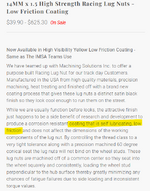
I believe these nuts are doing exactly what they were designed to do. They are advertised as a racing lug nut with a low friction coating. Race wheels go on and off after every session. Benefit being they spin on and off long studs easily without binding. They are re-torqued before going out every session. Not exactly the same as a road type vehicle.
1788930604866.png
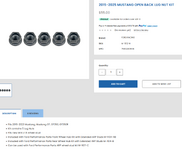
I run these nuts which while very similar are not a low friction coated version. I occasionally add some copper grease to the threads as they are spun on at speed. Purely to reduce the dry steel on steel interface as the studs are quite long.
Torque once and are fine using a similar process to you, star then circle to make sure i didn't miss one. Set and forget for the limited road driving. Track days they are torqued before first session and checked after cool down. Throughout the day i random check 2 or 3 per wheel as a precaution.
1788930887005.png
 
Top