The Mustang Forum for Track & Racing Enthusiasts

Taking your Mustang to an open track/HPDE event for the first time? Do you race competitively? This forum is for you! Log in to remove most ads.

  • Welcome to the Ford Mustang forum built for owners of the Mustang GT350, BOSS 302, GT500, and all other S550, S197, SN95, Fox Body and older Mustangs set up for open track days, road racing, and/or autocross. Join our forum, interact with others, share your build, and help us strengthen this community!

Splined Strut Camber Bolts - Why are they splined

This site may earn a commission from merchant affiliate links, including eBay, Amazon, and others.


-5 Camber is a lot though do you really need it ?
That's was with a 285 on a 9.5 inch rims at full adjustment on both strut and camber plate, when I went to 305 on an 11 I had to reduce the strut to hub camber significantly. Actually looking to change my camber plate to gain more back as I'm destroying outer edges and want to try some different settings.
 
That's was with a 285 on a 9.5 inch rims at full adjustment on both strut and camber plate, when I went to 305 on an 11 I had to reduce the strut to hub camber significantly. Actually looking to change my camber plate to gain more back as I'm destroying outer edges and want to try some different settings.
I'm fine with 295/35 and around -3.2 I can't go less than that because of fender clearance but it's overall ok.
 
That's was with a 285 on a 9.5 inch rims at full adjustment on both strut and camber plate, when I went to 305 on an 11 I had to reduce the strut to hub camber significantly. Actually looking to change my camber plate to gain more back as I'm destroying outer edges and want to try some different settings.
What was the reduced camber with the 305 that is still destroying the outer edges?
 
What was the reduced camber with the 305 that is still destroying the outer edges?
To be honest not really sure but i was running just on -4 and it worked for me and my setup.
I just dialed it back to clear the struts and forgot about it.
2024-07-13 17.27.33.jpg
285 on 20x9.5 allowed way more camber on the strut leg.
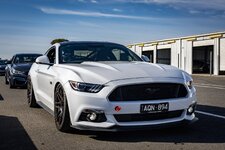
Ford Mustang 5.0 Gordon Robertson-3small.jpg

Same camber plate setting, just enough strut camber to clear the rim& tyre.
305 on 19x11
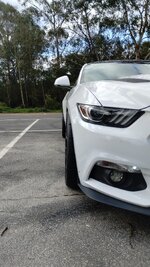
2024-09-22 15.29.44.jpg
I've really taken a fair bit of time building the car that we haven't rally concentrated on settings yet.
My driving style coming from 4 cylinder no hp was always pushing to find the limit of grip through corners to maintain speed so part of it will be that, its still quick just hard on outer edges.
 
Please provide more on “hard on the outer edges”. Four degrees negative is a healthy amount of camber and appears that you have zero toe. Would I be correct in thinking that the outer edge wear is from your attack in the corners? Or do you attribute it to set up? How bad is the outer edge wear? Maybe photos with track days/miles will help as well.
Thank you for your input. Thanks to all for your input. I am now installing new struts, shocks, springs, bars and camber plates so all of this is of great interest to me.
 
I have maxed out my camber to ~3.3* with plates and slotted struts, and I still wear the outer half of 305-315 front Cup2 (200tw) tires. I will switch to Steeda plates and open the tower holes this spring. I hope to get to at least -4 degrees.

I think we need to have at least -4 degrees available for 200tw tires, even if that means there is a little extra camber in reserve.
 
Please provide more on “hard on the outer edges”. Four degrees negative is a healthy amount of camber and appears that you have zero toe.
I probably should not be speaking for him, but I thought he was saying 4 degrees worked, but now he does not know where it is, just "less," and it is wearing the outer edge. When I asked him how much he reduced the camber, he did not know.

So 4 degrees was not wearing the outer edge.
 
The best working camber value between 3-4 will vary for the tire model and construction, springs and roll rate, and brake bias even. On my 200tw nankangs 4 degrees had faster turn in and mid to exit front grip. But will wear the inside shoulder more. 3.2 was more even, but 4 is faster. A cup2 or vitour does not require as much camber to be sharp. My 350 was also very happy and fast with 2.5 degrees with 315/19 rt660s on 11.5” wheels and bmr springs and bars.

Having the strut and plate to adjust give you lots of options. The more stretched the tire, the stiffer your suspension, the less camber you need.
 
On my 200tw nankangs 4 degrees had faster turn in and mid to exit front grip. But will wear the inside shoulder more. 3.2 was more even, but 4 is faster.

I swear every time I come over to this forum I learn a little more. I naturally assumed the camber setting on the front with the most even tread wear would also be the fastest.

A cup2 or vitour does not require as much camber to be sharp. My 350 was also very happy and fast with 2.5 degrees with 315/19 rt660s on 11.5” wheels and bmr springs and bars.

Having the strut and plate to adjust give you lots of options.

I had an idea that camber settings were different with different tires, but had no idea the fastest setting could be as little as 2.5° for street tires. It is good to put a real number on it.

Wow, 11.5" wheels! Does the GT350 permit wider wheels than a standard GT or Dark Horse? I assumed if I purchased 11" I would be pretty maxed out with installing a 295 or 305.

The more stretched the tire, the stiffer your suspension, the less camber you need.

Stretched tire - And I learn yet one more new thing, all from a single post. Thank you.

This makes me wonder if the Youtube videos where they test tread width as compared to wheel width, if the result (wider wheel on same size tread is faster) has to do with camber settings and not the width of the wheel compared to the tread??? The camber setting stays the same throughout the test.
 
Yes, the gt350 has wider front fenders. The apex 19x11.5 et56 works well for a square fitment with a 20-25mm spacer up front. 305 and 315's fit great on that. 325's are a bit pinched but work ok.

As for the wider wheel being faster, pretty sure it does have something to do with the need for camber reducing slightly as the tire deformation gets reduced a bit.
 
This was the 285/R20 when at -4. When you see what a tyre goes through in a corner you can understand why everyone spends some much effort trying to figure out what works for them.
Screenshot 2023-11-10 094215.jpg
@Junkyard Dog from another thread where cold tyres were mentioned, all the grass on the front lip was from my out lap, forgot i towed the car to the track for the first time. Takes more than 1/2 a lap to get some heat into them from dead cold. Oops.
This is the full photo of the above.
_JCP4052.jpg
 
The biggest thing to keep in mind is that we're setting the alignment numbers with the car standing still (static), but the tire wear is happening when the car is under lateral and/or longitudinal g-forces and the suspension is in a different position due to the different loads (dynamic). The most grip is obtained from a tire when it's contact patch is flat on the ground. I've read that you want the dynamic camber of the outside wheels under optimal lateral load to be 0.5 to 1 degree negative to deal with sidewall deflection (assuming a "normal" tire/wheel width match).

What you have to factor into the static alignment numbers is the "camber curve" of the suspension design -- how does the camber change under bump (a wheel in droop is less loaded and will have less influence on overall grip as well as less wear). When the chassis rolls (in a turn), the outside wheels move in bump, and the camber curve determines the dynamic camber angle of the wheel at each angle of roll, and how flat the contact patch stays to the ground.

Double-wishbone / SLA suspensions can be designed with very nice camber curves that can increase camber in bump. McStrut is not as easy - the lower arm arc reduces camber in bump past the point where the lower arm is parallel to the ground (one reason to not lower the car too much). The more the McStrut lower arm is angled up to the tire, the larger the reduction in camber. A stick axle doesn't change camber in chassis roll (but does in one-wheel bump).

The more grip a tire can generate, the more lateral acceleration the car can generate in a turn, which means more roll angle in the chassis (all else unchanged), and more bump travel in the outside wheels/tires. And if the camber curve doesn't compensate enough, a reduction in dynamic camber. That's why low-grip tires on a McStrut generally need less static camber - they don't get the outside (loaded) wheel/tire into the camber curve where the dynamic camber is reducing a lot per degree of roll.

While a suspension that increases camber in bump to compensate for chassis roll is good for cornering, the same change in camber reduces grip in dive and squat. In brake dive, the front wheels are moving in bump (both equally), but there's no chassis roll. So you can end up adding dynamic camber (especially with SLA) when you really want the contact patch to stay level. Same thing for squat in an IRS rear end.

Designing a suspension's camber curve is a tradeoff between adding grip in roll and losing grip in dive (front suspension) or squat (rear suspension in IRS).

Beyond all the above, you can also get into tire carcass design, sidewall stiffness, "stretched" vs "pinched" wheel-to-tire width, etc., that all have an affect on how flat the contact patch stays under various tire loads.
 

Buy TMO Apparel

Buy TMO Apparel
Top