The Mustang Forum for Track & Racing Enthusiasts

Taking your Mustang to an open track/HPDE event for the first time? Do you race competitively? This forum is for you! Log in to remove most ads.

  • Welcome to the Ford Mustang forum built for owners of the Mustang GT350, BOSS 302, GT500, and all other S550, S197, SN95, Fox Body and older Mustangs set up for open track days, road racing, and/or autocross. Join our forum, interact with others, share your build, and help us strengthen this community!

Advice on setup for street and track!

This site may earn a commission from merchant affiliate links, including eBay, Amazon, and others.

Update on my setup:

Tomorrow, I am having AJ's front conversion kit put on the car with 400lb spring rate. I currently have FP M-5300-W with 250lb spring rate so it will be interesting to see the difference. The car is on shelby GT500 Magneride dampers with OEM PP1 magneride tuning. For now, I am not changing anything else suspension wise on the car except slightly more front camber(-2.3 to -2.75). Later on, I plan to eventually install the rear AJ kit too once I figure out if I need more rear spring rate or less than the current 850lb(I will refer with feedback to the experts here on what I've felt after next HPDE). The AJ kit also allows me to adjust front/rear ride height because the car is raked as it sits, and I want the car to sit flat with neutral rake - this is because I superficially like the way flat looks better and more importantly, others here and Kenny Brown have stated its better for S550 platform.

To be honest, I am still a bit unsure about how front 400lb spring rate will feel, especially since I am on PP1 OEM magneride tune. I may feel a bit more sure if I had the DSC, but thats another $1000+ and potential world of headache/tuning to deal with. I also want to maintain or improve road ride ability if possible and I've heard DSC sport cannot accomplish that, and is even worse than ford street tuning. With Ford OEM PP1 Magneride tuning I feel like I am bouncing and rebounding around everywhere without enough damping.

Tomorrow I'm also installing OPmustang front hubs with extended studs, DSUNO pads and DBA slotted rotors up front too(upgrade from OEM front). Rears will stay OEM rotors and pads. I am planning on running 19x11 with 305/30r19 square Yoko AD09 for next track day compared to the 275/40r19 square Conti ECS02 I've run the last few HPDE. I hope to make it to SCCA TNIA June 18th at Thunderhill.
 
Alright folks - just got back from the shop....

At the suggestion of the resident mustang/shelby expert mechanic here in the SF bay area(Trent Musser), I did not install the AJ hartman coilover conversion kit up front.

Couple reasons I am OK with this:
1. I am already generally happy with the way the car rides on street and performs on track.
2. This is still a street driven car and want to maintain streetability.
3. I am changing camber, rotors, brakes, camber and tires before my next track day so a lot of variables that already could affect driving dynamics.
4. He suggested sway bars first over spring rate modifications to get the desired turn in response and for my use case.

As for the changes I have made so far: DBA T3 4000 rotors up front and DSUNO pads up front. Initial thoughts on the drive home:
1. MUCH smoother braking - feels like blank rotors. The powerstop slotted rotors on the car before had a gritty brake feel and I didn't like that. I attribute that to the DBA slot style.
2. Brakes feel a bit more grabby and/or on/off than the DS2500.
3. Moderate squeal while coming to a stop or at speeds below 5MPH.

Now I'm looking into sway bars - Trent suggested Steeda Competition kit. I would love adjustability, and perhaps having slightly above my current PP1 setup as the softest setting possible. I don't want to end up with sway bars so stiff that I'm lifting a wheel often.
 
Regarding Front spring rates, track and street performance, here's my experience. I own a 2022 Mach 1, A10, Handling Package, 200TW tires 305F/325R.

For the past 2 1/2 years, @TeeLew has been kind enough to work with me and make some recommendations:

The first was to purchase some Urethane Spring Rubbers from RE Suspension for the factory OEM Mach 1 front springs which are 211 lbs/inch. I purchased the middle of the road 70A durometer, they install in like 20 minutes with nylon tie wraps. They made a significant difference in reducing nose dive in heavy brake zones at Lime Rock and especially Watkins Glen. For me significantly reducing the pitch in the chassis during braking made the driver much more confident, higher entry speeds, and more stable through the corners. These spring rubbers are a great way to "test" stiffer spring rates without pulling Magne-ride struts and changing springs, and they are made in 5 different durometers.

This spring, I chose to replace my front Magne-Ride springs with OEM Ford Shelby GT500 CFTP springs 276 lbs/inch about 30% stiffer than original HP springs, and I moved the RE spring rubbers over to the new springs. Handling continued to improve. One track day at Lime Rock so far, and I am very pleased with the way the car feels. 6 more track days at Watkins Glen starting mid July, I can't wait to get there

I still have the OEM Mach 1 front sway bar in the car, and replaced the rear sway bar with a Sam Strano adjustable bar which gets set to max stiffness at Watkins Glen where there is around 6% banking/camber, and then the softest setting at Lime Rock where there is almost no camber.

I won't tell you that the 30% stiffer springs aren't noticeable with the spring rubbers effectively silencing one full coil it is noticeable on the relatively poor public roads here in the New England. Would I go back to softer 211 pound spring (factory Mach 1 HP set up), NO, would I go even higher spring rates, I doubt it. But I haven't driven Watkins Glen on this set up yet.

To provide some context, I have about 50 track days total since 2020. About 1/2 of those are in the Mach 1, the other 1/2 were in a 2015 C7 Z51 Corvette, so not a newbie, at 67 years young, not a track junkie expert either. Best times at LRP = 1:03 flat for the 1.5 mile course, Watkins Glen I finally got under 2:14 last fall on the long course 3.45 miles, 11 turns.
 
cjatrains - so you are running stock HP rear set up except for the bar? Front is only the CFTP springs plus the spring inserts? Asking because I’m chasing trying to dial in my M1 HP and not liking where I’m at now. Did you do anything with the MagnaRide controller?
 
cjatrains - so you are running stock HP rear set up except for the bar? Front is only the CFTP springs plus the spring inserts? Asking because I’m chasing trying to dial in my M1 HP and not liking where I’m at now. Did you do anything with the MagnaRide controller?
I just finished cutting my rear Stock Mach 1 HP rear coil springs 9 mm to take some of the "rake" out of the chassis. I can't provide any feedback on whether it's better/worse or no change as my next track day is at Watkins Glen 7/13 and 7/14. The motion rate in the rear is 0.50 +/- 0.02 so the rear should theoretically come down around 17 mm.

So to review quickly: Only modification to the front are the Factory GT500 CFTP springs with the RE suspension 70A durometer spring rubbers installed.

The Magne-Ride controller and all four Magne-ride shocks/strut cartridges are all OEM Stock whatever Ford supplied with the Handling Package option. Ford marketing says Shelby GT Tune, I have no idea what that really is, if it's anything significant at all. The longer I own my car, the more suspicious I am of Ford Marketing Claims, but that's a different thread altogether.

As other's have mentioned, I am real hesitant to replace the magne-ride controller with DSC and go down what I perceive as a "rabbit hole" of trying to adjust and then evaluate and try to optimize dampening rates. I think I'll stick with the devil I know so to speak.

My biggest pet peeve is the lack of adjustment for the Ford Stability Control Intervention. I really don't want to drive with Stability Control disengaged, but in Track Mode with TC off and Stability Control on, it's a challenge to get the car to rotate at all in corners. I go through rear brake pads as fast as I go through front brake pads, and my rotor temps coming off track are as high in the rear as they are in the front, so I know the system is working it's butt off controlling "Yaw".....
 
Thanks, appreciate the feedback. I went down the Steeda dual rate springs and matching bars along with their DSC controller path. I ran the DSC one weekend and swapped back to the OE controller as I was suspicious it wasn’t functioning. I’m tempted to put the stock front bar back in and if that doesn’t do it change back to a linear rate spring. The car felt much more confident inspiring stock, feels slow to respond now which may be the effects of dual rates.
 
I understand. After spending sometime discussing variable rate springs with @TeeLew I was convinced I didn't want to introduce what seemed to me like another variable with "dual rate" springs. I was relieved when I removed both my front and rear Factory Mach 1 HP springs to find that they were single constant rate springs.

Maybe for a daily driver, there's some minor benefit for ride comfort, but I bought this car to drive it to/from and on track, so if I'll trade ride comfort for predictability on the road course, especially at Watkins Glen.

I am sure some folks can make the dual rate spring set up work, but for me there's already more variables than I can logically interpret and hope to optimize, the driver, being the main variable.

I know I have significantly reduced nose diving when braking at -1.2 to -1.3 g's in the braking zones, the chassis isn't pitching as much. While I don't purchase "track day photos", I open them and review. I can absolutely see improvements less nose dive and reduced body roll, which for me means I am able to better manage the 4 corner weight distribution more successfully, if I am driving well !

I am hoping to work on improving trail braking and getting the chassis to rotate enough that my direction vector at apex is better so I can apply more throttle at the apex and put more power down consistently on corner exit. Changes made to date, have enabled me to confidently carry more speed into the corner and through the corner, but so much so that I am still having to maintain a bunch of steering input on corner exit, which is limiting how much I can get on the gas pedal and not run out of pavement as I track out.
 
For reference, I think @cjatrains has a front spring rate of about 310 #/in once all-in with the spring rubber. That probably ramps to 330 or so as it compresses, because that's what spring rubbers do. These are guesses, but it will give an idea of the stiffness level involved. This is a "Go drive it 300 miles and not get beat up" type of a car or a street car that has necessary upgrades for the track. It was never meant to be a race car.

I know the numbers I throw around for front spring rates seems out of line from what is 'normally' used, but this is only because Ford missed it SO BAD. This is an example of a completely streetable car has about a 50% increase in front spring rate from how Ford delivered it (which was one of the stiffest front springs they offered at 212 #/in?) and performance across nearly every way of measuring it improved, ride and handling. You shouldn't be able to do this, but I'm not the one with the unusual choices, they were. My car came with 175 #/in on the front. It was even worse. I think a standard GT starts at 165? I honestly can't imagine what the hell they're doing setting the cars up like this? Objectively speaking, there is no advantage to this approach unless you've never pulled your nose out of a book. This car could be SO MUCH better from the factory.

The rear spring is the stock Mach 1 with the end nipped off. The actual spring rate difference will be minimal, it might increase the rate by 10#/in. I have to confess I don't remember what the stock rate was... 730 #/in? So maybe he's at 740 #/in now? It might not even be that much of a difference. The bigger point was to reduce rear ride height. It's a very good tuning tool to improve the car stability, particularly on braking and corner entry. It was also the least expensive way to experience the change.

I'm looking forward to hearing the verdict.
 
Spot On @TeeLew ... You're numbers for the rear are extremely close to what I was able to research on the forums, Factory Mach 1 HP rear coil spring rate = 742 #/inch, Front Mach 1 HP coil spring original equipment = 211 #/inch. We had rain here most of the day, I will get out tomorrow and take some chassis to ground measurements as well as fender lip to wheel mount bore and let you know how much the rear dropped. It's taken quite a bit of seat time to appreciate how much faster I can drive on track when I am able to smoothly shift the weight (3,900 pounds) in the braking zones and the corners.

Every bit of your guidance regarding spring rate/chassis modifications, sway bar settings, and driving habits has resulted in incremental improvements, new personal best lap times, and a car that's more predictable and easier to control the few times that I have over driven it, or had someone lift off the throttle unexpectedly at an Apex. (yes that even happens in the more advanced INT 2 group !)

And yes, this car drives to and from 8-9 track day events every season, 400 miles - 6 hours to and from WGI on some pretty poorly paved and maintained roads in MA & NY

I'll report back after 2 days at Watkins Glen 7/13 & 7/14
 
Thanks guys for sharing the knowledge, you've short cut my next steps to sorting out my M1 HP. Was in the process of looking at linear rate springs both production offerings and aftermarket.

Purpose for our car is exactly the same, make it a great track car that can still go on a 6hr weekend road trip. We have a dedicated track car that is less than streetable, don't need another. I would like to say I was fairly impressed with the car box stock, seemed very capable but of course due to the masses not being track customers it leans more street than track in some aspects of tuning. It also can't step too hard on toes of the GT350 that was in production at the same time. Retired from Ford Product Development so have somewhat of an inside lens on why things happen as they do, everything has a lane. One of my last projects was the F150 Tremor and as I wrote those product and engineering assumptions I had to be very careful of the Raptor.

So...I'm going to track down a set of the CFTP front springs, rubber inserts, and reinstall the M1 HP front bar. I'm also very interested in how you cut the stock M1 HP rear springs to get the ride height correct, probably obvious, just need to dig them out and have a look. Any knowledge of how different the Strano rear bar is from the Steeda rear competition bar I already have? I'm sure the rates are on the google somewhere.
 
Last edited:
So a quick reply to some of your questions:

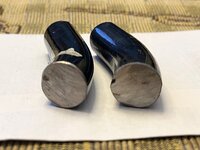
I used an inexpensive 4 1/2" Angle grinder (Harbor Freight House brand), bought there 4.5" x 060 (1/16") cut off wheels. I clamped the spring horizontally to a work bench sending a 2 x 3 or 2 x 4 down the center. I took my time, wrapped the upper coil with terry cloth wash rag soaked in cold water to keep any heat from travelling. Maybe unnecessary but cheap insurance. I stopped cutting maybe every 20 seconds to pull the heat out moving the wet cloth over the cutting area. Ended up getting no bluing or overheating discoloration at all, photo of the cutoffs below.

Measuring - I wrestled with this for a while. Finally decided to lay the spring down on the work bench, slid a good quality square up to the upper end coil that I was going to cut and cut a piece of thin hardwood stock 1/8" x 8.6 mm (0.34") Found the point on the coil where my 8.6 mm stock was in contact with the spring and the edge of the square and marked it with corner of a small fine file. Checked 3 times to accuracy and then went for it. The motion rate is 0.50 +/-, so removing 0.34" x 2 should equate to 11/16" drop which was my "Target".... Just went out there to see how I did and my Right rear tire is flat - Splendid.... No measurements for me today...

I don't think Sam Strano is still offering the rear sway bar, but it has 3 positions. My understanding and this was confirmed by @TeeLew is the Center and Softest settings are less stiff than the M1 HP stock bar, and the firmest setting is slightly stiffer than the M1 HP bar. I use the stiffest setting at Watkins Glen, very high speed circuit with maybe 6 degrees banking on average in probably 9 of the 11 turns. I use the softest setting at Lime Rock Park where there's almost no camber in the track... I have been pleased with it so far, nothing dramatic which is absolutely ok with me.

Side anecdotal story. My prior track car was a 2015 C7 Z51 track pack equipped car. I installed a larger C7 Z06/Z07 front sway bar, made a huge difference. Then I figured I'd purchase the matching GM C7 Z06/Z07 rear bar. Drove it for 2 days at Watkins Glen it caused the rear end to be really nervous and unstable inducing understeer. Removed it and sold it the following week and never looked back. I know - 2 very different chassis, and I wasn't changing spring rates etc, but that was enough to convince me that stiffer rear sway bar can have some serious implications.

I'd encourage you to purchase 2 new (one LH one RH) bottom spring bushings that sit in the control arms under the bottom of the rear coil springs in the M1. Wish I had sone that as one of mine was showing wear through. It's only maybe 1/8" and obviously taking a beating at the end of the spring coil. The other advice is to make sure that you chamfer the corner of the cut you make on the top of the spring so it doesn't start eating into the upper spring perch bushing.

Changing over to the CFTP springs (268 #/inch) wasn't as bad as I thought it would be. Didn't have to compress the M1 HP springs, or the CFTP springs more than like 3/4" maybe to get the nut off.

IMG_3154.jpeg
 
For reference, I think @cjatrains has a front spring rate of about 310 #/in once all-in with the spring rubber. That probably ramps to 330 or so as it compresses, because that's what spring rubbers do. These are guesses, but it will give an idea of the stiffness level involved. This is a "Go drive it 300 miles and not get beat up" type of a car or a street car that has necessary upgrades for the track. It was never meant to be a race car.

I know the numbers I throw around for front spring rates seems out of line from what is 'normally' used, but this is only because Ford missed it SO BAD. This is an example of a completely streetable car has about a 50% increase in front spring rate from how Ford delivered it (which was one of the stiffest front springs they offered at 212 #/in?) and performance across nearly every way of measuring it improved, ride and handling. You shouldn't be able to do this, but I'm not the one with the unusual choices, they were. My car came with 175 #/in on the front. It was even worse. I think a standard GT starts at 165? I honestly can't imagine what the hell they're doing setting the cars up like this? Objectively speaking, there is no advantage to this approach unless you've never pulled your nose out of a book. This car could be SO MUCH better from the factory.

The rear spring is the stock Mach 1 with the end nipped off. The actual spring rate difference will be minimal, it might increase the rate by 10#/in. I have to confess I don't remember what the stock rate was... 730 #/in? So maybe he's at 740 #/in now? It might not even be that much of a difference. The bigger point was to reduce rear ride height. It's a very good tuning tool to improve the car stability, particularly on braking and corner entry. It was also the least expensive way to experience the change.

I'm looking forward to hearing the verdict.
Speeking of Street/Track spring rates I think there is a reason why so many people go with BMR Handling Springs (because the rates are just about perfect) 300/980 lbs springs. The other options I would consider is Eibach Pro-Kit Progressive Springs with (200 - 314 lbs/in front and 800 - 914 lbs/in rear) I actually had a chance to ride in cars equipped with both: 1. 2019 GT with FP Dumpers and BMR springs (currently the car that's closest to me on track times) and 2. 2017 GT with PP1 shocks and the Eibach Pro-Kit Springs that I was actually able to test drive on my usual route and to me the Eibach Pro-Kit is what I would have on my car if I wasn't on the Ohlins.

Overall 200/800 lbs or 300/914 lbs are the too best options for a Street Mustang in my personal opinion. The reason why Ford went for softer springs is compliance on the street and that standard Ford ride with the bouncy rear that Ford owners are so used to.
 
Speeking of Street/Track spring rates I think there is a reason why so many people go with BMR Handling Springs (because the rates are just about perfect) 300/980 lbs springs. The other options I would consider is Eibach Pro-Kit Progressive Springs with (200 - 314 lbs/in front and 800 - 914 lbs/in rear) I actually had a chance to ride in cars equipped with both: 1. 2019 GT with FP Dumpers and BMR springs (currently the car that's closest to me on track times) and 2. 2017 GT with PP1 shocks and the Eibach Pro-Kit Springs that I was actually able to test drive on my usual route and to me the Eibach Pro-Kit is what I would have on my car if I wasn't on the Ohlins.

Overall 200/800 lbs or 300/914 lbs are the too best options for a Street Mustang in my personal opinion. The reason why Ford went for softer springs is compliance on the street and that standard Ford ride with the bouncy rear that Ford owners are so used to.
But, that's kind of the point. At the end of the day, we can look at compliance as a function of an overall car vertical stiffness. The distribution of that stiffness isn't set. We can be front stiff, rear stiff or equally stiff front and rear. The have chosen to use a high rear stiffness and a soft front. That's exactly opposite of what they should have done. Let's say with keep the overall car spring rate the same and just distribute the f/r stiffness opposite from what they did (I'm speaking in terms of ride frequencies here, not spring rates). If you just did that, it would be a much better car. Excessive rear spring contributes to the little Mustang rear hop. If you soften the rear, that goes away.

As far as the canned springs you,'ve mentioned, I clearly disagree with those choices. It wasn't just a case that I theoretically dislike them, though. I've actually tried them on the car. When I first dipped my toe in the water I decided to try to try what was conventional before running off on my own. I had the Vorshlag front spring (222 #/in) and an 850 #/in rear spring on an adjustable platform. I knew I was going to be running through a lot of iterations, so I did this right away. It was stiffer than stock PP1, but the balance was no better. The original Vorschlag spring was 880 #/in. I coudln't run it with Magneride. After the 850, I went to 950. All the stuff I didn't like at 850 was worse at 950. The rear was not well planted and every time you go over a bump the front passes undisturbed followed by a quick kick in the butt when the rear axle hits it. I completely appreciate that opinons vary. This just isn't my cup of tea.

I generally steer people towards the GT500 GFTP front spring (268 #/in) if they want a stock style spring, and AJ Hartman's kit if they don't mind race spings. I don't feel the rear needs to be stiffer than it is from the factory. Lowering the rear ride height is a good bargain, so it's important to come up with some way to accoplish that goal. Several 'lowering' rear spring packages have a 700-750#/in rate spring. It's just as easy and cheaper to cut the spring a little.
 
Top